
In the hours after a section of the Pajaro River levee crumbled in 2023 and sent floodwaters rushing through the town of Pajaro, North County Fire crews were quick to respond and assist with evacuating residents.
But they had to rely on the California National Guard, which arrived with high water vehicles and boats to access those hard-to-navigate areas where the water was just too deep.
Throughout the day that followed, military-grade vehicles traversed Pajaro residents to safety, fording through the constantly rising water.
But if North County Fire had such equipment in their arsenal, how much faster would the evacuation have been? Could there have been less damage to personal belongings if more people were able to evacuate sooner?
“There were a lot of what-ifs,” North County Fire Division Chief Carlos Gonzalez says.
Should the disaster strike yet again, those “what-ifs” can be answered.
North County Fire is now equipped with a high water rescue vehicle that can tread up to 50 inches of water and carry up to 16 people, along with a motorized boat and a skid steer.
It’s all part of the $20 million the County of Monterey received from the state to assist in Pajaro’s post-flood recovery.
The truck can get to most areas of the town, but for those nooks and crannies, that’s where the boat comes in.
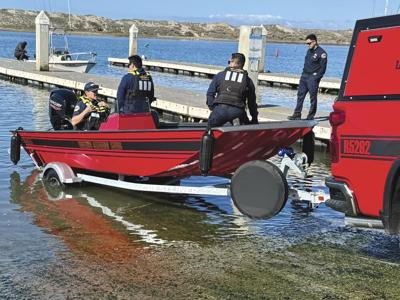
On a quiet Nov. 4 morning at North County Fire’s Station 3 just outside of Pajaro on Elkhorn Road, the boat sits atop a trailer attached to a truck. When it arrived at the station earlier this year, it was decked out in camo colors – not exactly fitting to the North County Fire brand, if you will. It now shines with the red-and-black color scheme of the department.
Firefighter Rhett Parker is joined by about five other firefighters who stand around the boat. They are part of a group of 10 firefighters certified in swiftwater rescue – a first for the department.
Parker, who Gonzalez describes as a guy who’s grown up on the water, is the team manager for the boat crew. This morning, he’s showing the other firefighters where the life jackets are stored and how to adjust the boat’s motor, among countless other details.
After about a half-hour, the crew jumps into the truck and drives to the Moss Landing Harbor with the boat in tow. It’s a big day, as it marks the second time the boat will ever touch water. It’s perhaps not as stressful as a couple weeks prior – at least now, the crew knows the boat floats.
After backing the truck down the boat ramp multiple times in order to get a feel for the maneuver, three firefighters hop inside the boat and fire it up. As the boat prepares to leave the dock, a curious fisher asks what’s up. “We’re training today,” a firefighter responds.
With that, the crew creates distance from land and makes their way to Elkhorn Slough, testing procedures and equipment along the way.
Gonzalez says the boat can be launched anywhere in Monterey County where it is needed. It, along with the other rescue vehicles and equipment, is housed at Station 3, the department’s closest station to Pajaro.
The boat can carry five people, and the goal is to have two crew members operating it so there’s room for three more people.
The possibility of a strong El Niño has flood-weary Pajaro residents on edge. The Pajaro Regional Flood Management Agency, which maintains about 26 miles of the Pajaro River system, is fortifying the levees with new soil and large masses of rocks.
The permanent levee upgrade project got a funding boost when U.S. Rep. Zoe Lofgren, D-San Jose, announced Nov. 2 that she had secured an additional $54.8 million for it.
In these in-between years before the new levee is completed, water rescue training is ongoing for North County Fire, and more accessories are to be equipped on the boat, such as lights, microphones and speakers. But the crew, and the boat, are ready for whatever happens.
“We’ve been training on it in preparation for the upcoming storm season,” Gonzalez says. “Hopefully, we don’t have to use it, but our crew will be prepared.
“If it [flooding] happens tomorrow, we will take action on the boat.”


(0) comments
Welcome to the discussion.
Log In
Keep it Clean. Please avoid obscene, vulgar, lewd, racist or sexually-oriented language.
PLEASE TURN OFF YOUR CAPS LOCK.
Don't Threaten. Threats of harming another person will not be tolerated.
Be Truthful. Don't knowingly lie about anyone or anything.
Be Nice. No racism, sexism or any sort of -ism that is degrading to another person.
Be Proactive. Use the 'Report' link on each comment to let us know of abusive posts.
Share with Us. We'd love to hear eyewitness accounts, the history behind an article.