
In 1974, Albert Brett decided he wanted nothing to do with his fellow Vietnam War veterans. “I didn’t want to be associated with any of those crazy vets,” he says.
He wandered the west, then settled in Idaho. Then in 2013, he was diagnosed with pancreatic cancer and went through surgery and chemotherapy at a Veterans Affairs clinic. His odds of survival were low. So low, he says, that out of desperation he decided to try every remedy he could. He hadn’t smoked weed since 1982, but Brett asked some hippie friends to hook him up. They procured a bag – he didn’t ask how – and Brett processed it into oil and started taking a gram a night in capsule form, like pills.
Now he’s 67 and cancer-free, and credits his recovery to cannabis. “I don’t expect a ticker tape parade, but I do expect an honest dialogue,” Brett says.
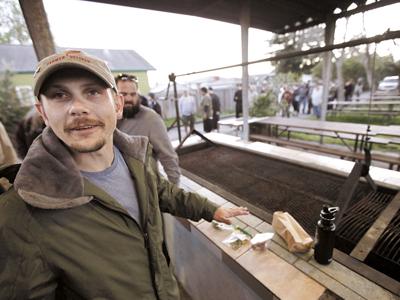
He moved to Santa Cruz, because he wanted to be in a place where medical marijuana is legal. He also reconnected with the veteran community for the first time in 40 years. On a recent Monday night, he’s standing in line behind Veterans of Foreign Wars Post 7263 in Santa Cruz along with about a hundred other veterans.
The line snakes past a rain-soaked barbecue pit, but they’re not here for a party; they’re here to pick up free medical marijuana. As the line creeps forward, the men (and a couple of women) show their IDs, and an attendant checks off their names on a clipboard, then reaches into a big black container and pulls out a small baggie.
The cannabis giveaway is run by the Santa Cruz Veterans Alliance, a collective operated by two combat veterans, Jason Sweatt, who served from 2004-05 in Iraq and Aaron Newsom, who served from 2004-05 in Afghanistan.
They’ve been in business since 2011, mostly selling marijuana to dispensaries and handing it out to veterans twice a month. They started with about a half dozen regulars, and it’s now grown to more than 100. They’re looking to start an Alliance chapter in Monterey County, with eyes on the American Legion Post 41 in Salinas as a distribution hub.
They also hope to start cultivating in the Salinas Valley, where the medical marijuana business promises to be the next big agricultural boom. Today, they grow on the basement level of an office in Santa Cruz County. They’re partnering with Salinas businessman Mike Hackett, who owns greenhouses he hopes to transform; the plan is for Newsom and Sweatt to do the operations. (Monterey County officials are actively working on an ordinance that would allow cannabis cultivation; Hackett has already applied for a permit under an expanded loophole in an existing Monterey County moratorium.)
Sweatt and Newsom see themselves as pro-veteran activists, helping them shed dependency on addictive painkillers like Oxycontin, and avoid the side effects of antidepressants and anti-anxiety meds that are commonly prescribed.
“For the majority of them, it’s chronic pain,” Newsom says. “A lot of our members are Vietnam-era veterans who were jumping out of helicopters. Cannabis can reduce pharmaceutical dependence.”
Brett likes to talk about how he’s off multiple prescription meds, and he’s written up his story and plans to give it to the VA. At 67, he says he’s got nothing left to lose. He’s waiting in line at the VFW giveaway with a 35-year-old friend, Jeremy, who served in Iraq during the surge. Jeremy declined to give his full name for fear of jeopardizing his VA benefits – a common problem for the veterans who are abiding by state law, but violating federal law when it comes to marijuana.
Jeremy’s weaned himself off seven prescription meds and instead takes cannabidiol (CBD) daily, dropping the oil on the back of his tongue with an eyedropper. But he tells his doctor he’s diligently taking his prescriptions. “I face an ethical dilemma every time,” Jeremy says. “I’ve brought it up, and [the doctor was] like, ‘That’s the end of our conversation.’”
Jeremy spent three years after getting out of the Army living in his mom’s basement in Kansas, bumming around with dead-end jobs. A friend encouraged him to move to California and he enrolled at Cabrillo College, but says he couldn’t focus – outside sounds and hallway whispering blended with lectures, and he just couldn’t stop tuning into the background noise. He flunked two classes.
Brett encouraged him to try cannabis. Jeremy says it’s working – he’s back in college, and doing well.
By 6:45pm, the long line is gone. A bartender emerges from the VFW, and invites the dozen or so stragglers to come in for a drink.
No one moves. “We’ve all had problems with alcohol,” Newsom says. “I’d love to rip out that bar and put in a smoke lounge. We’d call ourselves the VFW of cannabis.”
For more visit www.scveteransalliance.com.
Editor's note: This story has been updated to reflect the following correction: Jason Sweatt served in Iraq, not Afghanistan, and Aaron Newsom served in Afghanistan, not Iraq.


(0) comments
Welcome to the discussion.
Log In
Keep it Clean. Please avoid obscene, vulgar, lewd, racist or sexually-oriented language.
PLEASE TURN OFF YOUR CAPS LOCK.
Don't Threaten. Threats of harming another person will not be tolerated.
Be Truthful. Don't knowingly lie about anyone or anything.
Be Nice. No racism, sexism or any sort of -ism that is degrading to another person.
Be Proactive. Use the 'Report' link on each comment to let us know of abusive posts.
Share with Us. We'd love to hear eyewitness accounts, the history behind an article.