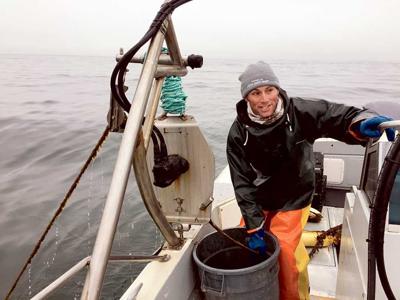

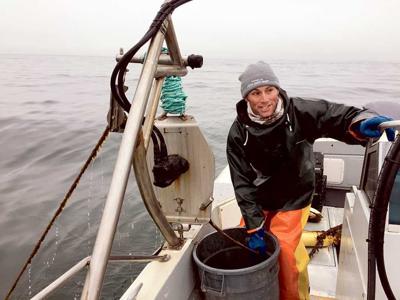
It’s just after 5:30am in early August when Calder Deyerle, 30, motors his small fishing boat out of Moss Landing Harbor. Aside from a few streetlights reflecting on the water, and a faint glow on the eastern horizon, the harbor is blanketed in darkness.
Deyerle is a Moss Landing native and second-generation fisherman, and currently runs a one-man fishing operation that helps supply the Sea Harvest markets in Carmel and Monterey (which his parents own), and Real Good Fish, a Moss Landing-based, community-supported fishery that specializes in locally caught sustainable seafood.
But today, Deyerle is not fishing: He is out to collect lost or abandoned crab gear, which can entangle and kill whales. Today’s mission is part of a partnership that he and a few other local fishermen formed earlier this year with Monterey Bay Fisheries Trust, a Monterey-based nonprofit with the mission to “advance the social, economic and environmental sustainability of Monterey Bay fisheries.”
The program, funded by a Nature Conservancy grant, is intended to work like this: The team finds and collects lost pots, and then turns them over to the Fisheries Trust for $60 a pot. The pots are then sold back to their owner – identifiable by the license number on the buoy – for $60.
Deyerle is targeting just under a half-dozen pots on this mission, which fellow fishermen and boaters called in after logging their coordinates: Down on the ocean floor, pots are only marked by a small buoy, and finding them without coordinates is tantamount to finding a needle in a haystack.
Which is what it feels like when Deyerle stops his boat at the first coordinate, eager to pick off what he expects will be an easy grab. But the pot’s buoy is nowhere in sight.
“Buoys are only 11 inches tall, and I can’t see it,” he says, searching troughs of the waves for any possible glimpse.
The surface is clear in all directions, and a few minutes later, a whale flips its tail out of the water nearby.
“We’re trying to get these pots out for you, Mr. Whale!” Deyerle says.
The whale is not seen again, nor is any sign of the pot’s buoy, and after more than 20 minutes of searching, Deyerle decides to push south, toward the other reported gear on today’s roster.
Deyerle fishes for all kinds of species, but crab are his bread and butter: He’s the Monterey Bay’s representative on the California Dungeness Crab Fishing Gear Working Group, which the California Department of Fish and Wildlife created in 2015 to address the issue of whale entanglements.
But while many whale entanglements are spotted locally – Monterey Bay is the whale watching hub of the West Coast – Deyerle says most of those whales are entangled somewhere else, particularly further north near the Oregon border, where lost gear is a far bigger problem. It’s something he attributes to a longstanding local ethos where fishermen return lost pots they find back to fellow fishermen. “The lost gear issue is really not as big here as it is in some areas,” he says, “but we want every single pot out of the water.”
Deyerle says pots are usually lost due to winter storms, which can rip up kelp beds and create “kelp patties” that bury the buoys underwater. In some cases, he says, strong currents can even drag the pot across the ocean floor.
When Deyerle arrives to the next coordinates, the buoy is in plain sight, and he hooks the pot’s rope and pulls it into his hands, then threads it through a mechanical pulley that pulls it up.
That process is repeated when Deyerle comes upon the next buoy. This pot has two crabs in it, one of them huge.
“That’s a bootlegger right there,” he says with a smile. “That means I want to stick him in my boot and take him home.”
But he doesn’t, and tosses both crabs back into the sea.
In the end, Deyerle comes back with just two pots after a four-hour journey.
“I don’t know if that makes me look good, or makes me look bad,” he says, adding that he doesn’t plan to collect the $60 a pot, and will instead just return the pots to their owners.
Deyerle is dismayed by an Oct. 3 story in the San Francisco Chronicle about a lawsuit the Center for Biological Diversity filed against the Department of Fish and Wildlife over whale entanglements. According to the Chronicle, “The suit calls for using shorter fishing lines and a reduction in crabbing in areas with heavy whale traffic, such as Monterey Bay.”

“It took us a really long time to get this program set up in this area, and now it’s all systems go,” Calder Deyerle says. “I just want to get it done.”
That has Deyerle shaking his head. “Anybody that has any good idea is being listened to,” he says. “There’s already a really intensive and collaborative effort going on. We’re all in it together.”
He says he never did collect the money for the pots back in August: “That was just a karma day for me.”


(0) comments
Welcome to the discussion.
Log In
Keep it Clean. Please avoid obscene, vulgar, lewd, racist or sexually-oriented language.
PLEASE TURN OFF YOUR CAPS LOCK.
Don't Threaten. Threats of harming another person will not be tolerated.
Be Truthful. Don't knowingly lie about anyone or anything.
Be Nice. No racism, sexism or any sort of -ism that is degrading to another person.
Be Proactive. Use the 'Report' link on each comment to let us know of abusive posts.
Share with Us. We'd love to hear eyewitness accounts, the history behind an article.