
A field of large parabolic antennas, followed by a constant piercing sound lingering in the background, is a classic combo in science fiction movies, especially when earthlings receive a message from outer space. On screen, it builds uneasiness and suspense for the viewer.
But for amateur radio (or ham radio) operators, the radio waves around the Earth create connectivity. People use antennas and transceivers to communicate with each other without Wi-Fi or phones.
Non-commercial radio not only connects people worldwide but it can be an important tool in emergencies, when other means of communication, such as phones and internet, go down.
“Amateur radio has been around since radio was invented,” says Dusan Tatomirovic, Monterey Bay Amateur Radio Association’s president. “Since radio was invented, there have been individuals who would play with technology, and that’s what amateur radio is.”
Local ham radio groups include MBARA in Marina and the Naval Postgraduate School ARC; many people have their own stations at home. To operate, all users need a license from the Federal Communications Commission.
MBARA as a formal organization has been around for more than 25 years. In 1996, when the group was a club, the City of Marina recognized the opening of the Marina Amateur Radio Station, later MBARA, at a former Army radio station facility on Fort Ord for emergency communications.
While both broadcast and ham radio use radio waves to communicate, there are several differences between them. Broadcast radio is primarily a one-way mass communication tool made for public consumption. Programs and radio stations set a slot for each program and are assigned a frequency. Ham radio, on the other hand, is primarily a two-way communication tool; all users share the same frequencies and move between them depending on the type of communication they are using or how far they want to reach.
All radio operators have their own signal. In the 1920s, the Federal Radio Commission separated the assigned “K” signal for all stations west of the Mississippi River and “W” for the ones in the east. For example, the local NPR station is KAZU and Tatomirovic’s signal is KN6OBW.
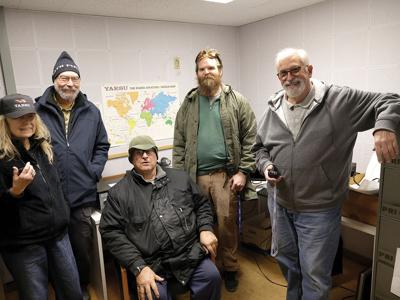
MBARA has more than 80 members around Monterey and Santa Cruz counties and beyond. They meet on the first Saturday of each month to share ideas, ask questions and plan events. (MBARA members also provide communications during the Life Time Sea Otter Classic and Big Sur Marathon.)
The association focuses on high frequency and very high frequency radio; DXing, or listening to faraway radio and TV stations and making contact with them; and taking part in a contest with a goal to reach the largest amount of contact with other radio stations in a specific timeframe.
Travis Edson has been part of MBARA for nine years. He goes to the facility in Marina to test and use equipment and get help if needed.
“It’s a unique resource,” Edson says. “If you are interested in electronics, this is the place to be because you get a really great jumping-off point and there’s decades of collective knowledge.”
Goals at MBARA include increasing interest in ham radio and STEM among young people and creating partnerships with local colleges and high schools, building a new generation.
Liam Hostrop, 70, has been part of ham radio since he was 16. “It is a platform for long-time learning,” he says.
Hostrop was a research and development technologist for Xerox Corporation and says “ham radio was something that prepared me for my technical career.”
Operators must learn about electronics, physics and technology, in a space geared toward experimentation.
Jeff Cooper’s interest in building a repeater led him to MBARA. Along with others, he recently set up a repeater in a small booth near MBARA’s building to receive and transmit radio signals.
“Someone out at Pigeon Point, almost in Half Moon Bay, was using the repeater,” Cooper says. “It was pretty unexpected and kind of fun.”


(0) comments
Welcome to the discussion.
Log In
Keep it Clean. Please avoid obscene, vulgar, lewd, racist or sexually-oriented language.
PLEASE TURN OFF YOUR CAPS LOCK.
Don't Threaten. Threats of harming another person will not be tolerated.
Be Truthful. Don't knowingly lie about anyone or anything.
Be Nice. No racism, sexism or any sort of -ism that is degrading to another person.
Be Proactive. Use the 'Report' link on each comment to let us know of abusive posts.
Share with Us. We'd love to hear eyewitness accounts, the history behind an article.