
If a tree falls in the forest and no one is around to hear it, does it make a sound? This philosophical musing on perception and reality is often vaguely attributed to Irish philosopher George Berkeley, the Bay Area city’s namesake, whose own philosophy boiled down to, “To be is to be perceived.”
For much of the discipline’s history, ecological researchers studying the presence of endangered species in underwater habitats were forced to operate under a similar axiom. If, for instance, after a day of trudging through ponds and combing the water with dip nets, Brian Woodward, an ecological researcher at the Santa Lucia Conservancy in Carmel Valley, was unable to perceive with his own eyes the presence of a California tiger salamander or its larvae, he would have no physical evidence of its existence. The rules of detective work 101.
Yet, the human senses have limits, and a relatively recent advancement in scientific analysis known as eDNA (short for environmental DNA) has the potential to transcend those shortcomings. It is being deployed in habitats across Monterey County, from the ponds of the Santa Lucia Preserve to the estuaries of Elkhorn Slough and even in the canyon depths of the Monterey Bay.
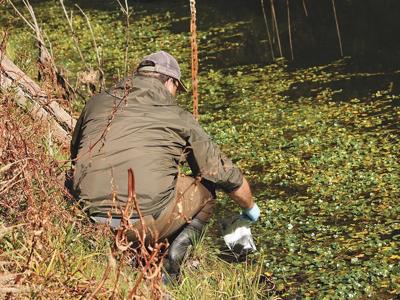
Earlier this spring, with the help of a grant and a partnership with the Elkhorn Slough National Estuarine Research Reserve, Woodward and a team of researchers set out to monitor the presence of the tiger salamander and the similarly endangered California red-legged frog on the Santa Lucia Preserve. Instead of sweeping the ponds with a net and manually counting the adults and larvae they found, the team bagged up samples of pond water and shipped them to the Goldberg Lab at Washington State University for analysis. The results, which Woodward expects to receive by September, will tell which ponds are hosting the endangered species.
The use of eDNA does for ecology what forensic labs did for crime scene investigators. For the preserve’s pond tests, the eDNA lab can capture particles as microscopic as bacteria, skin cells or fecal matter. The DNA is then extracted from those particles and analyzed using polymerase chain reaction testing (the same PCR tests used for the coronavirus) to see if it matches with the DNA of the tiger salamander or red-legged frogs.
Throwing on a pair of waders, dragging a net across the pond and manually counting species remains the official protocol for determining amphibian presence set by the U.S. Fish and Wildlife Service. It’s also more immediate and offers greater detail, including a rough species count. However, to answer the question of, “Are they here?” eDNA offers a groundbreaking opportunity, especially in terms of efficiency. Woodward says the traditional method allows monitoring of 10 to 12 ponds per year; eDNA allowed his team to sample 34 ponds in less time.
Out at the Monterey Bay Aquarium Research Institute in Moss Landing, research technician Kobun Truelove is helping develop an automated eDNA system in which an autonomous underwater vehicle takes the sample, filters the water, extracts the DNA, sequences it and identifies the species match. Over the last two years, he has already helped cut the time needed from marine sample collection to species identification from three months to six hours. Truelove says beyond the sci-fi of eDNA, the technology has allowed MBARI to track population shifts amid changing ocean conditions. Scientists even found presence of the rare beaked whale in the Monterey Submarine Canyon, a surprise discovery. If a species is detected using eDNA, it means it was likely present within five days of the sample collection.
“There is so much that we’re beginning to understand that we didn’t know before eDNA, and it’s opening up a lot of new questions,” Truelove says.
However, eDNA leaves a lot of question marks, such as population density and whether the animal was even alive or just part of the fecal matter of a predator. Truelove says eRNA will be able to answer the dead or alive question eventually, but that method remains under development.


(0) comments
Welcome to the discussion.
Log In
Keep it Clean. Please avoid obscene, vulgar, lewd, racist or sexually-oriented language.
PLEASE TURN OFF YOUR CAPS LOCK.
Don't Threaten. Threats of harming another person will not be tolerated.
Be Truthful. Don't knowingly lie about anyone or anything.
Be Nice. No racism, sexism or any sort of -ism that is degrading to another person.
Be Proactive. Use the 'Report' link on each comment to let us know of abusive posts.
Share with Us. We'd love to hear eyewitness accounts, the history behind an article.