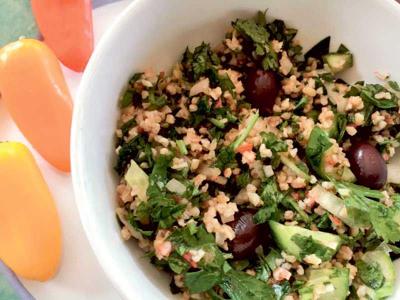
When I used to frequent the IHOP and other such establishments with my homies, I would raise eyebrows by eating the parsley that garnished my plate. Not the delicate flat-leafed parsley, but the curly kind that tastes like green steel wool. “Nobody eats the parsley,” I was informed, erroneously.
I don’t eat out with knuckle-draggers like that anymore, but garnish-sized portions of parsley remain the rule, rather than the exception. One noteworthy exception is tabbouleh, the Mediterranean parsley salad. And I have a tactic for making tabbouleh that will blow the doors off of any other you’ve tried.
My trick comes by way of a farmer friend. Farmers know how to prepare vegetables in simple, easy ways that make them shine brightly. In addition to being a way to eat parsley, tabbouleh is also a vehicle for many other ingredients that are currently in season, including cucumbers, garlic, onions and, most importantly for our purposes today, tomatoes.
The making of a typical batch of tabbouleh begins by cooking the bulgur wheat.
Instead of cooking the grain, my farmer friend opts to puree a mess of the juiciest tomatoes available, with garlic, then rehydrate the grain by soaking it in the resulting slurry. Bulgur that’s rehydrated in fresh, garlicky tomato juice has more flavor than bulgur that was rehydrated in plain water, plus a pleasing red color.
Currently, many tomatoes are sagging under their own weight on vines and windowsills near you. At the end of the farmers market, growers will often cut deals on the extra soft and juicy specimens that are too unstable to survive the trip home or to unload to restaurateurs. Those fruits, the kind you can barely even slice in half without flooding the kitchen, are exactly the fruits you want to use in tomato juice tabbouleh.
The best alternative to bulgur wheat is couscous. (Quinoa, while a gluten-free option, refuses to absorb the tomato juice as vigorously.) Couscous absorbs the juice faster even than bulgur. The downside of tabbouleh made of couscous is you have to eat it sooner rather than later, because it will continue to soften. Another option, buckwheat, will absorb the juice if you soak it overnight, but I don’t recommend it. The texture is chalky, and the flavor is wrong.
Once you’ve decided on your grain, pick a recipe. There are countless recipes for tabbouleh from which to choose. Virtually any of them can be easily modified by soaking the grain in tomato and garlic puree. Here is how I do it:


(0) comments
Welcome to the discussion.
Log In
Keep it Clean. Please avoid obscene, vulgar, lewd, racist or sexually-oriented language.
PLEASE TURN OFF YOUR CAPS LOCK.
Don't Threaten. Threats of harming another person will not be tolerated.
Be Truthful. Don't knowingly lie about anyone or anything.
Be Nice. No racism, sexism or any sort of -ism that is degrading to another person.
Be Proactive. Use the 'Report' link on each comment to let us know of abusive posts.
Share with Us. We'd love to hear eyewitness accounts, the history behind an article.