
You can mention decaf in a hipster coffee joint, no problem. Ketchup on a hotdog? Outside of Chicago, you can probably get away with it. Mention barbecue, however, and you’ll likely spark verbal fisticuffs.
Barbecue buffs dig in their heels over just about everything grill-related. The bickering extends to sauce – vinegar, mustard, white, adamantly none at all – and what goes into a rub. Some insist barbecue is pork and nothing but, while others believe it refers to beef brisket. And even within these camps are little spats. Pork, for instance, should be either whole hog or a shoulder cut, depending.
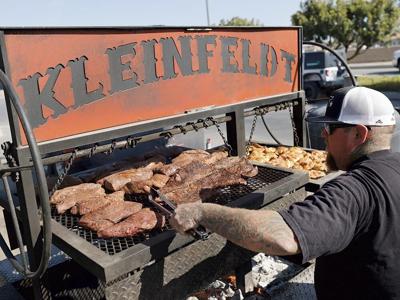
“A lot of people are closed-minded when it comes to barbecue,” observes Justin Kleinfeldt, pitmaster at T&A Cafe, home of Kleinfeldt Family BBQ in Spreckels.
At the heart of all this friction are regional styles, whether Lexington, Central Texas, Memphis, etc. Eastern Carolina style, for instance, goes whole hog with a vinegar and pepper sauce. Lexington is made from shoulder and adds ketchup to the mix. In parts of neighboring South Carolina, pit minders dab in mustard.
Barbecue places in Monterey County tend to borrow from two or more of the major regional genres. At Salinas City BBQ – a long-time favorite – they serve pulled pork, brisket (the Central Texas staple) and hot links, in addition to chicken and ribs. Bon Ton L’Roy’s Lighthouse Smokehouse in Monterey offers a similar lineup but brings in andouille sausage. Big Sur Smokehouse can slather on a Memphis or South Carolina mustard sauce.
One meat that most have in common is tri-tip, a cut that is rarely seen in barbecue outside California. Kleinfeldt Family BBQ is known for this cut, cooked over an open flame Santa Maria style – but there’s a question mark hanging over this Santa Maria version of barbecue.
“They’ll say that’s grilling,” explains Todd Fisher of The Meatery in Seaside, referring to people from other regions. “I would say they’re not wrong. Barbecue is very different from grilling.”
Fisher made his name as a chef rather than a pitmaster. But his 18-hour brisket at The Meatery rivals anything from the sweltering pits of Lockhart, the temple of Central Texas barbecue.
Barbecue as a form of cooking has evolved over the centuries as it was adapted by immigrants from different cultures and expanded into new landscapes. Historians believe the word refers to a wooded grate that held meat above an open flame used by indigenous peoples of the Caribbean. It appears as “barbacoa” in a 1526 account of a Spanish explorer’s travels. And that resonates with Kleinfeldt.
“I define barbecue as anything cooked over a real fire,” Kleinfeldt says.
That is its likely origin – direct heat. But as the style developed and new utensils came into play, rifts emerged. A big one is over the boundaries that define grilling, smoking and barbecue.
The most common explanation is that barbecue involves indirect heat applied low and slow – typically between 200 and 275 degrees Fahrenheit over many hours. An even temperature through the entire span is essential, requiring someone to tend the smokebox. This is why it’s difficult to find great brisket.
“It’s a time commitment,” Fisher explains. “Sixteen to 18 hours [for brisket] is fairly standard in the barbecue world.”
Smoking goes even lower and often slower, with temperatures in the comparatively chilly 125 to 175 range. In both cases, pitmasters essentially cook the wood while smoke and radiant heat drift through the meat. What differentiates the two from grilling (and direct heat styles like the pit beef of the Central Atlantic) is the emphasis on low, slow, smoke and a closed chamber. Or, as Natasha Geiling jabbed in a Smithsonian article: low and slow is “the true definition of barbecue – imposters who grill take note.”
Yet in a barbecue-agnostic state, pitmasters can blur the lines. Kleinfeldt turns to the smoker for pork, using a mix of oak and cherry. He also prepares chicken, local Swiss-style sausage and ribs. “There’s a lot of good barbecue out here,” he points out.
“You can really get caught up in it,” Fisher says of the arguments. “I love all barbecue. The only bad barbecue is poorly executed barbecue.”


(0) comments
Welcome to the discussion.
Log In
Keep it Clean. Please avoid obscene, vulgar, lewd, racist or sexually-oriented language.
PLEASE TURN OFF YOUR CAPS LOCK.
Don't Threaten. Threats of harming another person will not be tolerated.
Be Truthful. Don't knowingly lie about anyone or anything.
Be Nice. No racism, sexism or any sort of -ism that is degrading to another person.
Be Proactive. Use the 'Report' link on each comment to let us know of abusive posts.
Share with Us. We'd love to hear eyewitness accounts, the history behind an article.