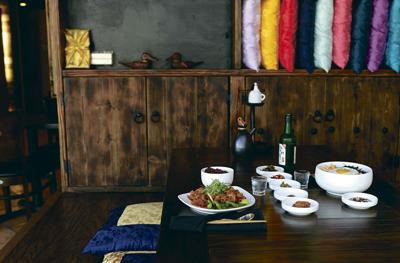

Soban is one of the most beautiful restaurants I’ve eaten at. It sits atop the upper level of Carmel’s quaint Barnyard Shopping Center, where Thunderbird Bookstore (and a few restaurants since then) used to; you get to it by walking or wheeling up a sloping brick walkway. Inside, it feels cosmopolitan contemporary. Owner Hank Kim put four months of renovations in, and it shows.
It shows in the stylish-but-sensible dark-stained wood tables and chairs. It shows in the recessed lights, spotlights and wall-mounted light fixtures that cast a soothing glow. It shows in the art and artifacts, like the installation of giant onggi clay pots, once used to preserve and ferment foods, especially sauces.
That talented eye for design ranges over the entire establishment, which has been open three months, from the restrooms to the full bar, the wall-mounted wine and soju (Korean rice liquor) to an altar that greets customers at the front door, a window-lined panoramic observation deck to the earthy flatware. There is an elevated Korean dining room platform, arranged like a set from a play, with pillows instead of chairs at a low table where diners can sit cross-legged, shoes off. That table, by the way, custom in many Korean homes, is called a soban.
For the first visit, my wife and I started with hobakjuk, a pumpkin porridge of golden color and pureed creaminess, and kimchi wang mando (these dumplings known as mandu, spelled “mando” in the menu, are what Americans call “potstickers”). Here they are steamed and filled with pork, potato noodle, tofu and kimchi. I have never encountered mandu with kimchi in it. It was savory and filling, but served cold. A trip back to the kitchen for a reheat fixed that, and it came with a complimentary bamboo pot of warm, boiled edamame beans (normally $5). My wife says the ginger tea ($3), garnished with chopped almonds and pine nuts and jujube (Korean dates), was the best she’s had in a restaurant.
There are some menu items that seem to skew Japanese, like miso soup (which came to the table automatically and for free), edamame beans and thick noodles that look like udon. But chef Nestor Marin says they only use the Japanese names because Americans aren’t familiar with the Korean equivalent. The only truly Japanese import are the chopsticks, which are wooden.
For dinner, we ordered galbi ($19), marinated and grilled boneless short rib (people like to cook this at their table on the built-in inset grills) with black rice. We also ordered vegetable noodle soup ($10). The galbi was tender and chewy, sweet and plentiful. The noodle soup, not unlike Vietnamese pho, is slurpingly good, satisfying to the belly like a hearth fire in a winter’s cabin.
The banchan, the myriad side dishes – like root vegetable, kimchi, radish, anchovy, daikon – that should accompany every dish, especially those with rice, were presented artfully. But there were too few choices and too little of each.
On the second dinner visit, we brought more family and roamed more of the menu. The seafood pancake ($13) appetizer was crisp on the edges and tender in the middle, studded with chunks of squid and scallions, compulsory with the dipping soy sauce that wakes up the otherwise mild flavor. The grilled chicken ($15), atop a bed of sauteed onions and drenched in a sweet house sauce, was a safe choice, neither daring nor a failure. There is bibimbap ($16) and dolsot bibimbap ($17), both comprising a big bowl of rice with assorted vegetables, meat and egg on top. That dollar difference is that dolsot is an iron pot that comes hot and sizzles the food (and cooks the egg) when you stir it. It’s worth it. It’s also usually served with gochujang, Korean hot sauce, but Soban’s wasn’t that hot. Luckily there were fresh sliced hot peppers from another dish to add that heat.
The spicy pork ($19), a favorite for many, and synonymous with “Korean barbecue,” is mislabeled on the menu. It’s pork belly. That’s fine, if you go for that sort of thing. We don’t. But the flavor, sweet and spicy, pungent and tangy, was just right. I would have liked to have seen what they do with the grilled mackerel ($17), which is a Korean staple, but they were out. So I ordered the soy bean paste stew ($13) with vegetables. It was delicious, swimming with chunks of fresh tofu and big cuts of onion and mushroom, but it was a disappointingly small portion.
The prices, however, are the converse. There are comparable meals to be had at other area Korean restaurants for less money. There isn’t much food fare tailored to kids, but they might like the soup, the tactile experience of edamame, or the grilled chicken. And the service, on the second visit, was a little disjointed and unsure. But what this new restaurant lacks in confidence and execution, they make up for in style, hospitality and beauty. In the coming weeks and months, as it ages and steadies those shaky components, it can prove to be a compelling place to go and bring family and friends for a taste of something lively and different.
SOBAN GRILL AND BAR • 3601 The Barnyard, Carmel. 11am-3pm and 5-10pm daily, 4-10pm Sunday. 624-3318.


(0) comments
Welcome to the discussion.
Log In
Keep it Clean. Please avoid obscene, vulgar, lewd, racist or sexually-oriented language.
PLEASE TURN OFF YOUR CAPS LOCK.
Don't Threaten. Threats of harming another person will not be tolerated.
Be Truthful. Don't knowingly lie about anyone or anything.
Be Nice. No racism, sexism or any sort of -ism that is degrading to another person.
Be Proactive. Use the 'Report' link on each comment to let us know of abusive posts.
Share with Us. We'd love to hear eyewitness accounts, the history behind an article.