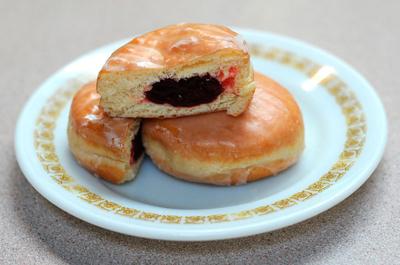

For proof that food is central to Judaism, look no further than the fact that its most famous holiday revolves around the deep fryer. There are other holidays on which food becomes part of the ritual, standing in as a symbol for a season, an ancient tool or one of the 10 plagues. On Hanukkah both strictly observant and less serious Jews extract an ingredient of significance – oil – and proceed to cook just about anything in it as part of the celebration.
While Hanukkah is also eight days of candle lighting and gift giving to commemorate a bloody spat between the Jews and the Greeks in 168 B.C., it’s the finger-licking that often feels most celebratory.
Deep-fried filled donuts (sufganiyot) and potato pancakes (latkes) are the classic Hanukkah foods, because of their greasy goodness. Add to that chocolate gelt and games of dreidel, and you’ve got a holiday that barely resembles the droll recitations of prayer that come with some comparable occasions.
“Is it all just a ploy to keep kids lingering around the candles and enjoying a family meal?” asks the Orthodox Jewish website chabad.org. “Not at all!”
The liquid fat is actually an homage to the miracle at the center of the celebration. The Hanukkah story is one that follows a familiar plotline, with a specific, miraculous twist that leaves us with fried foods as part of the observance.
The Jews were persecuted by King Antiochus, a Hellenist who had little tolerance for non-Greek culture. He outlawed Judaism and ordered the destruction of the sacred temple in Jerusalem (of which one celebrated, mournful wall still stands on the western side).
“IS IT ALL JUST A PLOY TO KEEP KIDS LINGERING AROUND THE CANDLES AND ENJOYING A FAMILY MEAL?”
A makeshift militia of sorts, known as the Maccabees, took up arms and fought back to victory.
They returned to a ransacked temple, where in keeping with tradition, they looked to light a ritual lamp, or menorah. But their supply of oil – olive oil only, as stipulated by the Torah, and then only the first drop from each olive could go toward the temple supply – had been contaminated or dumped out. All the weary worshippers could scrounge up was one day’s worth; it would take eight days for a new shipment to arrive from the olive groves in the hills around Jerusalem.
But as the story goes, that one-day supply of olive oil burned for eight days. Which brings us to 2,200 years later, and a holiday that leaves us full-bellied in grease-splattered kitchens.
“It’s just like we have Thanksgiving,” says Rabbi Dovid Holtzberg of Chabad of Monterey. “It’s not enough just to be thankful. We have a dinner with turkey and pumpkin pie.”
The only ritual requirement of Hanukkah is to light candles on this festival of lights, but the commemorative cuisine certainly doesn’t hurt.
“If you don’t eat a latke over Hanukkah, it’s not the end of the world,” Holtzberg explains. “It’s not considered a transgression.”
But to miss out on crispy goodness would be a culinary sin, since the grating of potatoes and crackle of frying the pancakes is a sensory delight of its own.
Part of the beauty of latkes is that they’re simple, and a few ingredient substitutions can make them more colorful and flavorful – and a good way to prepare your winter root vegetables. For a pound of potatoes, all you need to add is one medium onion, a large egg, a handful of flour or cornmeal as a thickener, and salt and pepper to taste.
I prefer finely ground potatoes, but a coarse grind works well too and looks a little nicer. Substitute sweet potatoes, or add grated beets, celery root, carrots or squash for variations. Soak and dry your tubers, then mix in the egg and flour until you’ve got a consistency that’s a little runny, but sticks together.
Form quarter-inch thick patties and fry in hot vegetable oil until they’re golden brown, about three minutes per side. Drain the latkes on paper towels, and serve them sizzling hot with applesauce and sour cream.
You’ll need something to cut the grease, and acidic white wines work well with latkes. I was invited to a “Vodka and Latke” party this year, which has the dubious advantage of including potato-based food and drink (besides the irresistible rhyme perk), but some Bay Area mixologists are going for bourbon-based latke-pairing cocktails, the Contra Costa Times reports.
If eating fried potato pancakes for eight nights (from Dec. 8 to 15 this year) wears on you, don’t look for any relief for your belly in other Hanukkah-related food groups. Dairy counts as Hanukkah food, because one enterprising battle heroine fed a general lots of salty cheese so that he would drink more wine. Once he’d passed out drunk, she beheaded the general in a strategic war victory.
While the story might seem archaic and violent, Holtzberg says it’s got relevance today regarding the ability of an oppressed people to fight for freedom. “It’s a democratic holiday,” he says. “Minorities overcame the majority. They were able to sustain and maintain their Jewish culture.”
And when part of that cultural practice includes copious amounts of grease-soaked foods, it’s certainly worth sharing the party – and sharing the culinary side of Hanukkah, and the donuts, along with the story.


(0) comments
Welcome to the discussion.
Log In
Keep it Clean. Please avoid obscene, vulgar, lewd, racist or sexually-oriented language.
PLEASE TURN OFF YOUR CAPS LOCK.
Don't Threaten. Threats of harming another person will not be tolerated.
Be Truthful. Don't knowingly lie about anyone or anything.
Be Nice. No racism, sexism or any sort of -ism that is degrading to another person.
Be Proactive. Use the 'Report' link on each comment to let us know of abusive posts.
Share with Us. We'd love to hear eyewitness accounts, the history behind an article.