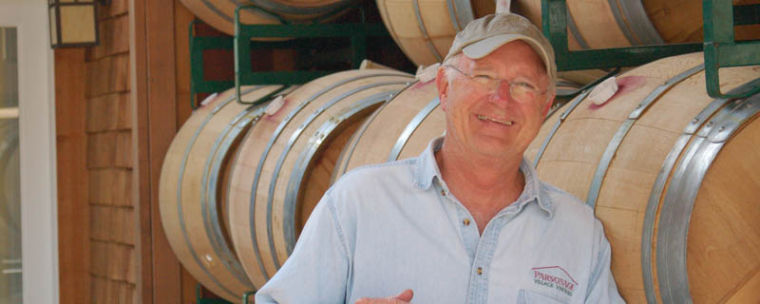
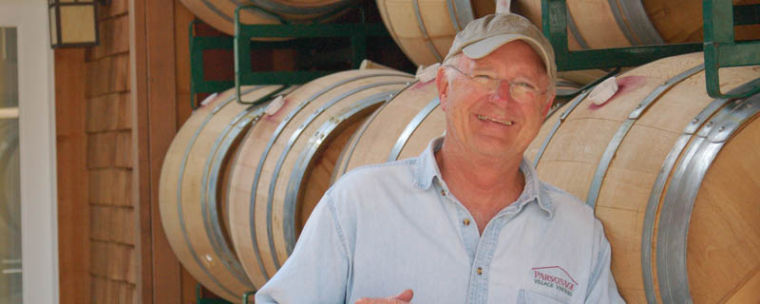
Frank Melicia cultivates and crushes and barrels and bottles a small river of grapes every year. He can identify a Syrah vine’s sickness with a passing glance. When he’s not winemaking– or in the field testing soil, cultivating buckwheat bushes that bring in bees, or battling gophers– he often mans Parsonage Village Vineyard’s tasting room. But he says he’s never been to a wine tasting– at least not to taste.
He explains this as he stands at the top ridge of the scenic nine acres that are Parsonage’s Carmel Valley plot, next to a row of vines named after his son, Rocco, that burrow bravely into a limestone, south-facing hill. As smoke from the area wildfires makes the summer air hazy, he’s clear about why his palate hasn’t seen much extracurricular activity.
“People think winemaking is such a romantic thing. It’s not. It’s 99.9 percent farming,” he says. “I don’t get out much. I’ve never been wine tasting. I’ve never been to Napa.”
His comment speaks to how a tiny family-run operation survives in a region that includes bazillion-bottle behemoths like Kendall-Jackson and Delicato: with plenty of 18-hour days from a dedicated core of people who love what they do.
But a postage stamp-sized winery doesn’t last in one of the most prolific grape-producing counties in the world for a decade– Parsonage celebrated 10 years last month– on work ethic alone.
Those in the know thought they knew. “You can’t possibly make serious wine with the world’s peasant grape,” was the reaction Bill Parsons remembers. “Don’t damage the appellation’s identity,” some of the area’s most powerful wine people said. “Syrah won’t ripen here.”
They told Melicia’s father-in-law and the proud papa of Parsonage that he was aiming squarely at sure-fire failure, but Parsons wasn’t listening. After all, he knew what failure felt like– he and some friends had cornered the market on it when they blundered their way into essentially burying Britona Creek Vineyard (located northwest of Sacramento) by 2003.
His friend sought him out as a partner in Britona because, as Parsons says, “I was starting to learn the difference between good wine and great wine.” Parsons’ work as the first general manager of the Peninsula’s waste management district had allowed him to stick around the area he and his wife Mary Ellen liked so much, and eventually enabled them to invest in some real estate– “where I got lucky,” Parsons says– which in turn would provide the seed money for a small business. But with Britona they lost their entire investment.
“I learned how not to do it,” Parsons says. “We had the wrong root stock, the wrong varietals, the wrong clones. We over-watered and over-fertilized.
“But for every mistake, I knew what I shoulda done. I graduated from the school of hard knocks.”
So at 56, the wine entrepreneur with relatively little experience– a few UC Davis viticulture and oenology classes and some earnest home studying being the most to recommend him– went looking for some land that would fit with his vision for a vineyard.
His vision then is front and center on the family winery’s website today. “The focus is on quality over quantity; the vineyard is managed to yield only two-and-a-half to three tons per acre,” it says. “At full production, the winery will generate 1,200 to 1,400 cases per year.”
When Parsons found his patch of possibility just past Carmel Valley Village, he uncovered the first of several magic ingredients that would bounce Parsonage toward unlikely excellence. He got the land from the Carmel Unified School District for a song; or more accurately, he concedes, a stanza.
“I got it for $300,000 back in fall of ’97– and it also included another building lot, a half-acre, which I sold off for a little over $100 [thousand],” he says, an ounce of amazement in his voice even now. “That I got in for $200 [thousand] makes me look brilliant 10 years later.”
Called in to collaborate, local wine consultant Dave Coventry– himself a key ingredient in this fermenting mix– immediately recognized what Parsons had.
“He has one of the nicest vineyards anywhere in the world. When you’re a winemaker and you see a piece of ground like that… ” Coventry says, trailing off into his imagination, “I would’ve helped for free– but he decided to pay me well.”
Coventry saw conditions attuned to produce glorious terroir.
“It is basically limestone and decomposed granite– not even weeds were growing,” Coventry says. “Which is great, because you want to plant in places that make the vine struggle– to limit what they produce, so the flavor is more concentrated and intense in those grapes.”
The sunny-but-mild climate, meanwhile, was similarly ideal, allowing the fruit to hang on the vines long enough to allow for rare amounts of ripeness and flavor. The Parsonage team covered half the acreage with some of the area’s only Syrah and filled the rest in with mostly Cabernet and Merlot.
But the pressure was on, and Parsons admits to feeling it. “If you’re gonna make a small amount of wine and have it make economic sense,” he says, “it better be damn good.”
So Parsons asked a simple question, and Coventry delivered.
“What do I have to do to guarantee success?” was Parsons’ question; the answer was surprisingly succinct, according to Coventry: Grow enough crop to make money– but not too much to dilute flavor. Find the courage to let grapes get so ripe so late in the fall that they become vulnerable to weather events. And pay for the good barrels to amplify rather than amputate the wine’s flavor.
“Bill did not pinch a penny,” Coventry says. “He never compromised on the wine-making process.”
The naysayers– not long after they told Parsons there’s no way he could make a wine with his sort of sugar levels– would eventually buy Parsonage Syrah for their restaurants, and even plant some Syrah themselves.
Meanwhile, the growing body of believers– who are, with increasing frequency, snapping up the reserve and estate reserve wines, despite prices that can eclipse $75– are moving Parsonage closer to a cult status with every sip.
“Maybe I got lucky between the site and the way we farm it,” Parsons says. “We’re making it in a way that makes it exceptional. [It’s] not that hard to sell.”
The main office in their home at the heart of the vineyard doubles as a family room: Little Rocco, the superlative reserve Syrah’s namesake, scurries around underneath a long desk in his underwear. Meanwhile, his sleeping brother, Dario (whose name graces a Merlot-based reserve blend), purrs in his sleep from the screen of a nearby baby monitor. Through the window the family dog, Boots, takes a break from “herding the cats,” napping in the shadow of a tall stack of French oak wine barrels.
As Parsons’ daughter (and Melicia’s wife) Alison choreographs the bottom-line side of the operation on one of the computer terminals, her mother appears to count corks for a guessing game at an upcoming VIP celebration. It’s mom’s gorgeous tapestries of grapes, peacocks and growers that double as the labels on their various varietals.
In short, there are family-run operations, then there’s Parsonage.
As hard as it is to find an operation this devoutly family-functional, it might be just as hard to find a bottle of the winery’s estate reserve Syrah, from virtually any year. Even at steep boutique prices, every bottle they’ve ever released has sold out; upon the next release this fall, the majority of their vintage likely will be snatched up by members of their ever-expanding mailing list and their nationwide wine club, which includes a strong contingent in Texas and individuals that fly Bill and Mary Ellen out to Illinois for special dinners.
(With no distribution and no sales– “a lot of people don’t know we exist,” Melicia says– the remaining sales hail from the tasting room-art gallery space they opened in November, and limited wholesale traffic with discerning local restaurants like Café Rustica, Tehama and Casanova.)
As the “sold out” stamps multiply on Parsonage’s website, it’s not hard to see a trajectory materializing. Parsons acknowledges that they are nearing maximum output, considering a small expansion in facilities, and preparing for the attractive troubles that come in cahoots with success.
“The true test of being a cult winery is you’ve sold all of your wine before you’ve made it,” he says. “Technically, you don’t have enough for people who want it. It’s a wonderful problem to have.”
The doctor says Melicia has his own problem. For all the stress the tough soil conditions puts on the vines, managing those vines so closely puts a less-savory strain on the grower-winemaker himself.
“We farm completely different, in a way people wouldn’t even try,” Melicia says, “with water stress, leaf removal, quality management… ”
As he speaks, one can almost hear Coventry saying, “Great wine happens in the vineyard,” or “The large wineries of Monterey County bring attention to the area, but it’s the small wineries that will bring greatness.”
“I went to the doctor,” Melicia adds after a pause. “He said, ‘You’ve got high blood pressure.’ I said, ‘Well, I make wine.’ ”
Asked to list his greatest nemeses, Melicia smiles and starts ticking them off: Frost, heat, drought, mildew, insects, gophers…
Fortunately, he has built-in methods to manage that special wine effect called “stress”: time spent with family and a great glass of red wine never far away.


(0) comments
Welcome to the discussion.
Log In
Keep it Clean. Please avoid obscene, vulgar, lewd, racist or sexually-oriented language.
PLEASE TURN OFF YOUR CAPS LOCK.
Don't Threaten. Threats of harming another person will not be tolerated.
Be Truthful. Don't knowingly lie about anyone or anything.
Be Nice. No racism, sexism or any sort of -ism that is degrading to another person.
Be Proactive. Use the 'Report' link on each comment to let us know of abusive posts.
Share with Us. We'd love to hear eyewitness accounts, the history behind an article.