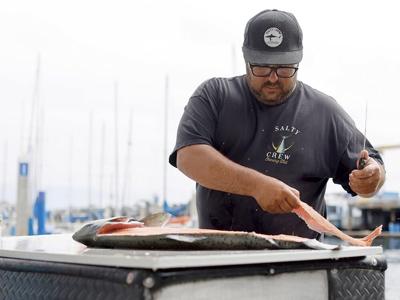

With the close of summer comes the close of king salmon season for commercial fishing operations in Monterey Bay. This most recent season, which ended for commercial boats on Aug. 12 – the recreational season lasts until Oct. 2 – turned out to be a weird and even frustrating one according to people across the local industry, from folks on the boats to those selling the fish at markets and on menus.
The king salmon, also commonly called Chinook salmon, is the largest and most economically valuable salmon species in the Pacific Ocean. The fish are found between Alaska and Ventura in Southern California and can be identified by their silver and black spotting around the tail. The Sacramento River Fall Chinook, which makes up a majority of the king salmon that is harvested in California’s ocean fisheries, hatch in Sacramento River tributaries before making their way out to the Pacific Ocean, where they feed and grow before heading back to the northern California rivers to spawn and die. The average lifespan is about four years.
Traditionally, the commercial season lasts from May through August, but in recent years the California Department of Fish and Wildlife has been shortening the seasons to protect endangered and threatened salmon stocks, such as the California Coastal Chinook. Even given this trend, the 2022 Monterey Bay season was an unusually sporadic one.
Joseph Lucido, a lifelong Monterey County resident who hasn’t missed a local king salmon season in 20 years of commercial fishing, says the short spurts of season openings meant the few days available each month were a precious resource. When bad weather came early in the season, instead of taking a day off, Lucido says some boats had to make a business decision and tempt fate.
“It made it so that you had to go fishing when you really shouldn’t have been going out,” Lucido says. Although boats could only tap the resource for 43 days over the four-month season, Lucido said the stock of fish this year was healthy. Lucido hosts dock sales through his business, Fresh Catch Monterey. He says the typical salmon haul averages 10 to 12 pounds per fish. The average during some sales this summer reached 17 pounds.
Aaron Rayor, chef de cuisine at Cella Restaurant in Monterey, also calls the past local season “weird and sporadic.” Just because the local season is over doesn’t mean king salmon will disappear from menus and markets, it just means the product on offer will have either traveled a much greater distance to arrive there if it’s wild-caught (often from as far as Alaska) or will be farm raised.
While he prefers the local wild-caught stock, Rayor has some foundational tips for getting the most out of any piece of salmon. First, he says a center cut is always going to pack more flavor than a cut from the tail. After bringing it home, put it on a paper towel and let it dry out. Before cooking, let it sit at room temperature for about an hour. Getting the fish closer to room temperature makes for less of a shock when it hits the hot pan, which can impact the flavor.
At Cella, Rayor makes a curing rub that contains salt mixed with the finely chopped stems of what he refers to as “softer herbs” such as tarragon, parsley, fennel or dill – no rosemary, thyme or basil. Rub the salmon down and let it sit for 20 minutes, allowing the flavor to sink into the fish. After 20 minutes, wash the cure off, heat up some oil in a pan on high – olive oil is fine – and slap the salmon on, skin side down.
Rayor presses his finger on the top of the salmon once it’s on the pan to feel for rupturing bubbles. After a few minutes, the feeling of rupturing bubbles will slow down, at which point Rayor says to put the pan in the oven, preheated to 500 degrees. After five minutes, pull the pan out.
The salmon, he says, will still appear raw on top while everything else looks cooked through. Without putting the pan on any heat, flip the fish over to sear the top against the residual heat of the pan for one minute. Pull it off, plate it up, and enjoy.


(0) comments
Welcome to the discussion.
Log In
Keep it Clean. Please avoid obscene, vulgar, lewd, racist or sexually-oriented language.
PLEASE TURN OFF YOUR CAPS LOCK.
Don't Threaten. Threats of harming another person will not be tolerated.
Be Truthful. Don't knowingly lie about anyone or anything.
Be Nice. No racism, sexism or any sort of -ism that is degrading to another person.
Be Proactive. Use the 'Report' link on each comment to let us know of abusive posts.
Share with Us. We'd love to hear eyewitness accounts, the history behind an article.