
Sara Rubin here, studying what looks, at first glance, like a very straightforward monthly bill I receive from PG&E for gas and electricity. There’s a handy little bar graph that shows my monthly usage, and each bar shows electric vs. gas costs. It helps make obvious on paper what I already know: It’s been cold, my heater has been running, so the gas portion of the bar is bigger than usual, and the total amount I owe is more.
The bill is broken down into three main line items: electric delivery charge (roughly the same for my household every month); gas charges (much higher in the winter); and Central Coast Community Energy (3CE) charges, the amount I pay to the region’s public agency that contracts for power sources and sets rates, but not to deliver actual power—that is still done by PG&E.
This month’s bill came with an extra page explaining that my energy bill—and your energy bill too—will change in March.
On a technical level, the restructuring includes two main features. There will be a new base service charge—listed as “around” $24 per month—and a lowered cost per kilowatt hour (about $0.05/kWh). PG&E expects this will balance out to make my monthly total about the same as what I currently pay, and it is described as a restructuring, not a new fee.
The whole thing is the result of 2022 legislation meant to make energy more affordable, on average, to low-income customers. (Low-income customers enrolled in certain programs will receive discounted charges.)
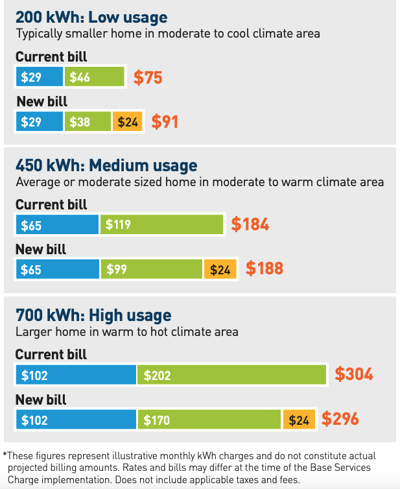
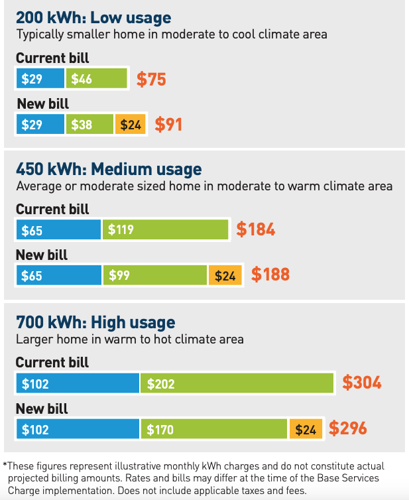
But I was struck by a sample chart showing me how my bill might change. It’s just a hypothetical demo, but it bugged me (see PG&E’s example below). The low-usage and medium-usage examples show the monthly total going up. For high-usage users, thanks to the reduction in the per-kilowatt-hour charge, the monthly total goes down.
“What this new rate is doing is putting a greater portion of the one big number into the fixed monthly charge—and a smaller portion of the one big number into the volumetric charges—the prices you pay based on how much energy you use,” 3CE Chief Customer Officer Catherine Stedman writes by email.
The new structure is meant to help with affordability, but Stedman observes the same potential problem illustrated in the sample bills: “If you're someone who uses very little energy, having a higher fixed charge would be less beneficial to you.”
This is not a new problem and it’s not unique to energy usage. Conserving resources—electricity, water, gas—should save money. But utilities still have fixed costs of maintenance of their facilities and when customers use less and therefore buy less, they end up looking for other paths to compensation.
A PG&E spokesperson points out that overall, customers’ electric bills have gone down by 11 percent (about $20/month) since January 2024, going against the national trend in which residential prices rose by nearly 10 percent over the same time period.
I don’t expect any of our utilities to get any cheaper, but I do hope there are ways to incentivize conservation, instead of the biggest users getting the most significant savings, whether it’s for water or for power.


(0) comments
Welcome to the discussion.
Log In
Keep it Clean. Please avoid obscene, vulgar, lewd, racist or sexually-oriented language.
PLEASE TURN OFF YOUR CAPS LOCK.
Don't Threaten. Threats of harming another person will not be tolerated.
Be Truthful. Don't knowingly lie about anyone or anything.
Be Nice. No racism, sexism or any sort of -ism that is degrading to another person.
Be Proactive. Use the 'Report' link on each comment to let us know of abusive posts.
Share with Us. We'd love to hear eyewitness accounts, the history behind an article.