
It was not from the Supreme Court bench but in a Harper’s Weekly article in 1913 that Justice Louis Brandeis wrote the now-famous line, “sunlight is said to be the best of disinfectants.” Today, you can buy chemical disinfectants with variations of the name sunshine and sunlight; and for the record, yes, sunlight is actually, scientifically, a disinfectant.
But for purposes of Sunshine Week, which starts today, March 16, it’s about the metaphorical sunlight Brandeis was referring to—letting the light in to mean transparency.
Sara Rubin here, thinking about what that means in practice for journalists. A lot of the time, it is far less glamorous than it may sound; it’s about reviewing records, sometimes that are in plain sight. (Check registers of public agencies appear regularly on agendas, for example—it’s pretty easy to find where they’re spending their money, if you look.) Sometimes it means requesting records from government agencies, thanks to the U.S. Freedom of Information Act (FOIA) or its state counterpart, the California Public Records Act (CPRA).
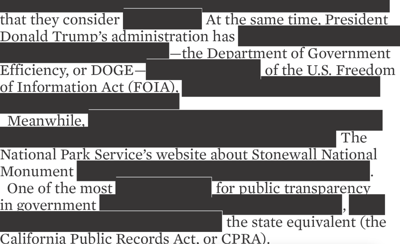
Sometimes, when those things don’t work, it means writing about how frustrating it is to be kept in the dark. And that is the concept that underlies The Foilies, annual tongue-in-cheek awards for the worst in government transparency, produced by the Electronic Frontier Foundation and MuckRock. This year’s awards are the subject of this week’s cover story, in honor of Sunshine Week 2025.
We try to be strategic at the Weekly about CPRA and FOIA requests we submit. Our mission is to shine that light as a disinfectant, airing things out before they fester.
To do that, instead of submitting random, blanket requests, we strive to submit requests that might help reveal something interesting and newsworthy about the inner workings of a government organization. (For example, documents produced from a CPRA request to the City of Salinas are what first revealed Amazon’s secretive plan for a giant warehouse, now in the works.) And to that, we rely heavily on tips from people in the know.
Not every tip is highly sensitive, and not every whistleblower demands anonymity. But whatever the situation, we are committed to protecting sources and being transparent with our sources. For a companion piece to this week’s cover story by EFF, here’s a guide for would-be whistleblowers from the Freedom of the Press Foundation.
If you think there’s information that would benefit from some sunlight, we’d love to hear from you. If you have a suggestion for a public records request we should submit, we’d love to hear from you.
And on a lighter note, here’s a link to thematic games, quizzes and even a playlist in honor of Sunshine Week.


(0) comments
Welcome to the discussion.
Log In
Keep it Clean. Please avoid obscene, vulgar, lewd, racist or sexually-oriented language.
PLEASE TURN OFF YOUR CAPS LOCK.
Don't Threaten. Threats of harming another person will not be tolerated.
Be Truthful. Don't knowingly lie about anyone or anything.
Be Nice. No racism, sexism or any sort of -ism that is degrading to another person.
Be Proactive. Use the 'Report' link on each comment to let us know of abusive posts.
Share with Us. We'd love to hear eyewitness accounts, the history behind an article.