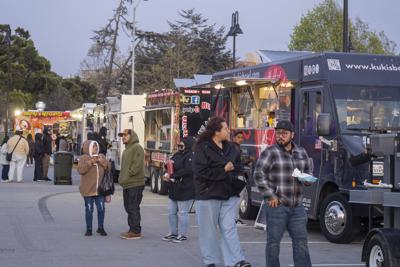

Dave Faries here, noting that some of the best tamales come not from restaurants, but from streetside carts.
The reason has to do in part with the long tradition of street foods in different cultures. In Mexico and across the Mediterranean, for example, dishes prepared by street vendors are celebrated. Sushi was originally sold from stands rather than restaurants. In American cities, however, the evolution and acceptance of street fare is a more recent phenomenon.
In this week’s cover stories we touch on some of the reasons why the food truck scene in Monterey County is so patchy, as well as why they have become popular. Simply put, the landscape for food truck owners is varied—in some place impassible, in others a relatively smooth ride.
Staff writer Celia Jiménez came up with the idea to address the growing food truck scene. As someone who has covered news from Salinas to South County, she had a basic understanding of the regulations governing food trucks and their locations, but wanted to find out more. We thought others would be interested, as well.
Granted, the story of food trucks in this country is rather complicated—and not always so rosy. As I note briefly in my part of the cover story package, such kitchens were once dismissed as “roach coaches,” and for good reason. Some cities, heeding concerns over traffic or those of restaurant owners, put up roadblocks. And there are cases where regulations favor gourmet trucks over simple taco trucks.
Should you wish to dive deeper into the matter, there is a collection of scholarly articles published by the MIT press titled Food Trucks, Cultural Identity and Social Justice: From Loncheras to Lobsta Love—if you care to understand “semiotic frameworks for discussing the spatial and cultural effects of how, where and what food is served,” as well as recognizing that cultural identity formation and community economic development “are two possible frameworks through which we can identify and ultimately foreground social justice in policy and practice.”
Like I mentioned, it is complicated. And, as with any story, there is more we could tell. But I hope you enjoy what we learned of food trucks in Monterey County.
I’m just happy that scholars trace the modern food truck back to chuckwagons of the Old West.


(0) comments
Welcome to the discussion.
Log In
Keep it Clean. Please avoid obscene, vulgar, lewd, racist or sexually-oriented language.
PLEASE TURN OFF YOUR CAPS LOCK.
Don't Threaten. Threats of harming another person will not be tolerated.
Be Truthful. Don't knowingly lie about anyone or anything.
Be Nice. No racism, sexism or any sort of -ism that is degrading to another person.
Be Proactive. Use the 'Report' link on each comment to let us know of abusive posts.
Share with Us. We'd love to hear eyewitness accounts, the history behind an article.