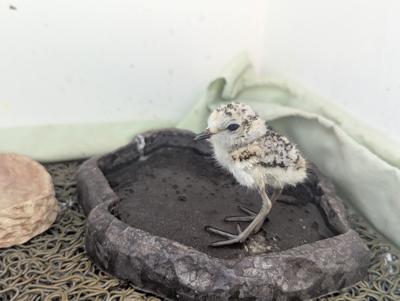

First, the bad news: Every nesting season, some snowy plover eggs don't make it to hatching. The threatened birds are listed under the Endangered Species Act.
The good news is that every year, some number, generally about one to six, eggs are saved. They can be incubated and hatched successfully. And research shows that captively hatched birds, released into the wild at about 4 to 5 weeks old, survive and reproduce at the same rate as their wild counterparts.
"We wanted to make sure captive rearing was an effective conservation strategy and we weren't just releasing plovers into the wild that weren't contributing to the population," says Kriss Neuman, principal ecologist and Monterey Bay program leader for Point Blue, a conservation nonprofit.
Three eggs rescued from Marina State Beach, after they were swept out of their nest in a high tide, were delivered to SPCA Monterey County's Wildlife Center for incubation. After 25 days, the first successfully hatched; two days later, another did (see a video of the hatching process below). One more egg remains incubating.
Plovers inhabit a relatively narrow sliver of beach, facing threats on all sides—there are predators in the dunes, chiefly ravens, and on the ocean side, there is the potential for big storm waves and high tides to wash them away. (Of course from all angles, there are humans—and human impact is contributing to rising sea levels and more ocean events that can damage plover habitat from the ocean side, narrowing their viable habitat even further.)
"They are very susceptible to human-caused disturbance, and that's why habitat areas are fenced," Neuman says.
Nests and eggs can easily blend in. All are tiny, and the small spotted eggs are camouflaged to look like sand. The nests are small depressions, sometimes lined with kelp, driftwood, shells or small rocks.
Plovers nest in a sweet spot, often near the high water line. Their food source is the arthropods in beach wrack, such as crabs that eat washed-up kelp. That means plovers, including babies, need to scurry down the beach to the water line to forage.
"The chicks are really mobile, they don't stay in fenced areas," Neuman notes.
If you encounter a plover egg or nest that is outside of a cable fence, Neuman suggests taking a photo, dropping a pin and calling the landowner (in most cases, California State Parks). If they are not already aware, they can extend the cable fencing that is meant to protect plover nesting areas from March through September.
"People see how fragile they are, but they are also tough to be able to survive," Neuman says.
This video shows the second snowy plover egg to successfully hatch, after 27 days in an incubator at SPCA Monterey County.


(1) comment
A heart-warming story. It appears that incubators are having a high success rate at geting eggs to successful adults. I'm wondering if they could be looking for eggs in nests, to up the odds for those eggs that don't wash out? And how the heck does someone find an egg that has washed out of the nest? More info, please.
Welcome to the discussion.
Log In
Keep it Clean. Please avoid obscene, vulgar, lewd, racist or sexually-oriented language.
PLEASE TURN OFF YOUR CAPS LOCK.
Don't Threaten. Threats of harming another person will not be tolerated.
Be Truthful. Don't knowingly lie about anyone or anything.
Be Nice. No racism, sexism or any sort of -ism that is degrading to another person.
Be Proactive. Use the 'Report' link on each comment to let us know of abusive posts.
Share with Us. We'd love to hear eyewitness accounts, the history behind an article.