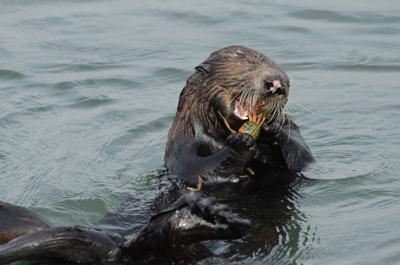

It takes a village to balance an ecosystem.
In this case, that village is a group of resident sea otters in Elkhorn Slough who have taken a liking to a proliferating crab.
A recent study published in the scientific journal Biological Invasions reports on the recovery of the southern otter population in this estuary, and their ability of keeping populations of the globally invasive green crab at bay.
It’s a win-win for the estuary as far as effective conservation strategies go, where an endangered apex predator is offering a way to control the green crab which, when out of control, can decimate native populations.
“I think what differentiates this current study is that now we're looking at the effects of the otters on an invasive species,” says Rikke Jeppesen, an estuarine ecologist at Elkhorn Slough National Estuarine Research Reserve who spearheaded the study. “They're so important for a healthy ecosystem. And there has just been study after study documenting that if you remove that species, everything can change. They're kind of like estuary assistant managers.”
The invasive green crab, whose native range is from Norway down to northern Africa, is believed to have been introduced a few hundred years ago through shipping activity—first to the East Coast, and later to the West Coast in the late 1980s. It established itself in the San Francisco Bay and has since spread southward and as far north as Alaska.
The green crab, an opportunistic feeder that preys on various types of other crabs and fish, even some commercial species like oysters and smaller Dungeness crabs, has established itself in higher tidal zones, invading bays, estuaries and other coastal habitats.
Jeppesen says that while she’s studied green crabs for decades across numerous coasts and continents, “this is one of the first pieces of good news we’ve gotten.”
“The thing with invasive species is that once they're introduced to a new place, they can be incredibly hard to control,” she says. “It's not very often that the species completely explodes and takes over, but if they have, say, a wide range of tolerance for temperature, salinities, water quality, and if they can eat pretty much whatever, then they have a better chance of making it in that new place.”
The southern sea otters' populations, which were hunted to near extinction, have slowly been recovering since the early 2000s. Elkhorn Slough is the only estuary in California where otters have successfully reestablished substantial populations, and the only estuary invaded by green crabs where this invasive species has a notably low population.
Otters, a keystone species known to feed on all types of food which also include mussels, clams, abalone and snails, have famously been associated with kelp forest regrowth by mitigating the impacts of sea urchins taking over the kelp forest ecosystems.
“Restoring the ebb and flow of tides—the lifeblood of the estuary—has so many benefits,” said Kerstin Wasson, research coordinator at the Elkhorn Slough National Estuarine Research Reserve, in a press release. “Now we know these benefits include decreasing the abundance of invasive species by restoring natural food webs, with our coastal apex predator, the sea otter, on top.”


(1) comment
This is a great report of a local success. Hopefully, this is a silver lining in the cloud of the slow recovery of the otter. It appears that the European green crab has invaded extensively both in the Atlantic, and in the Pacific. If the otter follows the food, it should help recovery of the otter population along the entire West Coast, which is the orginal range of our local otter, and the prospective range of the green crab: https://en.wikipedia.org/wiki/Carcinus_maenas
Welcome to the discussion.
Log In
Keep it Clean. Please avoid obscene, vulgar, lewd, racist or sexually-oriented language.
PLEASE TURN OFF YOUR CAPS LOCK.
Don't Threaten. Threats of harming another person will not be tolerated.
Be Truthful. Don't knowingly lie about anyone or anything.
Be Nice. No racism, sexism or any sort of -ism that is degrading to another person.
Be Proactive. Use the 'Report' link on each comment to let us know of abusive posts.
Share with Us. We'd love to hear eyewitness accounts, the history behind an article.