
With climate change driving sea levels ever-higher, the challenges facing California's coast over the coming decades are grave, and there is no easy answer for how to deal with them.
This point was driven home April 25 by Charles Lester, the former executive director of the California Coastal Commission who was ousted from his position in February 2016 by what was widely seen as a coup led by developer-friendly commissioners.
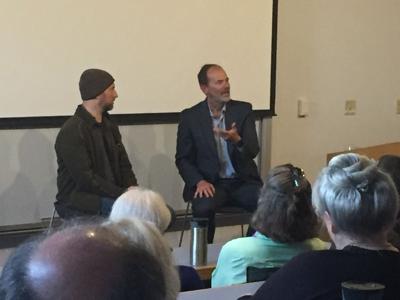
Lester, who is now a researcher at the Institute of Marine Sciences at UC Santa Cruz, gave a talk at Middlebury Institute of International Studies at Monterey on Tuesday evening about the history of the Coastal Commission, the tough questions it faces regarding sea level rise and why it's taking so long to take action on the Cemex sand mine in Marina.
Lester credited the agency with having largely succeeded in its mission in preserving the coast, and contrasted it with highly developed coastlines in other states.
He's also proud of the coastal access the agency has secured over the years, including at Stillwater Cove in Pebble Beach and Donald Trump's golf course in Palos Verdes.
The agency's achievements have not just been securing public coastal access and preserving open space, he added, but he even equality. He noted how the agency forced the Jonathan Club in Santa Monica to cease its discriminatory membership policy, and that it ensured women are allowed to compete in the Mavericks big wave surfing competition.
The most striking aspect of his presentation came when he showed aerial photos along California's coast from the '80s and '90s, and contrasted them with photos taken recently of the same places.
Those photos, whose locations included Monterey Tides hotel and the Surfside Apartments above Del Monte Beach, all showed the beach narrowing.
Perhaps most striking was Solana Beach, where much of the shore is buttressed with revetment—i.e. rip-rap—to protect homes built right on the shore.
Revetment, and any kind of sea wall, increases erosion in other parts of the nearby coast, and Lester noted that in the not-so-distant future, the city will no longer have any beach, despite what its name may be.
The tough choices facing the commission going forward, Lester said, would be when to allow coastal armoring, and when to let the beach retreat, even if that meant the loss of some private homes.
In other words, what's more important: Protecting private property, or protecting public property—i.e. the beach?
"How are we gong to gracefully move out of these areas that are threatened?" he said.
After Lester's presentation, MIIS professor Jason Scorse, the director of MIIS' Center for the Blue Economy, asked Lester some prepared questions.
Scorse has studied the economic cost of sand lost through the Cemex mine, and he got to the subject of the mine right off the bat, asking Lester why it was taking so long for the agency to take action against the mine.
Part of the issue, Lester said, is the tremendous caseload the agency's enforcement division faces. The other thing, Lester said, is the agency always strives to reach an agreement before issuing a cease and desist order.
When Scorse asked how the public could expedite the process, Lester said one way is to continue being a vocal presence and Coastal Commission meetings, and to continue writing letters to local state representatives.
When a question from an attendee came up about why the coastal zone lines are drawn the way they are, Lester offered in interesting anecdote about how the issue is sometimes political: He said former state senator Henry Mello "took the line and moved Embassy Suites [in Seaside] out of the coastal zone."


(0) comments
Welcome to the discussion.
Log In
Keep it Clean. Please avoid obscene, vulgar, lewd, racist or sexually-oriented language.
PLEASE TURN OFF YOUR CAPS LOCK.
Don't Threaten. Threats of harming another person will not be tolerated.
Be Truthful. Don't knowingly lie about anyone or anything.
Be Nice. No racism, sexism or any sort of -ism that is degrading to another person.
Be Proactive. Use the 'Report' link on each comment to let us know of abusive posts.
Share with Us. We'd love to hear eyewitness accounts, the history behind an article.