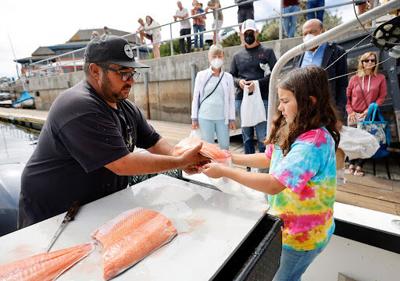

After three years of a total commercial salmon fishery shutdown, the season is expected to open in May.
The Pacific Fisheries Management Council voted on Sunday April 12 when and where Chinook salmon (also known as King salmon) fishing will occur in the ocean off California for 2026. The summer season will begin May 1 and go until Aug. 27, with 12 open fishing windows for Monterey and areas south to the U.S./Mexico border. The open fishing windows will last three to seven days long.
The fishing will also be limited: commercial boats will be capped at 160 salmon per opening with an overall quota of 83,000 salmon. An additional fall season will start Sept. 4 until a quota of 20,000 salmon are caught.
According to official estimates, the current adult salmon ocean population of California salmon is 392,349, a significant improvement over recent years.
Sport fishing for salmon began on Saturday, April 11 for the Monterey area; however, due to stormy weather, only a few boats fished and a small number of salmon were caught, according to a press release from the Golden State Salmon Association.
“We’re cautiously optimistic about this year’s improved salmon seasons,” said GSSA executive director Vance Staplin. “Businesses up and down the coast and inland are desperate for the economic boost this season will bring, especially after so many recent bad years of no business caused by the shutdown of salmon fishing.”
For sport fishing, the salmon that are caught will be counted as near to real time as possible and will shut down when quotas are reached. The summer sport fishing quota for Monterey is 21,800, whereas the San Francisco quota is 34,900 and Fort Bragg is 5,100.
The restrictions this year are to protect what is believed to be a low number of chinook salmon born in coastal California rivers and streams between the Russian River in Sonoma County and Redwood Creek in Humboldt County—protected fish under the federal endangered species act.
Currently, California’s salmon industry is valued at $1.4 billion in economic activity and 23,000 jobs annually in a normal season.
“Coastal communities that have grown to rely on the annual salmon fishery are excited at the prospect of hopefully becoming profitable again,” Staplin said. “When you calculate the economic multipliers, the salmon fishery can bring over a billion dollars, spread across not only California, but also in Oregon where many Central Valley salmon migrate to rear in the ocean.”


(0) comments
Welcome to the discussion.
Log In
Keep it Clean. Please avoid obscene, vulgar, lewd, racist or sexually-oriented language.
PLEASE TURN OFF YOUR CAPS LOCK.
Don't Threaten. Threats of harming another person will not be tolerated.
Be Truthful. Don't knowingly lie about anyone or anything.
Be Nice. No racism, sexism or any sort of -ism that is degrading to another person.
Be Proactive. Use the 'Report' link on each comment to let us know of abusive posts.
Share with Us. We'd love to hear eyewitness accounts, the history behind an article.