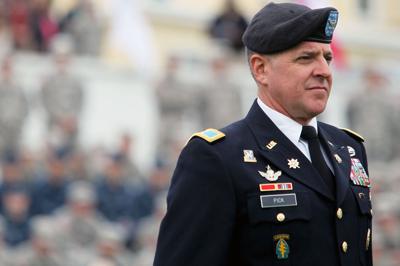

When Danial Pick first came to Monterey’s Defense Language Institute, he was a student of Arabic in 1996. He went on to serve in embassies in Kuwait, Jordan, Iraq, Afghanistan, and held policy positions in Washington, D.C.
He’d already been deployed to Desert Storm in 1991, before rounding out a rich military career that eventually led him to California, as a national security affairs fellow at Stanford’s Hoover Institution and commandant of DLI for the past four years.
Pick—who speaks Arabic, Persian-Farsi, Persian-Dar, and Assyrian—retired on April 18 from a 29-year Army career. He spoke with the Weekly in his last full day at his office at the Presidio before his retirement ceremony.
Weekly: What’s changed in terms of language instruction in your four years here?
Pick: When I came here as a student, we were issued bulky cassette recorders, and about 70 pounds of photocopied textbooks. When I returned in 2008 [as foreign area officer program director] I found we were using iPods for listening proficiency and smartboards in the classrooms. Curriculum had been significantly updated. And all of that led to a better education environment for our students.
How effective are these intensive language courses, that are supposed to take students from zero to proficient in about a year?
When I first reported to DLI, the number of students whose aptitude standard was waived was nearly 30 percent, which caused us to be less effective and less efficient than we otherwise would have been.
I'm proud to say as of the last quarter, the number of students who are waived is less than 5 percent and going toward zero. We're getting brighter, more capable students.
Has the student experience changed?
We needed our education environment to be more student-centric, more mobile, more current. In terms of access to authentic material, as opposed to textbooks that are old, so that we could train our linguists to be ready for the rapidly evolving missions that they have to do.
We had to migrate away from the military [computer] network, and deploy an academic network. That allowed us to have a much much faster network, which could access foreign content that the military network couldn't. The .edu network has been a huge step forward in the last four years.
To my knowledge, we are the first institution in the Army to be on a truly academic network.
Have you added or taken away any languages, and what does that show about the DOD’s direction?
Our language requirements are really determined by the DOD based on national security strategy.
We have added Arabic dialects, Levantine [spoken in parts of Lebanon, Syria, Jordan and Palestine] and Iraqi dialects. Those programs have grown. The next two dialects will be Egyptian and Sudanese, about a year from now.
The Arabic dialect program has been remarkably successful. It's frankly redefined the way Arabic is taught. Universities across the U.S. and elsewhere are reconsidering how they teach Arabic, based in part on the successes we've enjoyed with our dialect programs. As the dialect programs grow, the Modern Standard Arabic program will shrink.
French is growing here, mainly because of its use in Africa. Persian Farsi has grown significantly over the last couple of years because of the importance of Iran. Spanish continues to be a robust program; you can imagine violence along our southern border and narco-terror groups operating in Mexico cause the U.S. concern. We're training soldiers in Korean, Tagalog, Bahasa Indonesian, based on assessments of where they may go.
We’ve moved our Italian and Thai programs from Monterey to Washington, D.C., in the last year; the number of students in those two programs has declined.
You learned Arabic in the ‘90s at DLI before serving in embassies in the Middle East. How’s your Arabic now?
Fair.
How have budget cuts impacted DLI in your time here?
We've dealt with significant turbulence the past four years. Sequestration resulted in our budget going from $340 million to $273 million. It resulted in our civilian staff going from 2,400 to 2,080. That forced us to restructure.
There’s a lingering fear that another BRAC could mean DLI gets relocated to a more affordable region. What are the odds of that happening?
DOD derives the capability that is DLI in no small part because of the civilians that live here in Monterey.
Economically, our total economic impact is assessed at over $1 billion a year, which I'm told is bigger than broccoli. Any time you're competing with produce here, you're a pretty good sector of the economy.
What’s next for you?
Taking a vacation and relaxing.


(0) comments
Welcome to the discussion.
Log In
Keep it Clean. Please avoid obscene, vulgar, lewd, racist or sexually-oriented language.
PLEASE TURN OFF YOUR CAPS LOCK.
Don't Threaten. Threats of harming another person will not be tolerated.
Be Truthful. Don't knowingly lie about anyone or anything.
Be Nice. No racism, sexism or any sort of -ism that is degrading to another person.
Be Proactive. Use the 'Report' link on each comment to let us know of abusive posts.
Share with Us. We'd love to hear eyewitness accounts, the history behind an article.