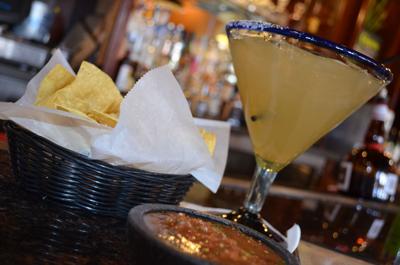

There was a time when you could order a margarita and leave it at that—a simple concoction of tequila, orange liqueur and fresh lime juice in a 2-1-1 or 3-2-1 proportion. And if people had left well enough alone, this particular Burning Question would be pretty much over and done with.
But along came a Texan with a blender. Then Jimmy Buffett chimed in. Suddenly we were forced to specify rocks or frozen. After that, the situation spiraled out of control.
Strawberry-basil, cotton candy, roasted poblano, unnatural neon hues—there are now hundreds of cocktails masquerading as margaritas. Yes, there’s even pumpkin spice. How could there not be? Recipes call for such ingredients as coconut cream, amaretto, or grapefruit juice. So it would seem that adding anything to tequila now qualifies a margarita.
But that won’t settle the question, either. And as we’ve seen with other standard cocktails, the pendulum eventually returns.
Mixologists around Monterey County have been touting the original recipe. “I prefer the classic—you can’t beat natural flavors,” says Alex DeBoer, bar manager at Alejandro’s in Monterey. “But clear is cool.”
Yes, there’s a caveat. By clear, he means the bar’s Mirror Margarita—a stirred-not-shaken mix of Don Julio Blanco, Cointreau, agave and…um…science. Best let him describe it.
“We make lime juice from acids found in fruit—malic, citric and ascorbic,” he explains. “A ton of prep goes into it.”
The result is a crystal cocktail with a brisk salinity that keeps the drink on an even keel and far too easy to sip. Alejandro’s also prepares a more traditional margarita, replacing orange liqueur with agave, which is the trend.
However, at Estéban in Monterey, the Boss Ana Margarita is composed from Mi Campo Silver, both triple sec and Grand Marnier—let’s not get into the difference—along with house made sweet and sour for the citric bite. “I feel you should go more tart than sweet,” says lead bartender C.J. Woodland. “It’s big, it’s good—what more could you ask for?”
Granted, the margarita consistently ranks as America’s favorite cocktail. And perhaps Woodland is right. What’s a little tweak to the original if it still brings a sweet-tart balance?
“For me, it’s quality ingredients—good tequila, fresh squeezed lime juice,” DeBoer says, providing his definition of a proper margarita. The Millionaire Margarita (it’s $30, so bring proof of social status) at Plaza Linda in Carmel Valley fits this description, a mix of Don Julio 1942, Grand Marnier and fresh lime juice. But DeBoer, who creates a short list of standout margaritas at Alejandro’s, reminds us that the cocktail’s holy trinity has changed. “We use agave,” he points out. “We don’t use triple sec.”
The cocktail is itself part of an evolutionary process (or an intelligent design process; don’t want to mess with Texas)—likely a knock off of a picador or tequila daisy. There likely was no a-ha moment, although several competing origin stories exist.
Perhaps the most recognized of these involves a 1948 house party thrown in Mexico by a vacationing Dallas woman. Inspired by alcohol, Margaret Sames and her guests were inventing new cocktails for sport, at least according to a version of the story.
Others involve bartenders smitten with either singer Peggy Lee, with a Ziegfeld Follies dancer fond of tequila, with a local woman named Margarita or with Hollywood’s Rita Hayworth. But in writing his The Complete Book of Spirits, cocktail historian Anthony Dias Blue came across a 1945 Jose Cuervo advertisement promoting the drink.
David Wondrich, another cocktail historian—where is this cocktail degree-granting university?—and author of Imbibe, believes the margarita was a spinoff of the tequila daisy, noting that the daisy recipe called for tequila, orange liqueur, a few squirts of lime and a finishing splash of soda. It was a popular drink in the 1930s.
Oh, yeah. There’s another bit of evidence that might be important. The flower we call daisy in English? In Spanish it translates to…you guessed it.
So those who claim credit for the margarita weren’t all that inventive. Skip the soda, and we have a cocktail sensation.
Well, not quite. In the Mad Men era, classics like the martini held sway. And Tex-Mex restaurants were yet to be the rage. So what happened to change the margarita’s fortunes?
“When sweet and sour came on the scene, the margarita exploded,” Woodland says.
Sweet and sour was introduced to the cocktail by a Dallas restaurateur looking to perfect a blender version. But it was hit or miss, until Mariano Martinez bought a used soft-serve ice cream machine.
According to Smithsonian Magazine—and Martinez’s machine is part of Smithsonian’s collection—he first tried to buy a Slurpee maker from 7-Eleven, but the company balked. So mother of invention and all, Martinez went to work on an old soft serve dispenser.
On May 11, 1971, missing Cinco de Mayo by less than a week, the first sappy machine-made margarita slushie was served. Within a few years, Jimmy Buffet had a hit singing about “that frozen concoction that helps me hang on.”
The margarita hasn’t been the same since. As Matador Network’s Nickolaus Hines wrote, “the margarita is just as much the most abused cocktail in America as it is the most loved.”
Fortunately, in the long evolution of intelligently designed cocktails, bartenders of the 2000s first rediscovered the classics then began playing with recipes, bringing in agave, for instance, to bring dimension to the savor of tequila without upsetting the cocktail’s fundamental profile.
“I like it a little more on the tart side,” DeBoer says. “But you are striving for a nice balance.”


(0) comments
Welcome to the discussion.
Log In
Keep it Clean. Please avoid obscene, vulgar, lewd, racist or sexually-oriented language.
PLEASE TURN OFF YOUR CAPS LOCK.
Don't Threaten. Threats of harming another person will not be tolerated.
Be Truthful. Don't knowingly lie about anyone or anything.
Be Nice. No racism, sexism or any sort of -ism that is degrading to another person.
Be Proactive. Use the 'Report' link on each comment to let us know of abusive posts.
Share with Us. We'd love to hear eyewitness accounts, the history behind an article.