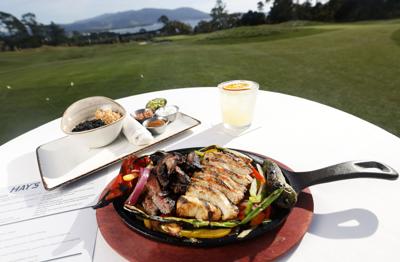

How many dishes become the subject of serious academic scrutiny?
Well, let’s take a look. “Evaluating the Efficacy of Whole Cooked Enriched Egg in Modulating Health-Beneficial Biological Activities” sorta qualifies. Or there’s “Preference Mapping of Whole Grain and High Fiber Products: Whole Wheat Bread and Extruded Rice and Bean Snack.”
What the…? These folks really need some marketing tips.
At least when Texas A&M graduate student Homer Recio published his research of skirt steak with Mary K. Sweeten in 1985, the pair gave it a catchy title. Are you more likely to pick up “Coffee Bioactives Regulate Lipid Metabolism in Caenorhabditis elegans”—a thriller out of University of Massachusetts—or “Fajitas South Texas Style.”
Not really a question. Recio and Sweeten even spiced things up with a little mystery. In seeking the origins of fajitas and speaking of the borderland of Texas and Mexico, they wrote “Historically, in this region of south Texas, secrets are never readily told.”
Yikes. No wonder the question of whether fajitas are Mexican, Tex-Mex or an inspiration from Chili’s remains so tricky.
Fajitas are listed on menus at La Tortuga in Seaside and La Casa del Sazón in Monterey, just to name two. At the Mexican inspired Hay’s Place in Pebble Beach they are a standout. But the dish is also common in national chains, bistros—hell, it’s hard to find a kitchen not serving fajitas.
“I’ve had them in Mexico so I think they are,” says Weekly staff writer Celia Jiménez, who is a native of the country so might be in a position to give us some guidance.
Moments later, however, she came back with “Per Google search fajitas aren’t Mexican, but Tex-Mex.”
Chili’s tried to stake claim to the dish in 1984 when the chain added fajitas to the menu. And it caused a sensation. Indeed, it was the sudden, omicron-like spike in demand for the lowly skirt steak that alerted Recio and led to the groundbreaking research.
However, a popular spot in Houston—Ninfa’s—had introduced fajitas to their menu (first as tacos al carbon) in the early 1970s. And the German-born chef at Austin’s Hyatt Regency, George Weidmann, launched the hotel’s La Vista restaurant with “sizzling fajitas” on the menu in 1982.
By 1984, Weidmann and his team were preparing 13,000 or more orders of fajitas each month, according to composer Joel Beckerman, who studied the effect of that sizzling sound in his book Sonic Boom: How Sound Transforms the Way We Think, Feel and Buy.
In writing about the “fajita effect,” Beckerman explained “the boom moment of the first sizzle of the night always kicked off a multisensory chain reaction that made the whole dining room want the dish.”
Fajita research is broad in scope.
Back on the trail. In a Texas Monthly piece, John Morthland told of the sizzling fajitas served at Round-Up Restaurant in the little town of Pharr back in 1969. But as Sweeten and Recio indicated 16 years later, “Although Texans have enjoyed fajitas for a long time, this food…is not eaten in most parts of the United States because people are unaware of it. Many people have just never heard of fajitas.”
It all seems so long ago.
A number of food writers credit Sonny Falcon with spreading the fame of the dish in Texas. He set up a fajita stand annually at a popular festival in another small town—Kyle—starting in 1969. So it was already a regional favorite, just slow to make its way into kitchens.
Some say Falcon dubbed the strips of grilled skirt steak “fajitas”—faja is Spanish for belt, something the scrap cut of meat resembles. Recio and Sweeten traced use of the word as far back as the 1930s. And their work located the origin of fajitas to Texas borderland ranches, where cowboys, vaqueros—yes, same thing—and other ranch hands were treated to the unwanted skirt.
But there’s an interesting tidbit in Morthland’s 1993 article. Otilia Garza, owner of Round-Up Restaurant, said she picked up the art of grilling the tough cut from a grandmother who owned a restaurant in Mexico.
One long common treatment of skirt steak in Mexico is called arracheras. But there’s another that more closely resembles what we know as fajitas.
“We do have something similar that is called alambre,” Jiménez points out.
By tradition, fajitas involved skirt steak, although chefs broke from that regimen from the moment the dish became widely known. Blame Weidmann. He started to upscale the ingredients. Hyatt, you know.
Alambre can draw on many proteins and vegetables, as well as cheese. It has been referred to by Americans traveling in Mexico as anything from “basically fajitas” to a “goopy mess” (meant in a good way).
So is the dish Mexican or American? Do we really want to scroll back to the top? All that researchers can tell us with any certainty, apparently, is that the sizzling platter sounds amazing.
That’s the best we can do.


(0) comments
Welcome to the discussion.
Log In
Keep it Clean. Please avoid obscene, vulgar, lewd, racist or sexually-oriented language.
PLEASE TURN OFF YOUR CAPS LOCK.
Don't Threaten. Threats of harming another person will not be tolerated.
Be Truthful. Don't knowingly lie about anyone or anything.
Be Nice. No racism, sexism or any sort of -ism that is degrading to another person.
Be Proactive. Use the 'Report' link on each comment to let us know of abusive posts.
Share with Us. We'd love to hear eyewitness accounts, the history behind an article.