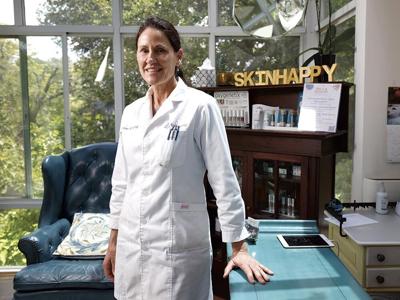

Unless you remain trapped in 1970s logic, when phrases like “a healthy tan” were tossed around casually, you are aware that sunlight can damage skin. If you want graphic details of the ultraviolet pummeling you’ve taken over the years, that’s when it helps to see Dr. Julie Kenner.
The Monterey dermatologist has developed a unique “Discovery Center” alongside her practice that is the medical version of an interactive amusement house – except that with its focus on skin ailments, a visit is illuminating. There’s a UV camera that can reveal pending damage and demonstrate the value of sunscreen, and there’s a Visia facial scanner to document the unseen.
From the street, SkinHappy resembles anything but a doctor’s office. It sits in the historic 1852 Casa de la Torre near Colton Hall. Kenner planted a colorful and serene courtyard garden. There are also chickens roaming the grounds.
Kenner came to Monterey in 2015 after selling a successful practice in Hawaii. Her father was a foreign service officer, so she grew up in West Africa, Turkey and other spots around the globe. As a physician, Kenner continued to travel, serving on medical missions to places like Mongolia, Uganda and the Solomon Islands.
She earned a PhD in pathology from Boston University. Kenner attended medical school at George Washington University and became a medical scientist, working on vaccine development and doing research into bioterrorism. She also spent nine years with the U.S. Army. It was during her medical residency at Walter Reed Army Medical Center that Kenner turned to dermatology.
All of this background is condensed into SkinHappy and the center.
Weekly: What is this place?
Kenner: One of my lifelong dreams was to create a learning experience. What’s better than having a fun experience? This is the first-ever skin discovery center.
[Demonstrates “Villain or Hero” display.] Hollywood villains are often portrayed as having some kind of skin disorder. I put together this thing that gives the backstory and explains what it is. We’re trying to get people to have more empathy. Look at the mirror in the middle: “What’s your story?”
[Turns a nob under a video monitor.] This shows how your face shape changes over time, and that’s mostly due to the sun. And you can see skin texture change. [At another station.] This one is all about emotion. People can talk about their own emotions – a safe place to share. It’s been fun. I’d like to make a bigger version of this.
You talk a lot about emotion.
I talk to a lot of patients. They are really distressed by what’s bothering them. If they feel so harmed by their appearance, they can develop poor self-esteem that lasts long after their skin is healed. I’ve spent a career creating specialty compounds, but also inspiration and information. I want them to know “you’re not alone.” We walk your walk with you. I’m not a psychiatrist, I’m not a counselor. I’m just giving people acknowledgment. It’s a more humanistic way to care for people.
You have a line of retinoids you created. That’s different.
I came with a different perspective. I’m a research scientist. I’ve always enjoyed problem solving. One of the things I’ve been frustrated with in dermatology is it’s very drug-centric. We treat after the fact. I wanted to work on prevention. I thought, “what can we do better to protect the skin?” What I want to emphasize is you can’t just say “I’m going to be less stressed” or “I’m going to eat a healthier diet.” Both are good, but you have to locally protect and locally repair skin.
The two forms of retinoids most people are familiar with are Retin A and Retinol. The problem is they are very irritating. During my residency I tried every retinoid. I had a red face all through my residency.
My question with retinoids is if we start using it at age 1 or 2, can we reduce some of that accumulation? This is the product of seven years of research. This has all been a process. I have my patients to thank.
How did you find a historic adobe?
The house found me. I told my real estate agent that I like something where I can run a practice. I like to garden and I appreciate history. When I walked through the door it was “Wow! This is the place for me.” It’s got good energy. I tried to set up a practice that is not in a sterile environment.


(0) comments
Welcome to the discussion.
Log In
Keep it Clean. Please avoid obscene, vulgar, lewd, racist or sexually-oriented language.
PLEASE TURN OFF YOUR CAPS LOCK.
Don't Threaten. Threats of harming another person will not be tolerated.
Be Truthful. Don't knowingly lie about anyone or anything.
Be Nice. No racism, sexism or any sort of -ism that is degrading to another person.
Be Proactive. Use the 'Report' link on each comment to let us know of abusive posts.
Share with Us. We'd love to hear eyewitness accounts, the history behind an article.