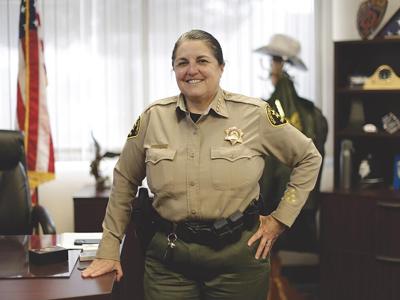

Even before she was sworn in as Monterey County Sheriff on Dec. 30, Tina Nieto was thrown into the maelstrom of a historic weather event, in the form of this winter’s torrential rainstorms and floods. She was involved in emergency management meetings that began on Dec. 26, when she was still transitioning from her previous role as Marina’s police chief. “I had stuff in boxes in the [Sheriff’s] offices, and the prior administration hadn’t vacated the premises yet,” she recalls. “It was a little awkward.”
For Nieto, the proverbial baptism by fire became a “baptism by water, by Mother Nature,” she says. But the sheriff notes that she was prepared by 33 years in law enforcement, including her experience dealing with wildfires as a member of the Los Angeles Police Department. “I got to see very early in my career the destruction of Mother Nature, and what it can do to communities very quickly if you’re not prepared.”
Nieto’s first two months in charge have been so hectic that she’s yet to finish decorating her office, which is furnished with broken-in brown couches inherited from her predecessor, Steve Bernal. (I’m getting new office furniture,” she notes.) Still, she made some time recently to discuss her early days in the role and her plans for the Sheriff’s Office moving forward.
Weekly: You came into the job and immediately were met with this once-in-a-generation storm. What were those early days of your tenure like?
Nieto: It was an opportunity to get to know our county partners very quickly. It was chaotic, but I was very comfortable in my role. The hard part was the unpredictability of it, because we were hit by storm after storm after storm, and that can get tiring. By the end of that first 16 days, I was tired – the rest of the team was tired, the county was tired.
There was criticism that we got from some people, like “Why did you evacuate us?” Based on the information that I was given at the time by the weather experts [and] the water resources board, I would make the same call now.
What kind of respite did you have from that stress? Was there any way to unwind?
I would go home and hug my dogs, and then fall asleep. I like to read, believe it or not. I’m reading Caste [by Isabel Wilkerson]; it’s about social justice. I’m not trying to impress you – these are books that people handed to me and said it would help me understand the community. I’m reading a book that has to do with the history of the whole Salinas area [by Carol McKibben]; I learned a lot of stuff about Salinas I didn’t know. And for fun, I like to read science fiction – I’m a big sci-fi nut.
Do you have any favorite sci-fi shows or movies?
When I was a kid, I loved Close Encounters of the Third Kind. I think I wanted to go with aliens; I was one of those kids who hoped they were adopted, but I’ve done 23andMe so I am related to my parents, unfortunately [laughs].
What about a favorite cop show?
My favorite cop show right now is The Rookie. It’s not even close to what LAPD is really like. To me, it’s just entertaining and funny. I saw a couple episodes of Bosch and that’s the closest [depiction] that I’ve seen to the LAPD. They are really that harsh; they eat their young, there’s horrible language used. I had to learn how to quit saying the F-word when I moved up here [laughs].
In a story we recently wrote about ghost guns, local law enforcement officials said the Sheriff’s Office under you has emphasized greater inter-departmental cooperation. Why has that been a priority?
Let me be perfectly honest: The inter-office cooperation sucked between the Sheriff’s Office and the other municipalities prior to me coming over. That’s why I’m your sheriff. I was president of the Monterey County Chiefs [Law Executive Association] at that time, and we didn’t really know what the Sheriff’s Office was doing; it seemed like they were in a silo.
Many of the chiefs in the county came from other counties where that’s not how it is; in many [counties], the sheriff’s office is the big brother or sister to other departments, because they’re normally the biggest agency in the county. In Marina, I didn’t even know what the Sheriff’s Office did. I want the other chiefs to feel like we’re a partner with them moving forward.
I’ll give you an example: cold cases. Prior to me taking office, the Sheriff’s Office wasn’t working with the Cold Case Task Force out of the DA’s office. Even before I became the sheriff, when I was running, I was told by one of the lead investigators [on the task force] that they didn’t do that. In my head, the conversation was, “The minute I’m sheriff, I’m boxing up all those cold cases personally, and I’m running them over.” And sure enough, before I even became sheriff—after I won the primary and they knew I was probably going to win the election—[the Sheriff’s Office] actually boxed up all their cold cases and gave them to the cold case team. Why wouldn’t you give them the files? Don’t you want to give answers to some of the families? It’s just the right thing to do. And from a leadership standpoint, why wouldn’t I use somebody else’s resources to help my organization and the taxpayers of Monterey County? So we’re working more strongly with the cold case unit now—simple stuff like that.
What else have been your priorities, besides rescuing the Dennis the Menace statue?
[Laughs] I’ll tell you, [Monterey Police Chief] Dave Hober said they went and looked at it and said, “There’s no way we’re getting into that lake, it’s full of duck poop.” But I’ll tell you, before that might have been a more difficult process for the chief of Monterey to say, “Can you guys do this for me?” This was just one phone call, and we’re like, “Yep, we’re there.”
We’re taking a hard look at the department processes across the board for how everything’s done. We’ve identified at least 112 things that we have to do as an agency just to get us to industry standard, outside of all of our lawsuits. My vision is to become the best sheriff’s department in the state, if not the nation—I’m very serious that that’s where I want us to be.
We’re laser-focused on the Hernandez settlement [requiring health and safety standards are met for inmates in Monterey County Jail]. This is a settlement from 2015, and we’re still not out of it. I would like to get us out of that settlement for two reasons: One, it has cost our taxpayers I think $800,000 every year that we’re in this settlement. Secondly, it’s the right thing to do for the inmates. We’re guardians of inmates; good, bad, however you feel about inmates, this is what our society has decided we’re going to do with bad actors in our community. As the sheriff, I have the obligation to care for these people while they're in my custody.
So meeting the mandates of the Hernandez settlement, because it was based on medical care and people dying in the jail, is important. And once we meet the mandates and we’re in substantial compliance and we get released from the settlement, then as the sheriff I can decide what direction my agency is going. I can do some of that now, but there’s other pieces where, because the court is telling me what to do, I have to do that.
It must have been disheartening, then, to have another in-custody jail death in the county recently.
It was very disheartening. It was a week after I came into the office. Here’s one of the things that we did differently right away: We sent out a press release. We were honest about it. We brought in another county agency [the Santa Cruz County Sheriff’s Office] to do the investigation for transparency, so we don’t get accused of trying to cover our own. Do I think that was happening in the Sheriff’s Office [before]? No, but how do you gain public trust from a public that doesn't trust their sheriff’s office? You certainly don’t do it by using your own investigators to say you did nothing wrong. You’ve got to bring in somebody else who doesn't have a vested interest, and we did that. We have to regain a lot of public trust when it comes to stuff like that.
Has anything surprised you about the job? Are there things that might be a bigger lift than you expected?
Every day is a big surprise about what I thought was going on and how the Sheriff’s Office has been run. Every day is a discovery where you think, “Well, this is industry standard,” and then you’re finding out that that’s not happening. I’ll give you one: How do you build a new jail that doesn’t have a kitchen or a laundry? How do you build a jail that has a third-floor area, but no elevator that goes up to it? It’s stuff that you go, “Are you kidding me?”
You now work with Joe Moses, the person who you defeated in the election for sheriff. What’s that relationship been like?
We sat down and had a heart-to-heart at the beginning. I was honest with him and he was honest with me. The one thing I can say is that I never lied: I went in saying I’m not going to throw dirt, I’m not going to run a campaign that way. Now, dirt got thrown, but it wasn’t thrown by me or by my election committee.
We’ve moved on. He’s part of the team, and like any member of my team I have an expectation while I'm the leader that you’re going to do certain things, you’re going to perform in a certain manner, you’re going to be held to a standard.
As one of the first openly gay and first female Latina sheriffs in the state, do you think you’re paving the way for others like you?
I know growing up I didn’t have those [role models]. People believed in me and I had mentors, but I also know it’s easier for the next person when those role models are already in place, because you don't have to imagine a world where that exists and what it would look like.
I don’t talk about the LGBTQ piece of it a lot, but I do think if I really broke it down, being LGBTQ was hard when I was growing up. But I think becoming comfortable with who I was helped me through many of the other obstacles I faced as I went through life. [It] made me more hardened to rejection and knowing that people may not like you, for whatever reason.
When I joined the LAPD [in 1989], you couldn't be gay—they wouldn't even accept you. Everybody had fake boyfriends or girlfriends, or were sham-married or stuff like that. If they found out you were gay, you would not have been hired by the LAPD.
I think a lot of my empathy has to do with my upbringing. Like most—and people don’t talk about it—there was addiction in my family. I had family members that were drug users, went to jail—yet despite all that I still love them, you can't take that away. Just today, I had a distraught mother calling because her son’s in jail and he has a mental illness. As I’m assigning this out [to staff], I told them: “You have to remember this is a mother who loves her son. I don't even know why he’s in jail, but she still loves her son and she’s concerned about her son, and when we talk to her we have to realize this is a mother who loves her son, just like your mom loves you.” And so we have to be compassionate to that and give her the best information we can—and if we can help her out, we do that. Because that’s just the right thing to do.
Is there anything else you’d like to say to the people of Monterey County?
Hold me accountable. You need to hold me accountable like you would anybody else. And don't assume that I know something about a community, because I may not. This is a journey—I'm learning every day. Give me and my new team a chance. I’m blessed that I’ve got six years on this term, because it takes four or five years just to start turning a big ship like this. It’s going to take time.


(0) comments
Welcome to the discussion.
Log In
Keep it Clean. Please avoid obscene, vulgar, lewd, racist or sexually-oriented language.
PLEASE TURN OFF YOUR CAPS LOCK.
Don't Threaten. Threats of harming another person will not be tolerated.
Be Truthful. Don't knowingly lie about anyone or anything.
Be Nice. No racism, sexism or any sort of -ism that is degrading to another person.
Be Proactive. Use the 'Report' link on each comment to let us know of abusive posts.
Share with Us. We'd love to hear eyewitness accounts, the history behind an article.