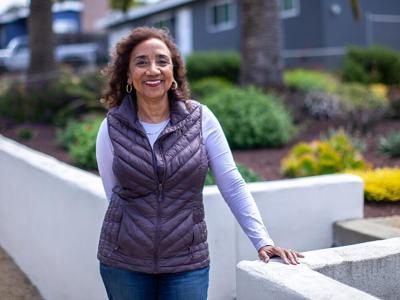

Lynne White Dixon has been a social worker for nearly 45 years. And she’s just as taken with that fact as anyone else – “Forty-five years is a looong time,” she says. This wasn’t her plan all along. As a psychology major in college in Chicago she got connected to the University of Chicago School of Social Service Administration, and it “just clicked.” “I am a true believer in what social work is about,” White Dixon says.
After graduating with her master’s, she moved to Monterey County, developed a specialty working with childhood trauma and the rest is history. These days (and for the past 20 years) she works part-time in private practice and part-time at CSU Monterey Bay’s Personal Growth and Counseling Center. In March, she was recognized with the 2021 Social Worker of the Year Award for the Monterey County Unit of the National Association of Social Workers. White Dixon spoke to the Weekly about what she likes about her work and how she’s stayed passionate about it over the years.
Weekly: You specialize in working with children and families in the child welfare, foster care and adoption systems. What draws you to this work?
White Dixon: I got into it because I’ve just always liked children. And then being African American, being a social worker into social justice, seeing kids in the system not having a voice – I feel children are really our most vulnerable population. [I want] to be able to be a voice, but also to help them heal and have them get stability.
Seeing what being stable – whether it’s with their birth family or winding up in adoption and healing with a new family – just watching the miracle of what happens for children when they can be in healthy, stable, consistent, loving environments.
How has the past year of the pandemic impacted the people that you serve?
I really see the disparities between how some of my kiddos have functioned and how they’ve been managing, dealing with not being in school and not being able to be with friends and their own individual mental health has really been dependent on how well their parents are functioning.
The difference between a family where there is a single parent and she has to work and she’s got to have her kid at home and there’s no support – that kind of level of stress compared to a family where there might be two caregivers and there’s more support. And I can also see the difference between my clients who have financial resources and those who don’t have as many. With my adult patients and the kids, if they had some issues before, they’ve all been exacerbated.
I imagine you must hear some heavy stories. How do you go about not taking that home with you?
The primary one that I’ve learned, over my many years, is I am not that person. And they have a right to their own self-determination. So I get worried about them, but if they’re going to make some decisions that I think aren’t going to be in their best interest or are unhealthy, I can process that with them. But at the end of the day, within reason, I am there to facilitate, I am not there to control.
And then some of the more systemic stuff that I know is impacting my clients’ lives – the way I try to not take it home is to acknowledge the systemic stuff and then I do advocacy at the systemic level. No, I can’t get rid of homelessness, but I can do something about advocacy for people who are homeless.
Is there something that you do, between sessions, to decompress and process?
I try to have, as much as possible, 15 minutes between sessions. And I make sure that I get up from my desk. One thing that I’ve made more of an effort to do since I’m at home and working is getting away from it – going outside and taking a walk through my backyard. And then I do the paperwork that’s necessary at the end of the day.
What’s it like to be a therapist during the pandemic, when a thing that’s challenging your patients is something you’re also actively living through yourself?
It has been interesting. I’ve learned a lot. I think I used to do good self-care for myself, and really promote that for my clients but now I really focus on that.
Not just self-care, but zeroing in on what I can and cannot control. That’s the shared experience – we’ve been traumatized, and there’s no blueprint on how to get out of this. I’ve had to practice, really, what I preach.


(0) comments
Welcome to the discussion.
Log In
Keep it Clean. Please avoid obscene, vulgar, lewd, racist or sexually-oriented language.
PLEASE TURN OFF YOUR CAPS LOCK.
Don't Threaten. Threats of harming another person will not be tolerated.
Be Truthful. Don't knowingly lie about anyone or anything.
Be Nice. No racism, sexism or any sort of -ism that is degrading to another person.
Be Proactive. Use the 'Report' link on each comment to let us know of abusive posts.
Share with Us. We'd love to hear eyewitness accounts, the history behind an article.