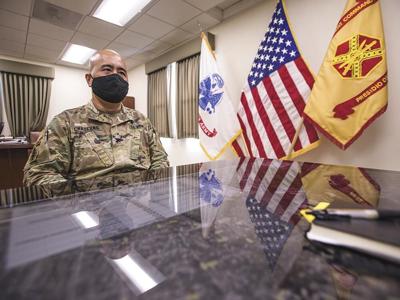
Col. Varman Chhoeung doesn’t remember much of his life before the airplane ride that took him and his parents from the refugee camps of Thailand to San Francisco in 1981. He was 4 years old at the time. When he was 18 months old, his parents left everything behind in Cambodia, fleeing the violence there.
His family settled in Northern Virginia where his father – a teacher, principal and Cambodian Army officer in his former life – mowed lawns and drove taxis before landing a job with the U.S. Postal Service. His mother – who previously worked in a bank – cleaned houses and hotels and eventually got her own job with the Post Office. They welcomed a new child, Chhoeung’s sister. (An older brother died in Cambodia before he was born.)
Chhoeung followed his parents’ lead, choosing a career in the military. He attended West Point and later joined Special Forces, serving overseas in Kosovo, Iraq, the Philippines and Afghanistan. He’s received the Bronze Star and other medals.
On July 9, 2020, he took over command of the Presidio, amid a pandemic and an ambitious plan to add housing in the Ord Military Community of Lower Stilwell in Seaside.
This isn’t Chhoeung’s first time in Monterey: From 2008 to 2010 he attended the Naval Postgraduate School; his son, now a senior at Monterey High School, started kindergarten then in Monterey. “It’s kind of neat to come back full circle,” Chhoeung says.
Weekly: How did your family make their way from Cambodia all the way to Virginia?
Chhoeung: My dad fought in the army against the Khmer Rouge. And unfortunately, the country was taken over. As soon as my parents learned they were taking refugees in Thailand, my dad made his way with me in tow, and with my mom, on a four-day bicycle trip from the southeastern part of Cambodia to Thailand. We stayed in the refugee camps until 1981. They were stripping off refugees between France and the U.S. and some other countries. And my dad said, I want to go to the United States. We were sponsored by some church in Richmond, Virginia, we’re not exactly sure which church it was. Because if we knew, we would probably make a pretty big donation to that church, in hindsight.
I took a look at the thesis you wrote while you were at NPS about the need for the military to use ethnographic intelligence – understanding the social relationships of a culture – as a way to build trust in other countries. Has the military adopted any of your recommendations?
Not because of my paper. The military always tries to understand the enemy, the friendly situation and terrain we’re working in so we can make good decisions on how we can help solve whatever problem it is that we’re trying to solve. If you don’t understand social dynamics, if you don’t understand the people that you’re working with, it’s hard to develop a path forward and help them advance the national interest, whatever it is.
How do you think your background coming from a refugee camp and landing in the U.S. helped you in the missions you were on?
It gives me a sense of empathy and the ability to adapt to different environments. Those two things help me frame problems to solve them.
What about understanding the social dynamics of Monterey now that you’re leading the Presidio?
We provide a stabilizing force to the economy, especially right now with the jobs we provide and the services we provide, the inter-government agreement we have with the city of Monterey. In all my interactions with the neighboring (Peninsula) cities, I always tell them we are teammates to make the community better.
Tell me more about breaking ground on 100 new energy-efficient homes in Seaside, replacing older homes.
Those homes are going to be for junior enlisted personnel. It’s an $80 million-plus project. I think it’s pretty awesome. And the great thing is we were able to do that just out of revenue that was generated from the rental income from homes over the last seven or eight years.
Our charter is to provide safe, quality homes to our personnel that live and work here. The energy and water savings across the entire installation is really good for the entire community, not just us.


(0) comments
Welcome to the discussion.
Log In
Keep it Clean. Please avoid obscene, vulgar, lewd, racist or sexually-oriented language.
PLEASE TURN OFF YOUR CAPS LOCK.
Don't Threaten. Threats of harming another person will not be tolerated.
Be Truthful. Don't knowingly lie about anyone or anything.
Be Nice. No racism, sexism or any sort of -ism that is degrading to another person.
Be Proactive. Use the 'Report' link on each comment to let us know of abusive posts.
Share with Us. We'd love to hear eyewitness accounts, the history behind an article.