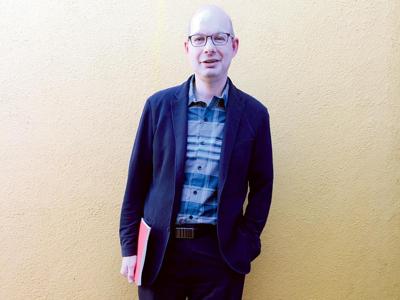

For Ferenc Dalnoki-Veress, a physics professor at the Middlebury Institute of International Studies at Monterey, 2015 was a very good year. In early October, he learned an experiment he worked on with Art McDonald, the experiment’s director, won McDonald the Nobel Prize in physics. Less than two months later, Dalnoki-Veress’ son Minseh – Korean for “citizen of the world” – was born. Dalnoki-Veress has taught at MIIS for five years, but the research that won a Nobel was completed in 2002. He specializes in particle physics, and speaks with a lexicon that sounds familiar, but is very technical: Terms like dark matter, anti-matter and gamma rays roll off his tongue.
His work with neutrinos – the second most common particle in the universe after light photons – won McDonald the Nobel. As part of large team of researchers, Dalnoki-Veress worked on an experiment deep in a nickel mine in Ontario, Canada, called the Sudbury Neutrino Observatory (SNO). The subterranean lab took a decade to build, and in its center was a giant acrylic ball filled with “heavy water” – water enriched with an extra neutron – that reacted to neutrinos when they passed through it by giving off cones of light, which were then picked up by detectors. The experiment found that there are at least three types of neutrinos, and that they can change form time and time again, which meant they had mass. Dalnoki-Veress calls those changes “flavors,” and refers to them as chocolate, vanilla and strawberry. That discovery confirmed the number of neutrinos that physicists believed came from the sun, but it upended the standard model of physics, and changed the way physicists see the universe. Dalnoki-Veress, who is of Hungarian descent, was born in the Netherlands and mostly educated in Canada, came to Weekly to explain his work.
Weekly: Where were you when you learned of the Nobel?
Dalnoki-Veress: It was so cool, it was in the middle of the night, and I received an email from my mother. She sent [an article about the Nobel] and said, “It looks like you’re going to have a very good year.”
What are neutrinos, and why are they important?
Neutrinos are particles that come from nuclear interaction or fusion interaction, and can pass through anything. They’re the second most prominent particle in the universe. They come from outer space, they come from the sun. You can start to understand, fundamentally, how the sun works by looking at neutrinos.
Why was the SNO lab experiment a breakthrough?
Previous experiments were only sensitive to one type of neutrino. What we decided to do is build an experiment where we not only detected chocolate types, but all three of them. These neutrinos were doing something funny by switching from chocolate to vanilla to strawberry, and that’s what was so shocking. Since we found these neutrinos have mass – and they’re not supposed to have mass in the common understanding – then it means the model we had is not complete. This may help us explain more cosmological questions, and more seriously deep questions.
Describe the lab.
It was like a 40-story building in an underground cavity. It’s the largest cavity that’s ever been built at that depth, which is 2.2 kilometers beneath the ground. So you go down 6,800 feet [in an elevator], and then you walk another 2 kilometers, and you’re wearing mining gear.
Then you come to this James Bond-style laboratory, and you have a take a shower because it’s so important you don’t [bring in] radioactivity. Everything has radioactivity, your cell phone has radioactivity. We can’t have that [when detecting neutrinos], so we have to be really, really deep underground, and also use ultra-pure materials. So once you go through the door you have to shower and change into clean-room clothes. Then you take an “air shower,” and then you can work in the area.
How did you become interested in neutrinos?
I saw the connection with the sun. Ever since I was 6, I loved astronomy. My father gave me [an astronomy] book, and it was just so amazing, the fact that you could look outside and see a star and realize that it’s so far away. Later I got hooked on particle physics because it’s so fundamental, and it’s so connected to cosmology. I’ve always found the connection between everything so interesting.


(0) comments
Welcome to the discussion.
Log In
Keep it Clean. Please avoid obscene, vulgar, lewd, racist or sexually-oriented language.
PLEASE TURN OFF YOUR CAPS LOCK.
Don't Threaten. Threats of harming another person will not be tolerated.
Be Truthful. Don't knowingly lie about anyone or anything.
Be Nice. No racism, sexism or any sort of -ism that is degrading to another person.
Be Proactive. Use the 'Report' link on each comment to let us know of abusive posts.
Share with Us. We'd love to hear eyewitness accounts, the history behind an article.