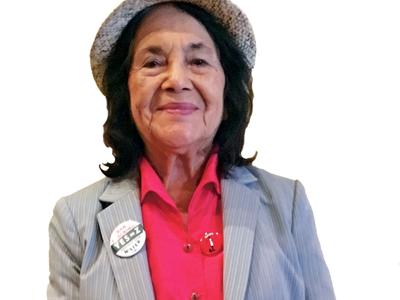

Decades before she made a name for herself as a co-founder of the UFW along with Cesar Chavez, Dolores Huerta was setting the stage for a successful career in social justice advocacy. She was active in Girl Scouts and her church group, and then realized in high school she could form her own organizations. “To me, to not only belong to a group but to make changes – that was like finding a pot of gold,” she says. “Anything that’s wrong, people can change it.”
Huerta has since gone not only to launch the UFW and work as the union’s negotiator, but also to create the Dolores Huerta Foundation in 2002, which organizes neighbor groups in six Central Valley communities.
She’s been active for years as a speaker on women’s rights, farmworker rights and other issues.
Huerta visited Salinas from her home in Bakersfield Oct. 4 to volunteer with the campaign for Measure Z, which would ban fracking, wastewater injection and expansion of the oil industry. She spoke with the Weekly about her involvement in the Monterey County ballot initative, presidential politics and some UFW history.
Weekly: You’re here advocating for Measure Z. Why?
Huerta: Many of my friends who are here working on Measure Z invited me to come. I also have been involved in environmental issues. Pesticides are a very big issue for farmworkers, and that battle is still ongoing. To me, this is another one of those environmental issues.
I am personally disappointed that some of our public officials, Latinos, are siding with the oil companies against Measure Z, instead of supporting the community.
Opponents of Measure Z make a social justice argument against it – that rich white people on the Peninsula are aiming to block economic activity in a rural, relatively poor community. What’s your take?
I think rich white people and middle-class white people and brown people are just as concerned about the environment. I don’t think it’s a social justice argument. The argument is, we’re going to have clean water and protect Mother Earth. That’s the social justice argument.
You’re supporting Hillary Clinton. What do you make of the criticisms of her, including from many progressives?
Of course they’re not going to like her; the press never tells about her accomplishments, it’s always negative. She called for the first Latino Youth Conference in Washington, D.C. when she was first lady. She pushed Hillarycare [the State Children’s Health Insurance Program of 1997] through Congress, health care that covered 8 million children.
She got Aung San Suu Kyi out of house arrest in Burma; no one was able to do that. She’s done great things. They don’t want her to be president, because Hillary will be strong, and make real changes for our country and the world. She’s a threat to the vested interests and power.
What do you make of the rise of Donald Trump?
You can look at that two different ways. Donald Trump was created by the Republican Party. All the terrible things he says and does, they have been saying for years now. He’s not new.
And in some respects, he’s making very visible the face of bigotry, racism and sexism to a degree that nobody can ignore. It’s so blatant, so overt, that it’s going to put pressure on all of our government and private agencies and corporations to start solving the issues because they’re so damaging.
After a career negotiating contracts for the UFW, do you have any bargaining advice?
Ask for more than what you want to get. Be very forceful and positive – like not only do you deserve it, but they owe it to you. You have to do a lot of role-playing.
You’re 86, and still going strong. Do you have any tips to stay healthy and active as you age?
I’m a vegetarian, I keep working and I don’t drink sodas.
The no soda thing sounds healthy.
When we were kids, my mother let us have two sodas a year, one for the 4th of July and one for the 16th of September, Mexican Independence Day. During the 1965 strike in Delano, I said I wasn’t going to drink any alcohol or soda until we got our first contract.
When we got our first contract, I did have a dry martini. I never went back to sodas.
What will be your drink on election night as returns come in?
A glass of red wine or a tequila and tonic with a twist.


(0) comments
Welcome to the discussion.
Log In
Keep it Clean. Please avoid obscene, vulgar, lewd, racist or sexually-oriented language.
PLEASE TURN OFF YOUR CAPS LOCK.
Don't Threaten. Threats of harming another person will not be tolerated.
Be Truthful. Don't knowingly lie about anyone or anything.
Be Nice. No racism, sexism or any sort of -ism that is degrading to another person.
Be Proactive. Use the 'Report' link on each comment to let us know of abusive posts.
Share with Us. We'd love to hear eyewitness accounts, the history behind an article.