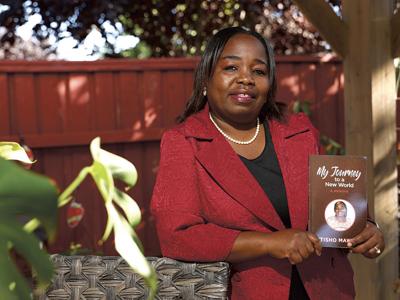

When Bitisho Mawazo’s father bought a boat in the 1990s, he intended to operate a ferry on Africa’s Lake Tanganyika, the second-largest lake in the world. He did not know that war and genocide in neighboring Rwanda would spill over into Congo, and his boat would become a vessel for refugees to flee impending danger.
But in 1996, that is how it served for him and his large family, with six wives and 22 children. The sixth youngest, Bitisho Mawazo, was 24 when she left home with her 3-month-old son and young niece, who was visiting to help with childcare at the time. Her husband, Mathias, stayed behind to defend their home. A few months passed without knowing whether he was alive or dead before he made the trip to meet Mawazo across the lake in Tanzania.
From there, their journey took them to Zambia, then Zimbabwe then Botswana, before they got on a list through the UN High Commission for Refugees to be relocated to the U.S.
The growing family – with a baby daughter, in addition to their son and niece – arrived in Oakland in 2000, knowing no English. (Mawazo speaks fluent French, Swahili and Kifuliru, her tribal language.) The IRC covered three months of expenses, then said, as Mawazo recalls: “You are in America. There is no war here, you can start fighting for survival.”
She and Mathias worked as certified nursing assistants while attending community college, saving up and learning to drive. When he enrolled in a master’s program at the Middlebury Institute of International Studies, they moved to Salinas in 2004. Now 52, Mawazo is a special education teacher for the Monterey County Office of Education. During the pandemic, she put her story to paper, and in 2024 self-published a memoir, My Journey to a New World.
Weekly: You write about when your dad came to visit you in Salinas, and how shocked he was to see a man on the street asking for money. Did you have a similar experience of what you thought the U.S. would be versus how it is?
Mawazo: On TV, we see America as very beautiful, very rosy, everything is nice. Most of the time when we see a white person in Africa, he is there to help. When we came here and see the same person who was there giving, like a small god, it feels like: Why do you want to go help people in refugee camps when you have your own people here?
Your story of falling in love has a little bit of a plot twist – you wanted a husband, and your family wanted you to hold off on marriage and instead pursue education.
I was very smart at school and my dad didn’t want to see me, with all that intelligence, just to drop everything and be married. My daughter [now 26] and I accomplished almost the same thing, but we did it in different ways – when she was 23, she was already done with her master’s. She is happy. I didn’t take that route but I still accomplished what I wanted my life to look like and I am happy.
You had remarkable success saving up for a home in Salinas, then buying a second, larger home and becoming a landlord – only to lose it all in the mortgage crisis and go back to renting an apartment. How did that feel?
We felt like wow, we are landlords here – the peak of our life. Then all of a sudden, everything came down, crashing in slow motion. It was on the news every day. That gave us a sense that it’s not only our family, it’s not like we are failing or we did something wrong.
You write about arriving in the U.S. a year before 9/11, prompting vocal anti-immigrant sentiment. Now that is happening again.
Africa was colonized by Europeans. America went to South America and created chaos. People from Latin America coming here, it’s the same way people from Africa are going to Europe. We are human beings, we want to eat, we want our kids to go to school.
I don’t understand why people here see people from Central America immigrating and say, “Why are they coming here?” You should ask: “Why did my government go there to destroy their government?”
Why did you decide to write a memoir?
All these Black Americans who came here through slavery don’t know where they came from, really – they just know they came from Africa. One-hundred years from now, my great-great-great grandkids will find themselves in Salinas and wonder, why did we end up here? This book will be a document for my family, to know where we came from and why we are here.


(0) comments
Welcome to the discussion.
Log In
Keep it Clean. Please avoid obscene, vulgar, lewd, racist or sexually-oriented language.
PLEASE TURN OFF YOUR CAPS LOCK.
Don't Threaten. Threats of harming another person will not be tolerated.
Be Truthful. Don't knowingly lie about anyone or anything.
Be Nice. No racism, sexism or any sort of -ism that is degrading to another person.
Be Proactive. Use the 'Report' link on each comment to let us know of abusive posts.
Share with Us. We'd love to hear eyewitness accounts, the history behind an article.