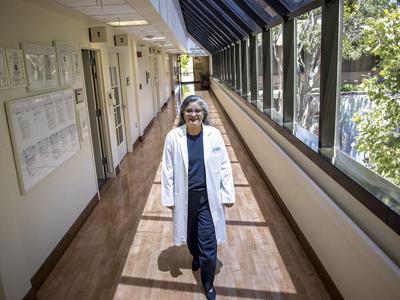

Jovita Dominguez wanted to become a nurse from a very young age. She was first inspired watching the 1970s TV show Emergency! while growing up as the daughter of farmworkers in Watsonville. She liked how the nurses on the show worked as part of the team with doctors and paramedics. After a detour early on, she started taking classes at Hartnell College and volunteered at Salinas Valley Memorial Hospital. She was offered a job as an emergency room clerk on the night shift. “Then that show that I was watching, there I was in the emergency room. It was pretty neat,” she says.
Dominguez earned her nursing degree in 1992 and was working as a nurse at SVMH when, in 1999, one of her Hartnell instructors asked her to take a temporary job as a clinical instructor for the college. She began taking nursing students to patients’ bedsides at the hospital to help them transfer what they’ve learned in the classroom to the real world.
“It was a temporary job, but I guess it’s a permanent one because they’re always asking me to continue,” Dominguez says. She meets with students at 6:30am, before nurses change their shifts, to go from room to room to interact with patients. Dominguez continues to work as a registered nurse for SVMH, currently working in the observational care unit. It’s been a rewarding career and one that’s helped her open the world to her children through travel to places around the world, something she never would have done if she’d remained a clerk, she says.
Dominguez’s passion for educating nursing students was acknowledged in March when Gov. Gavin Newsom announced that he was appointing her to join the California Board of Registered Nursing, a seven-member board that sets state nursing policy, to serve a three-year term.
“I really enjoy my profession,” she says. “You have to enjoy nursing because it becomes a burden if you don’t like it.” She spoke to the Weekly about the evolution of her career.
Weekly: What was it about the show Emergency! that made you want to become a nurse?
Dominguez: At the time that I was watching the show, the word “collaboration” wasn’t in my vocabulary but I liked that teamwork. If I could stand back a little – watching that show my mom only had a third-grade education. She grew up in a little town in Mexico about two hours from Guadalajara. She came to the U.S. alone to be with her sister in Watsonville. Growing up, I always helped her with interpretation, probably at doctors’ offices. That’s what I liked, I liked helping people.
You didn’t become a nurse right away, though. What happened?
My mom didn’t want me to be a nurse because her image was that it was not a clean job, which is true, it’s not clean sometimes. You get very close and work with someone at the worst time in their life; you have to clean them up to help them get better and give them the care they need.
I graduated from [Alisal] High School and my parents got divorced and you can just imagine the drama. So I escaped and went to San Francisco. And since my mom didn’t want me to be a nurse, I tried a little of everything… then I found a fashion school. I came back the following year because I didn’t care for the fashion institute. I saw [the divorce] as a ticket to do what I wanted to do, and so I was rebellious. And here I am.
What’s it been like teaching nursing to students during a worldwide pandemic?
Other than knowing you have fears but don’t show it? You deal with your own fears and then try to help your students, who are also very fearful. You have to listen to their fears and if they choose not to care for somebody because they felt uncomfortable, [you must] teach them that once they become a nurse, that’s not acceptable. You can’t refuse to care for a patient.
We all have problems but we can’t take them to work. As you get older and wiser you learn not to bring them to the bedside.
Were students understanding of that reality?
They actually were. They said, we understand what you’re saying, and they did work through it.
What does your mother think now?
She’s proud of me, but she’s a diabetic and she’s such a non-compliant diabetic. You can only help some people as much as they want to be helped.


(0) comments
Welcome to the discussion.
Log In
Keep it Clean. Please avoid obscene, vulgar, lewd, racist or sexually-oriented language.
PLEASE TURN OFF YOUR CAPS LOCK.
Don't Threaten. Threats of harming another person will not be tolerated.
Be Truthful. Don't knowingly lie about anyone or anything.
Be Nice. No racism, sexism or any sort of -ism that is degrading to another person.
Be Proactive. Use the 'Report' link on each comment to let us know of abusive posts.
Share with Us. We'd love to hear eyewitness accounts, the history behind an article.