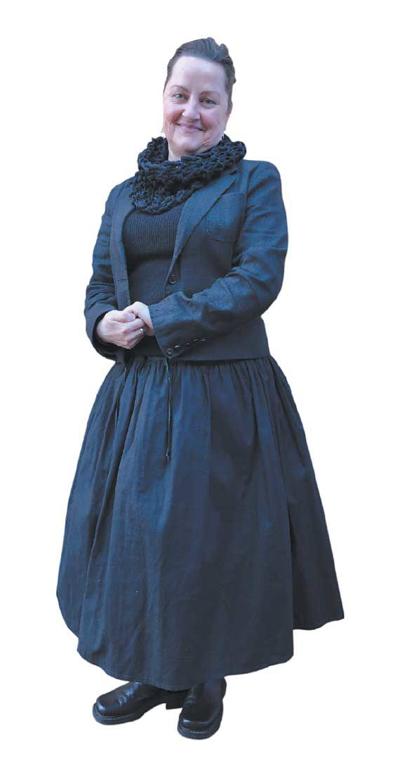
The women in Jaki Canterbury’s family taught her to be crafty and self-sufficient. The textile arts (like sewing, knitting and embroidering) served her well as a cash-strapped but style-obsessed kid growing up in Seaside and Pacific Grove in the 1970s and ’80s.

“When I watch television, I can’t sit with my hands in my lap,” Canterbury says. “I learned to knit without looking and I’m always making socks and scarves.”
Canterbury earned degrees in fashion and illustration, but she was turned off as the field became more digital in the 1990s. Instead she started a family and went analog, learning to spin, dye and weave yarn.
In the mid-2000s Canterbury and her then-husband, Larry Thurman, started Seaside’s Acme Coffee Roasting Co. In recent years Canterbury divorced, left the coffee business and returned to her passion for textiles. Her new business, Slowfiber, is as much activism as enterprise, part of a larger movement against fast fashion and its social and environmental abuses. She encourages people to repair and care for the clothing they already have, buy secondhand and resist the urge to buy new. She hosts “mendbars” and clothing swaps, teaching participants how to fix what they own. She also offers sewing classes and sells upcycled apparel.
Weekly: What do people need to know about you to understand Slowfiber?
Canterbury: Slowfiber started with the question, how can I get out of the fast fashion thing? I’d always had an enormous closet; I’d done my fair share of damage and it had to stop. I started by narrowing down the color palette and embracing a personal ideal that wasn’t influenced by other people.
I’ll admit I still have that consumerist drive to buy clothes, even if they’re secondhand.
What about taking something out of your closet that you already love and adding to it? When I get the urge to buy a new pair of jeans, I add a new patch to an old pair. Thirty minutes of this [mimes hand-sewing] is as good as 30 minutes of this [mimes flipping through a clothing rack].
And for me, it’s 30 minutes of this [mimes scrolling on a phone]. It’s hard to resist when clothing is relatively cheap and you can buy it from home.
I try not to get too caught up in the numbers because they’re depressing. Bottom line, we are buying too much. And the amount of time people keep things is too short. I recently led a patching workshop at the Youth Arts Collective. The idea was to teach them to think differently about their clothes – to hang onto things longer and not throw them out. They were like, “I don’t really care about fashion, but my jeans have to be high-rise.” What fills the needs of a 15-year-old is totally different than for a 30-year-old who is done growing, which is different than me. I now have to dress age-appropriately.
You seem like someone who would reject those conventions.
I’m covered in tattoos and I’m a firm believer in “Let your freak flag fly,” but I have my own ideas of what is attractive and appropriate. I have to prove to you with $500 boots that my tattoos are not because I belong to a biker gang. I’m 51, and I don’t get to show as much skin as I did when I was younger. I embrace looking age-appropriate and edgy all at the same time.
Describe your personal style.
If Rick Owens and Raggedy Ann had a baby, it would be me. I am committed to a philosophy that my clothing has to change sizes with me. Things have to compliment my silhouette and the fabric has to be fantastic, but it also has to be sustainable: upcycled, recycled, mill-end – the last bit of a bolt of fabric. I need the source to be considered. I prefer used, always. I just wear black and a little bit of blue and white, and that’s it. I want to be able to pour things on myself and not have it be detrimental.
One of your products is a “re-label,” to sew into clothes and write notes or dates. What’s behind that?
It’s a writing surface that you sew into your garment for the sake of longevity – I’m talking 10, 20 years. For example, I have this chambray Gap shirt that I got 10 years ago, and the pockets were starting to disconnect. The re-label describes how I put a patch on it that was made from a quilt scrap that I got from my Aunt Janet. The re-label gives that garment life; it gives it pedigree.
TO RSVP for a mendbar, call 915-5388 or visit slowfiber.com


(1) comment
Could the article have just focused on Jaki’s own accomplishments without mentioning her ex-husbands name? Very strange...
Welcome to the discussion.
Log In
Keep it Clean. Please avoid obscene, vulgar, lewd, racist or sexually-oriented language.
PLEASE TURN OFF YOUR CAPS LOCK.
Don't Threaten. Threats of harming another person will not be tolerated.
Be Truthful. Don't knowingly lie about anyone or anything.
Be Nice. No racism, sexism or any sort of -ism that is degrading to another person.
Be Proactive. Use the 'Report' link on each comment to let us know of abusive posts.
Share with Us. We'd love to hear eyewitness accounts, the history behind an article.