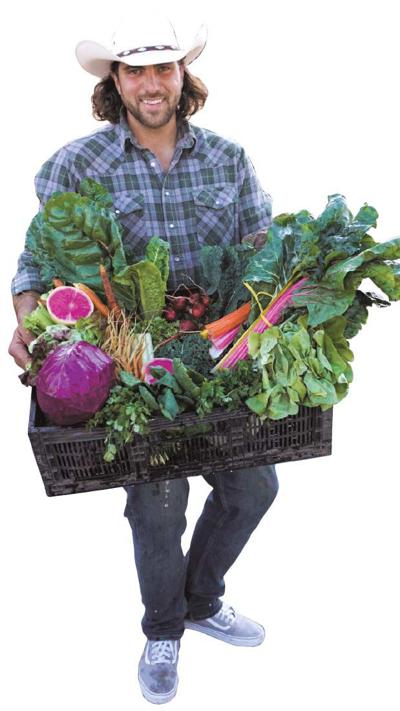
It’s increasingly rare to meet someone who has happily worked in one industry since their first job in high school. For Stevie Hall, owner of Hall’s Organic Farms in Spreckels, finding satisfaction growing plants started on day one. “My first job was at McShane’s Nursery, but I always wanted to get out and work in the fields and learn more about growing,” he says.

Steve Hall supplies produce to a handful of local restaurants including Casanova, Montrio and Tarpy’s.
Hall grew up seeing fields of strawberries, lettuce and artichokes around his hometown of Salinas. Through internships, jobs and 4-H and Future Farmers of America programs, Hall learned about farming, husbandry and metal fabrication, all before graduating from Salinas High School.
At a ripe young age of 29, Hall is the owner and operator of his own small organic farm where he grows several crops from kale to radishes to strawberries. He also staffs his own farmer’s market booths, offering samples while calling out, “It’s organic, don’t panic!”
Weekly: When did the idea of owning your own farm materialize?
Hall: At ALBA [nonprofit Agriculture and Land Based Training Association], I could get college credit through Hartnell College and potentially start my own farm, so I took that opportunity. I completed the eight-month course and then I submitted a business plan, and they leased me a quarter-acre in my fourth year of college. Then every year I kept growing and growing and getting more land. I took everything I made and put it back into my farm, and now we’re at 13 acres.
What future do you see for organic produce?
I see a bright future. Every year there’s more acreage being allocated to organic. There’s more young farmers. Right now it’s especially important that young people farm because the average age of a farmer is between 53 and 57. A lot of their sons and daughters don’t want to continue with farming. I think it’s really important that young people start getting into organic farming because the population is growing and we need to provide food for all the people on the planet.
Do you do outreach to get more young people involved?
Yeah. Through Hartnell, to get your certificates, you need to have cooperative work experience. I know the professors there, [and set up a cooperative work experience] so students can come and help me out with anything we need on the farm. They learn a lot. They see what it’s like to have a farm. We also have internships, paid and unpaid, and volunteers who help set up and work the farmers markets and all they want is fresh vegetables in return.
What’s your biggest challenge as an organic farmer in Monterey County?
Being a small guy when a lot of the big companies won’t cater to what small farms need. For example, they won’t come out to our farm and prep the land for, say, one acre. They only want to come out and prep 10 acres, minimum.
Also, only about 15 percent of farms in Monterey County are certified organic so we’re definitely a smaller portion of the agribusiness that goes on. Sometimes it’s harder for small farmers to access land. The big companies have lots of capital and can eat up all the land, and can outbid us on land and resources.
What do you see in the future for Hall’s Organic Farm?
It’d be nice to integrate animals into the operation. I see my farm getting bigger, getting more involved with the community. I would like to set up a CSA [community supported agriculture]. Also getting more chefs involved, and having them coming out to our farm and building relationships so they can tell us exactly what they want us to grow for them.
What do farmers need from their communities?
I’d like to see more philanthropy toward organic farmers, like people donating money because they want there to be more organic farmers out there in the world. I think people need to realize that if they want change [in the food system] they need to help out… with money to help farmers buy land, fund projects, buy equipment, stuff like that.
What’s your favorite produce to eat?
I’d say carrots, raw or sauteed. The only veggie I don’t like is a habanero, when it’s burning me. I love it, but in that moment, I hate it.
What’s your favorite thing to grow?
My favorite crop to grow is strawberries. They take the most time, the most energy, the most love.


(0) comments
Welcome to the discussion.
Log In
Keep it Clean. Please avoid obscene, vulgar, lewd, racist or sexually-oriented language.
PLEASE TURN OFF YOUR CAPS LOCK.
Don't Threaten. Threats of harming another person will not be tolerated.
Be Truthful. Don't knowingly lie about anyone or anything.
Be Nice. No racism, sexism or any sort of -ism that is degrading to another person.
Be Proactive. Use the 'Report' link on each comment to let us know of abusive posts.
Share with Us. We'd love to hear eyewitness accounts, the history behind an article.