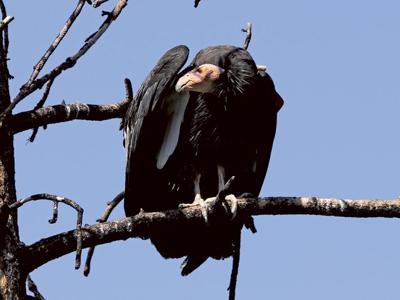

On June 24, condor 171 – aka Traveler – entered the condor feeding pen at Pinnacles National Park, and the pen’s door shut behind her.
Pinnacles’ condor management staff had been planning to capture her to re-affix a functioning radio transmitter, which allows scientists to track her movements, but an intern noticed her behavior was off, and suspected she might be suffering from lead poisoning.
Traveler isn’t the average condor – she’s the matriarch of the flock on the Central Coast, the top mama – and earned her nickname by regularly flying from Big Sur to the Sierra and back in just a few days.
“She’s had the most infamous flights in our flock,” says Joe Burnett, senior wildlife biologist for the nonprofit Ventana Wildlife Society. He’s known Traveler, who is 25 years old, her whole life. “She got that name early on.”
Pinnacles Condor Crew Leader Alacia Welch and her team ran blood work on Traveler the next day, and found dangerous levels of lead. Condors feed on carcasses, and animals killed with lead bullets can poison condors after feeding, potentially killing them. For that reason, it’s illegal to hunt with lead ammunition in California.
Welch took action immediately, and helped transport Traveler to the Oakland Zoo, which has long teamed up with Pinnacles and VWS to facilitate the recovery of the California condor, an endangered species.
Oakland Zoo Veterinary Technician Monica Fox and her team performed X-rays, and saw fragments in Traveler’s digestive tract that were suspected to be lead. If so, it would prove fatal.
Per protocol, Fox and her staff force-fed Traveler rabbit pelts, with the hope that would capture the fragments and then Traveler would regurgitate it all, a process that Fox says works 9 times out of 10. But it didn’t work. That’s when she moved to plan B.
Colleagues mobilized the services of Colorado-based nonprofit Lighthawk, which provides aviation services on behalf of conservation. On July 1, Fox and Lighthawk volunteer pilot Mark Dedon – a former VWS board member and bird program manager for PG&E – flew Traveler from Livermore to Van Nuys, where she was subsequently transported to the L.A. Zoo, where staff were better experienced to perform lifesaving surgery.
The two-hour flight was smooth, and Dedon got to regale Fox with stories about his longtime connection to VWS. “I love working with [them],” he says, “but usually there’s a sad reason: there’s a missing condor.”
Post-surgery at the L.A Zoo – where she was originally hatched in 1997 – Traveler recovered, and was re-released back into the wild on Sept. 7.
Traveler’s mate is 23-year-old Shadow (condor 209), an unusually large condor – he’s named for the size of his shadow – and the patriarch of the Central Coast flock.
To stave off lead poisoning, VWS has a program to distribute lead-free bullets to hunters and ranchers, but Kelly Sorenson, VWS’s executive director, says that’s been a challenge since Covid hit, and supply chain issues have made lead-free ammunition harder to acquire. That has resulted in increased condor mortality in the past two years.
“We’re not blaming the hunters and ranchers, we’re blaming the market,” Sorenson says. “It’s not readily available, that needs to change.”
The most common source for lead poisoning, Sorenson says, is 22-caliber bullets, typically used to manage ground squirrels.
Burnett says the good news is that the Central Coast flock, which currently numbers 86, appears to be bouncing back, and eight condors are set to be released this year (four at Pinnacles, and four near San Simeon).
And Traveler is bouncing back as well: She’s still hanging out in Big Sur, building up strength. “You can’t help but like an animal that is so tough and resilient. If we can get the lead poisoning issue out of the way, they’re going to thrive,” Burnett says of the species.
Fox, for her part, is grateful to have played a role in Traveler’s recovery.
“It’s so great to have happy endings,” she says.


(1) comment
Lead poisoning is what lead to their decline and near extinction, and why we took the very few remaining into captivity, for the captive-breeding program. We should ban lead bullets, plain and simple, for hunting/sport-shooting. If someone wants to hunt for food, let them use steel, which simply turns to common rust when exposed to the environment. Get the lead out.
Welcome to the discussion.
Log In
Keep it Clean. Please avoid obscene, vulgar, lewd, racist or sexually-oriented language.
PLEASE TURN OFF YOUR CAPS LOCK.
Don't Threaten. Threats of harming another person will not be tolerated.
Be Truthful. Don't knowingly lie about anyone or anything.
Be Nice. No racism, sexism or any sort of -ism that is degrading to another person.
Be Proactive. Use the 'Report' link on each comment to let us know of abusive posts.
Share with Us. We'd love to hear eyewitness accounts, the history behind an article.