
In the first novel about Sherlock Holmes, A Study in Scarlet, the narrator, Watson, describes an injury he sustained in service to the British Army during the second Afghan War. He took a Jazail bullet to the shoulder, shattering the bone and grazing an artery. In the next novel, The Sign of Four published three years later in 1890, Watson notes that he has trouble keeping up because he’d been shot in the leg.
It’s a mystery within a mystery – the kind of discrepancy that has Sherlock Holmes scholars looking to make sense of it. In the thousands of volumes that make up the Sherlockean canon, there are articles analyzing whether Watson was in fact shot in both places, and articles by physicians explaining how a shoulder wound could lead to leg pain.
It’s part of the so-called “Great Game,” which requires Sherlockean scholars to accept a few rules. 1) Sherlock Holmes was a real person; 2) Watson was a real person who wrote the stories; and 3) Sir Arthur Conan Doyle was not the author, but a literary agent.
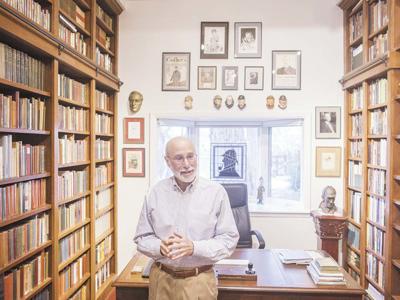
Michael Kean, a retired publishing executive who lives in Pebble Beach, has spent many hours combing over questions like these in his home library. Floor-to-ceiling custom-built bookshelves – the highest accessible only by ladder – hold an estimated 5,000 books. There are only 56 short stories about Sherlock holmes and four novels, but Kean has dozens of editions of each. There are children’s editions, foreign-language editions. Two full shelves are devoted to pastiches and parodies, with titles like Picklock Holmes and A Scandal in Bulimia. There are about 2,000 collectibles, like Holmes busts and pipes, and letters Doyle wrote. Kean shows off a handwritten note, dated 1902, he bought at auction for $65. “Now it would be 10 or 15 times that much,” he says. “They’re extremely collectible.”
To round out this idyll of a Sherlock Holmes library, Kean’s springer spaniel, with long floppy ears, looks the part of a detective’s sidekick. She’s named Violet, after a character in “The Copper Beeches.” She curls up at the foot of two leather chairs in front of the fireplace.
At the next annual meeting of the Baker Street Irregulars in 2020, Kean will become the sixth person in the association’s 86-year history to assume the role of “benevolent dictator.” (The technical title used to be “commissionaire,” but then a previous dictator benevolently changed the title to Wiggins – named after a character who leads a group of street urchins occasionally employed by Holmes to provide intel.)
Formed in 1934 in New York, the Baker Street Irregulars are the world’s oldest Sherlock Holmes literary society, by invitation only. Their annual dinner – on a Friday night close to Holmes’ supposed birthday (Jan. 6), at the Yale Club in New York, is also invitation-only.
“If you’re an invested member you get an invitation,” Kean explains. “You can recommend a dinner guest to Wiggins. Send a letter, indicating who the guest is and their Sherlockean bonafides. Wiggins then decides who is going to get an invitation and who isn’t.”
Kean’s bonafides include publishing several articles on Holmes. For one on place names, he brought his wife, Connie, on a research expedition to rural England. “There are some identifiable places in The Hound of the Baskervilles,” he says. “There’s a town called Combe Tracy. In real life, there’s a town called Bovey Tracy, another called Whiticombe.”
He also wrote a paper on first sentences, looking for “grabbers” in the 60 Holmes stories, only to find the first lines weren’t all that grabby. Still, Doyle’s fictional character is one of the most widely recognized in the English-speaking world, and he was once the highest-paid writer in the world because of Sherlock’s popularity.
“Doyle hoped that he would be known as a ‘serious’ writer,” Kean says, so he killed off Sherlock Holmes in a struggle at a waterfall – but then brought him back, after surviving the fall and crawling back up the cliff, in order to make money. (Kean’s library includes two shelves devoted to Doyle’s other works; Sherlock Holmes accounts for just about 5 percent of his writing, which includes six volumes on World War I, a history of the Boer War and political treatises with some contradictory ideas about women’s autonomy.)
Kean himself was first invited in 1978 to BSI’s dinner, then invested as a member in 1979. All members get a name, after a character, phrase or place in a story. (Names include “Cavendish Square” and “That Gap on the Second Shelf.” Kean’s is “General Charles Gordon.”)
“People ask, ‘What’s your most valuable book?’” Kean says. “I could pull a book off the shelf that’s worth about $12,000, but my most valuable is this complete Sherlock Holmes edition.” He climbs the ladder to reach a tall self, and opens to the title page. It was his first introduction to Holmes, given to him as a gift. There’s a note from his then-soon-to-be-wife: “With love on your birthday, 1968.”


(0) comments
Welcome to the discussion.
Log In
Keep it Clean. Please avoid obscene, vulgar, lewd, racist or sexually-oriented language.
PLEASE TURN OFF YOUR CAPS LOCK.
Don't Threaten. Threats of harming another person will not be tolerated.
Be Truthful. Don't knowingly lie about anyone or anything.
Be Nice. No racism, sexism or any sort of -ism that is degrading to another person.
Be Proactive. Use the 'Report' link on each comment to let us know of abusive posts.
Share with Us. We'd love to hear eyewitness accounts, the history behind an article.