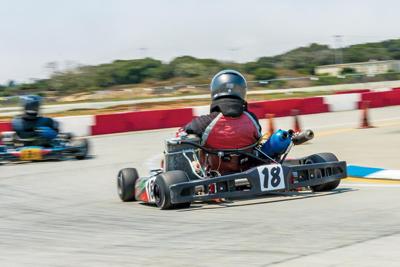

On a windy August afternoon, with patches of blue sky exposed in an otherwise overcast day, five grown men in go-karts bank into a corner at speeds in excess of 80 miles-per-hour. They sit not much more than an inch off the ground.
The track, less than the width of a two-lane street, gets tight, and touching tires with another go-kart at those speeds can result in a karter going airborne.
While their speeds drops to below 40mph as they come into a turn, the drivers step on the gas into the next straightaway, where they’ll try to top 90.
“It’s much more intense than any other racing I’ve been involved in,” says Bert Aramburu, who’s wearing a protective race suit and looking over his kart after finishing a race minutes before. “It’s just sensory overload.”
Aramburu is a resident of Santa Cruz who, five years ago, ditched track days at Mazda Raceway Laguna Seca in his 1997 Porsche 993 for karting in Marina.
One weekend a month, members of the nonprofit club Monterey Bay Karters meet for two days of track riding at the Marina Airport. While the track is painted on the tarmac, the karters set up plastic barriers along the turns and cones in the straight way to mark the course and add safety.
“This is a motorsport, so it’s still dangerous,” says Aramburu, who’s the vice president of marketing at O’Neill Wetsuits in Santa Cruz. “But after 30 years of mountain biking I can say karting is a lot safer.”
While it may seem counterintuitive, there are no seatbelts on these up to 400-pound gas-powered machines on 5-inch rims. Rather, the helmeted and leather – and kevlar-clad racers want to slide away from the cart in the event of a crash, as they would on a motorcycle.
On the weekends they meet, there’s an all-level practice on Saturday and competitive races on Sunday.
A typical weekend will bring out 50 people to test their luck on the track. In the pit off the course, the mood is festive and full of camaraderie. Interiors of trailers that haul their rides sit ajar, and club members and nonmembers alike help each other wrench on their karts to repair problems small and large.
These are not the go-karts of the amusement park variety. They’re more a source of excitement for adults than a novelty for kids. But all ages are welcome, and the youth vehicles on the track are often lighter and tuned-down as their drivers gain experience.
There are eight different racing classes in karting, and race days in Marina karts are separated accordingly, with the small 10-horsepower Briggs and Stratton engines making up the base class, to 125cc stock motos coming up at the high end with 40-plus horsepower and a top speed around 90 mph.
In terms of racing with internal-combustion engines, karting is one of the most accessible ways to do it. The cost to buy a race-worthy kart is $6,000 to $10,000. Motocross – dirt bike racing – has equivalent costs, but the risks for bodily harm are far greater, says Tom Agan, vice president of the Monterey Bay Karters.
“This is a great family sport,” says Agan, who lives in Hollister. His son Tyler just returned from Texas, where he raced in the International Kart Federation Grand National.
Tyler, 25, sits with friends and family in the pit area on the edge of the Marina tarmac, where he’s hung out with them since he was 13, barbecuing and coming-of-age. He talks about his three days at the nationals in Denton, Texas. Although he qualified for three final heats, he says didn’t place, but shrugs it off, having been happy to compete with the nation’s best karters while representing the Monterey Bay area.
Tyler is one a many multi-generational karters at the Marina tarmac. A generation ago the home of the Monterey Bay Karters was Laguna Seca, but the karters left around 1997.
With the embattled Sports Car Racing Association of the Monterey Peninsula (SCRAMP) now vying to keep control Mazda Raceway Laguna Seca, the local karters are eyeing their opportunity to return to where they started in the late 1970s.
Tom Agan is reluctant to get political, but with the newly formed Friends of Laguna Seca, he sees a possible future of returning to the iconic race track in the hills above Highway 68. The group is challenging SCRAMP, who’s now partnered with International Speedway Corporation and World Automotive Championship of California, with a bid to Monterey County to take over management of the raceway.
“We’re looking for a new home,” Agan says, “and we’d like that home to be Laguna Seca.”
Meanwhile, new heat of karters ready themselves at the starting line, revving their engines before they peel off down the half-mile track.


(0) comments
Welcome to the discussion.
Log In
Keep it Clean. Please avoid obscene, vulgar, lewd, racist or sexually-oriented language.
PLEASE TURN OFF YOUR CAPS LOCK.
Don't Threaten. Threats of harming another person will not be tolerated.
Be Truthful. Don't knowingly lie about anyone or anything.
Be Nice. No racism, sexism or any sort of -ism that is degrading to another person.
Be Proactive. Use the 'Report' link on each comment to let us know of abusive posts.
Share with Us. We'd love to hear eyewitness accounts, the history behind an article.