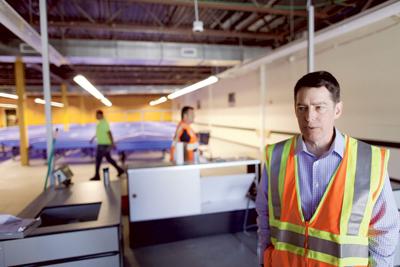

It’s hard to imagine getting excited over plain cement warehouse loading docks, but Edward Durkee, president and CEO of Goodwill Central Coast, is outright joyful.
“All Goodwill tours should start at the loading dock!” he declares, as he stands before 20 roll-up doors inside the organization’s new 98,000-square-foot warehouse just down the street from the Salinas Municipal Airport.
Some background reveals why he’s so excited: Goodwill’s previous headquarters in Santa Cruz was about 45,000 square feet, less than half the size, with just four loading docks and a parking lot shared by trucks and cars. The choreography of deliveries, employees and customers was complicated and hazardous, Durkee says. In addition, the building the 89-year-old nonprofit occupied for four decades had become functionally obsolete, says Anne Guthrie, Goodwill’s vice president of workforce services.
And Goodwill Central Coast – which operates independently of Goodwill International, but pays an annual licensing fee for the affiliation – had no room to grow, which in turn meant no ability to expand its services in Monterey, Santa Cruz and San Luis Obispo counties. Like a hermit crab cramped in its shell, the board of directors decided four years ago to find a new shell.
The new building opened July 19, while still in the midst of renovations. The public-facing side is Goodwill Outlet Store, one of just two outlet stores in the region where shoppers buy items by the pound. (A formal grand opening ceremony is planned in September.)
Jumbled piles of clothing, purses, cups, toys and other items fill giant blue plastic trays that are wheeled in from the warehouse. Customers pick through the trays, filling shopping carts with treasures before taking them to scales set in the floor at checkout for weighing.
But it’s not this shopping experience that represents the ultimate expression of the saying one person’s trash is another’s treasure. Goodwill officials say that comes when they turn people’s cast-off clothing, household goods and furniture into life-changing jobs for people with what they call “barriers to employment” – things like mental and physical challenges, limited education, homelessness, criminal records or addiction.
For Gloria Organista it was unemployment that sent her into Goodwill’s job-training classes three years ago. A year later, she applied for a job as an HR assistant with Goodwill. In April, she was promoted to supervisor.
“I’ve proven to myself that with my work ethic and my ability to learn new things, I can succeed,” she says.
Organista’s story is the idea that drives the organization: “Goodwill’s mission is to help people reach their goals and achieve economic self-sufficiency, and we do that through the power of work,” Guthrie says.
The organization takes in about 25 million pounds of donated items every year, then employs people full-time to sort through, process and either sell or recycle the mountains of stuff. They are hired at minimum wage with full benefits. Unlike retail jobs where schedules change constantly, Goodwill gives employees a consistent schedule with consecutive days off.
Besides workers to sort and prepare items for sale in one of Goodwill’s 15 Central Coast retail stores and one bookstore, it also needs employees for e-commerce sales, where some items culled from castoffs are prepped and marketed online. There will be up to 18 lines of recycled materials, including copper, textiles, plastic, metal, books, backpacks, stuffed animals and shoes. Goodwill’s goal is to send zero waste to landfills.
The new headquarters will start off with about 120 employees, compared to 114 at the old Santa Cruz HQ, and Durkee expects to hire an additional 80 workers. All told, in the three counties they employ approximately 600 people.
Goodwill bought this Salinas warehouse, originally built to house a microchip factory, for nearly $6 million, then invested another $10 million in renovations and equipment.
A new baler, which compacts 75,000 pounds of clothing per week and items that will be sold to overseas markets, is a “blessing,” Durkee says. It’s not only a training opportunity for employees, it’s safer than older models. And the improved efficiency is “one way we’re coping with the minimum wage” increases, Durkee adds.
The new building also means more classrooms for training, and an expanded kitchen and culinary arts training program. Goodwill already has a culinary program at its Monterey Bay Events Center in Marina. Students learn in the classroom, and broaden it through on-the-job training catering meetings and weddings at the events center.
One dream, Guthrie says, is for a sort of classroom on wheels: a food truck.


(0) comments
Welcome to the discussion.
Log In
Keep it Clean. Please avoid obscene, vulgar, lewd, racist or sexually-oriented language.
PLEASE TURN OFF YOUR CAPS LOCK.
Don't Threaten. Threats of harming another person will not be tolerated.
Be Truthful. Don't knowingly lie about anyone or anything.
Be Nice. No racism, sexism or any sort of -ism that is degrading to another person.
Be Proactive. Use the 'Report' link on each comment to let us know of abusive posts.
Share with Us. We'd love to hear eyewitness accounts, the history behind an article.