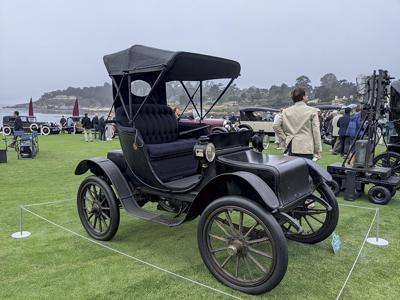

Electric cars are so last century. Before combustion was king, battery-powered cars were competing for a spot on the cutting edge, and they had their perks compared to the gas-powered cars that eventually won out. They were quieter, and they didn’t require a crank – not just a messy task, but one that required sheer physical strength – to start. As a result, they were marketed primarily to women, says Matthew G. Anderson, curator of Transportation at The Henry Ford, a museum in Michigan.
But even back then, Anderson adds, drivers had “range anxiety” – each charge on a 1912 Baker Electric Victoria, part of the museum’s collection, could get about 50 miles on good roads, and the car went at a top speed of 30 mph. It’s no Tesla, but it did come a century before.
And it was good enough for first ladies. Anderson is seated on the 18th fairway of Pebble Beach Golf Links at the Concours d’Elegance on the afternoon of Sunday, Aug. 15, alongside the Victoria that was purchased by President William Howard Taft for use by his wife, Helen Taft.
The car can still run, but it would be too involved and too costly to get it to be safely (and legally) operational for the streets. So unlike many competitors at Concours d’Elegance, this vehicle is not in contention for an award in its Class A-2 category, “Early Electric Cars.”
Anderson and Conservator Cuong Nguyen from The Henry Ford made it to Concours only at the last minute. Like museums everywhere, revenue was down due to Covid-19 closures, and the associated travel costs – it’s roughly $6,000 to transport the car – were too much. But organizers from Concours called the week before, offering to help pay the costs of getting to Pebble Beach for the 70th Concours d’Elegance.
“This is the center of the automotive universe, at least this week,” Anderson says.
And this car, while it’s of a variety that fell out of favor for roughly a century, helps tell the story of how car culture took hold in the U.S. Cars first came to the White House with Taft, a car enthusiast who succeeded horse fan Theodore Roosevelt. According to the White House Historical Association, Congress in 1909 appropriated $12,000 for the purchase of the first two White House cars – despite opposition. Congressman Thetus Sims, D-Tennessee, said, “The automobile is a genuine, all around nuisance.”
It was not a given that cars would really catch on. It happened largely thanks to the affordable Model T, introduced in 1908 – and also thanks to Taft. According to the historical association, “The automobile industry had gained a dream spokesman in the president of the United States. President Taft’s endorsement of the motor car as the official means of presidential transport created tremendous momentum for the automobile industry and accelerated the movement for improved roads…
“At the beginning of the 20th century, some people believed the automobile was a toy for the rich that would just create a greater class divide in America.” (Ironic, then, that the cars from this era at Car Week are so highly valued?)
More than a decade before Taft bought an electric car, they were a growing industry. Engineer Walter C. Baker built an electric car in 1897 and formed the Baker Motor Vehicle Company in 1898. By 1905, they were manufacturing 400 cars a week.
Despite range limitations, Anderson says electric cars stood a chance to compete, but they went out of fashion once Cadillac introduced an electronic-powered ignition in 1911.
“The invention was widely well received, as hand cranking was the number one cause of auto-related injuries at the time,” a history on Cadillac’s website reads. “For the first time, drivers could leave home any time without the need for demanding physical effort.”
It’s hard to imagine today that cars require immense physical effort just to start, but the love and attention that goes into refurbishing Concours winners is its own physical effort. Another thread that connects Taft to this high-end event: In 1910, he became the first president ever to attend a car show.


(0) comments
Welcome to the discussion.
Log In
Keep it Clean. Please avoid obscene, vulgar, lewd, racist or sexually-oriented language.
PLEASE TURN OFF YOUR CAPS LOCK.
Don't Threaten. Threats of harming another person will not be tolerated.
Be Truthful. Don't knowingly lie about anyone or anything.
Be Nice. No racism, sexism or any sort of -ism that is degrading to another person.
Be Proactive. Use the 'Report' link on each comment to let us know of abusive posts.
Share with Us. We'd love to hear eyewitness accounts, the history behind an article.