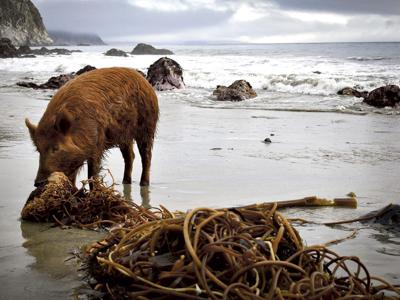
Pepper the Pig leads a pretty good life. She’s fed, she goes on walks, she’s loved, she frolics and she gets to wallow in the mud – regular pig-like activities, for the most part.
But Pepper’s life is a little different than that of other pigs. She lives on the Big Sur coast. When she goes on walks, it’s with ocean views. When she frolics, it’s in California wildflowers. And when she wallows in the mud, it’s at the beach.
How did Pepper the pig get to live this life on the Big Sur coast? Did she invest in Dogecoin (and get out) at the right time? No.
According to Dawn Fenton at the SPCA Monterey County, Pepper was one of three tiny abandoned piglets found when they were just days old. The SPCA Barn and Wildlife Center staff bottle-fed the piglets and provided the 24-hour care that they needed.
“Just as they were growing strong and healthy, the pandemic hit,” Fenton says. “The wonderful family who stepped in to give Pepper a loving foster home became her permanent family.”
Before you go out to adopt an adorable pig who will surely be your best friend, whose belly you will rub, whose hair you will comb and decorate with flowers and garlands, hold on: Adopting a pig is not for everyone and the Foster family (no pun intended – their last name is Foster) who adopted Pepper is a special case.
According to Stella Foster, the oldest daughter of the family, they adopted Pepper in May 2020 when she was 6 months old. Prior to that, they fostered her for four weeks. The shelter needed people to foster the animals because regular volunteers were not able to volunteer on site due to Covid restrictions.
To take care of an animal that has a lot of energy, eats like a pig and can get really big you need a little more space than most people have. “We live on a large piece of land that we caretake in Big Sur, which gives her lots of space to run around and live life to the fullest,” Foster says.
Pepper lives in a pen lined with hay. She loves fresh fruits and veggies, especially bananas and sweet potatoes, but “she will eat anything,” Foster adds. She also enjoys grazing and rooting and “she loves to wade in the pond and roll in the mud multiple times per day.”
“Adopting a pig is a commitment.”
Now, looking at pictures of a grown-up Pepper on the social media account dedicated to her (that’s instagram.com/bigsur_pepperpig, and it’s so worth a follow) she looks pretty wild, but the SPCA reports Pepper is a domestic pig.
Foster theorizes that Pepper is the pig version of a mutt dog. “She is most likely a mix of lots of different breeds,” she says. “She is the only big, red, hairy pig that I have ever seen.”
Foster also talks about the challenge of taking care of Pepper as something you have to do for the long haul.
“Adopting a pig is a commitment. They are very similar to a dog, but also very different. She is stubborn and needs a lot of attention,” she says. “Pigs have the intelligence level of a 3-year-old human. She is like a giant toddler who is hungry all the time.”
Pepper has also received some training from the family, and Foster reports she knows how to sit, spin and wait.
If you are interested, and up to the challenge, ultimately adopting a pig is similar to adopting any other animal.
Fenton says the SPCA receives quite a few pigs through its barn program, and they come in a variety of ways, some because their owners have to surrender them, or as strays. The procedures and preparation for adoption includes a behavior evaluation, vaccinations (tetanus, erysipelas, rabies) and trimming of tusks and hooves, if needed. If they’re babies when they come in, the SPCA also spays/neuters them.
The same questions you should ask when adopting a dog or a cat you should ask if you are thinking about adopting a pig.
Look at yourself in the mirror and do some deep soul searching before you make the plunge into pig parenthood and ask yourself if you can commit to taking care of the animal, can afford to and have a stable enough life where the animal will be safe and secure.


(0) comments
Welcome to the discussion.
Log In
Keep it Clean. Please avoid obscene, vulgar, lewd, racist or sexually-oriented language.
PLEASE TURN OFF YOUR CAPS LOCK.
Don't Threaten. Threats of harming another person will not be tolerated.
Be Truthful. Don't knowingly lie about anyone or anything.
Be Nice. No racism, sexism or any sort of -ism that is degrading to another person.
Be Proactive. Use the 'Report' link on each comment to let us know of abusive posts.
Share with Us. We'd love to hear eyewitness accounts, the history behind an article.