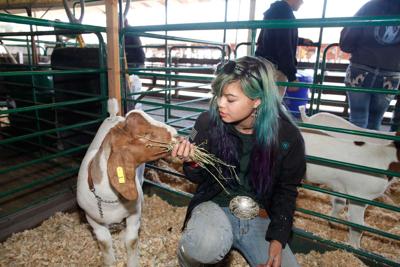

Isabel Hanchai taps on the cage of her Boer goat, whose long, brown ears resemble oblong oatmeal pancakes. “Hi, Mr. Squishee Pants, do you want a snack?” she says, feeding him single kernels of popcorn. Then she explains: “Goats like the crunchy texture.”
Hanchai, 16, is the treasurer of the Aromas 4-H Club, one of 13 Monterey County chapters of the farm-oriented youth group, which number some 6 million members nationally. At the moment Hanchai is waiting for a veterinarian to check Squishee for abscesses and illnesses before Hanchai is allowed to put him – along with three of her other goats, two dairy goats and one breeding Boer goat – into their designated pens at the 2017 Monterey County Fair. Hanchai also must get Squishee tagged and weighed. He lands at a plump 82 pounds, which is big for 9 months old.
Hanchai grew up in Aromas and started raising pigs after her older brother Ben did the same for Future Farmers of America (FFA). She got hooked, and now raises pigs as food for the family, and sells some to FFA and 4-H members.
“Pigs are my favorite. They’re like a really big dog – extremely sweet,” she says.
Despite not growing up with farm animals, Hanchai has built quite a farm: She currently keeps 14 pigs, seven goats, six rabbits and 15 turkeys.
“Bel is so determined and very responsible,” says her mother, Kerry. “She just takes great care of them.”
Hanchai says it’s helped her develop a range of skills that go beyond the basics of animal husbandry.
“I used to be impatient, but you have to wait a lot, like waiting for the babies to grow,” she says. “It’s a good way to practice being a parent without having a kid. I never really get a day off.”
Raising animals for 4-H took a new turn this year when Hanchai decided to raise a goat after she met her boyfriend, a goat breeder, at the 2016 Santa Clara County Fair. In January 2017, Hanchai and her mother went to a livestock auction at Fresno State University. Hanchai had a limited budget. While she buys pigs for around $300 each, goats can go for 10 times that.
As the number of goats at auction dwindled down to 10, Hanchai spotted one with a little brown face she thought was cute: “I just kept looking at him, thinking he would be a great goat to raise.” He was the runt of the litter at just over 40 pounds. (Squishee’s brothers were about 50 pounds each.)
Hanchai went for it, bidding up to her spending limit of $600 – money she’d earned from selling pigs – but lost to another bidder. After winning Squishee, however, the winner had second thoughts, and as the second-highest bidder, Hanchai had the option to buy him.
“He was a bit fat, so I called him Squishee,” she says.
Eight months later, sitting in the pen at the Monterey County Fairgrounds, Hanchai says she expects Squishee will sell for around $8/pound. She combs his fur and fluffs his tail in hopes of making him more attractive to potential buyers.
“You work so hard to get them up there and then it’s over and you’re pretty much saying goodbye to a best friend,” she says. “I love raising and showing, but I’m usually a wreck when he sells.”
For judging, 4-H animals are broken up into three classes – market, breeding and showmanship.
Squishee is judged with other market goats – those that are bred for meat – in his weight group. The top goat is awarded the distinction of Grand Champion and second place is named Reserve Grand Champion. The top two earn ribbons and – thanks to their lean body shape – considered higher-quality meat.
Squishee took third place for his weight class.
“Squishee is kind of fat and the judge said if he was more lean he would have done better,” Hanchai says. “You want a goat to be lean from shoulders to hips and not stick out too much in his mid-section.”
Hanchai says she has learned not to feed them so much hay, which causes goats to get chunky.
At the auction, all the 4-H animals are sold by the pound. The Grand Champion Boer goat sold for $26/pound. Squishee, at 82 pounds, sold for $21/pound, or roughly $1,600 – nearly triple what Hanchai paid for him at auction in January.
“I did not expect it to go that high,” she says. “I was thinking it would be closer to half that.”
After the auction is over, Hanchai brings Squishee back to his pen and sits with him for a while.
“I have mixed feelings. It is my last day with them, but I try not to look at them too much, because they’re a pet,” she says. “Squishee is special. He was the first market goat I ever had.”
At the end of the fair, he will be shipped off to be slaughtered and processed for his new owner.


(0) comments
Welcome to the discussion.
Log In
Keep it Clean. Please avoid obscene, vulgar, lewd, racist or sexually-oriented language.
PLEASE TURN OFF YOUR CAPS LOCK.
Don't Threaten. Threats of harming another person will not be tolerated.
Be Truthful. Don't knowingly lie about anyone or anything.
Be Nice. No racism, sexism or any sort of -ism that is degrading to another person.
Be Proactive. Use the 'Report' link on each comment to let us know of abusive posts.
Share with Us. We'd love to hear eyewitness accounts, the history behind an article.