
Spanglish has become a language of its own and has variations that are influenced not only by geography, but by culture. The hybrid language is widely used in Texas and elsewhere along the U.S.-Mexico border. Despite its widespread use in conversation, the presence of Spanglish in print is marginal.
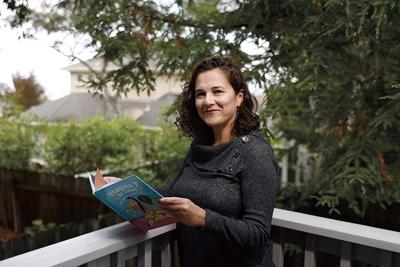
Enter Vitamina T for Tacos, a children’s book published last year. It deploys a colorful alphabet to explore Mexican and Mexican American culture through a Spanglish lens. Vitamina T is by Suzanne García-Mateus, a bilingual education professor and director of the Monterey Institute for English Learners at CSU Monterey Bay, and Mando Rayo, a Texas storyteller and taco-focused journalist.
“I thought of it as a way to contribute to the children’s literature,” García-Mateus says. The goal was to write “in a way that we actually speak Spanglish, because there are some books in English that are just not really reflective of how we speak.”
Spanglish is a hybrid language many Latin Americans use on a regular basis, a mix of English and Spanish words and phrases. Spanglish speakers swap words between both languages or modify some of them, such as “the brightest Yema on your huevos con bacon,” as the Y section reads, referring to egg yolks.
In academia, that’s called translanguaging. It’s an evolving expression of popular multiculturalism. García-Mateus says adults should be OK with children speaking Spanglish. That said, she was little nervous about how people would receive the book – but it has met with a positive response.
“It adds to the efforts to normalize the presence of Spanglish in classrooms,” says Martha Samaniego Calderon, the book’s illustrator. “It’s important for children to see themselves in the book.”
The idea for the book formed when both authors and their families gathered. While drinking coffee and eating tacos (of course), García-Mateus and Rayo decided to create a book, using the Spanish alphabet and brainstorm ideas with everyday language, objects and music common to the Mexican American childhood. Most of the words used in the book are related to tacos (both authors love tacos). On some occasions, finding words that started with a particular letter was a little challenging, so they opted to use a replacement that had that letter somewhere in the word itself. They represented Ñ and X, for example, with piña and Mexico.
Some phrases in the book call specifically to Latino readers. For example, the phrase for the letter N – “Nopales sigue sigue!” – is close to the chorus “No pares, sigue, sigue!” from “El Tiburón,” a song by the Dominican American group Proyecto Uno.
The book also includes compound letters LL and CH, although they are no longer part of the Spanish alphabet. “We purposely decided to include the letters even though they’re not recognized, because it’s a form of resistance,” García-Mateus explains. “Those letters are still part of our repertoire.”
The book has mixed-media illustrations, including photographs. Samaniego Calderon normally works with paint or charcoal on paper, then digitizes the completed piece. Because she was working on a short time frame, she traded paper and brushes for a tablet. Texture, she says, remained a crucial element of her illustrations and can be seen throughout the book. “That’s a good thing about technology,” Samaniego Calderon says. “You can really mimic the real medium.”
Samaniego Calderon says working on the book got her thinking about her own experiences. “There are all these little details of real objects that mean a lot to me culturally,” she says. “I hope that this book inspires readers to go explore their neighborhoods and go to their favorite taquerias.”
Vitamina T for Tacos is the first book of a planned Spanglish trilogy. The second one, which will be released this year, is called Vitamina P for Places. Following that, look for Vitamina C for Culture.


(0) comments
Welcome to the discussion.
Log In
Keep it Clean. Please avoid obscene, vulgar, lewd, racist or sexually-oriented language.
PLEASE TURN OFF YOUR CAPS LOCK.
Don't Threaten. Threats of harming another person will not be tolerated.
Be Truthful. Don't knowingly lie about anyone or anything.
Be Nice. No racism, sexism or any sort of -ism that is degrading to another person.
Be Proactive. Use the 'Report' link on each comment to let us know of abusive posts.
Share with Us. We'd love to hear eyewitness accounts, the history behind an article.