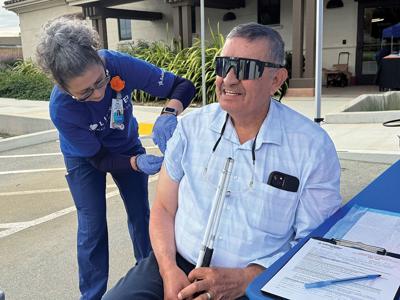

Last summer, before the flu season officially kicked off, one seasonal flu, influenza A, mutated into a more contagious and stronger version, influenza A H3N2 subclade K, dubbed the “super flu.” It packs a wallop with intense symptoms that can linger longer than in the case of other flu viruses. It has resulted in the highest number of cases in 30 years. The Centers for Disease Control estimates there have been 18 million cases nationally since last fall, with 230,000 hospitalizations and more than 9,300 deaths. Three children have died, all in California.
The super flu hit Europe and the East Coast hard, particularly New York, and has been making its way west. In December, Salinas Valley Health started seeing the variant appear in about 15 percent of test results. The rise in cases worried hospital officials, motivating them to initiate a public campaign to encourage more people to get vaccinated.
“The most important thing we can do to protect ourselves from influenza, or the super flu, is to vaccinate,” says Dr. Orlando Rodriguez, medical director and chief medical officer of Ambulatory Services for SVH.
Despite the scientific evidence that the vaccines are safe and save lives, vaccination rates have been declining. Among California health care personnel, the rate dropped to 72 percent during the 2024-2025 season, the lowest rate in 10 years, according to the California Department of Public Health. The CDC estimates 41 percent of California adults were vaccinated in 2024.
“Unfortunately we recognize there is tremendous vaccine hesitance,” Rodriguez says, adding that the criticism of vaccines by U.S. Secretary of Health and Human Services Robert F. Kennedy Jr. “has made it worse.”
The current vaccine was formulated before influenza A mutated, but because the formula contains elements to fight influenza A, it may not stop someone from contracting the flu. It’s estimated to be 30-percent effective at preventing flu but it’s still protective, Rodriguez says.
“Even though it’s not a perfect match, it helps prevent severe complications, hospitalizations and ultimately death,” he says. It’s especially important for young children, the elderly and pregnant women to be vaccinated. (Most pediatric deaths occur among unvaccinated children, according to CDPH.)
The majority of patients Rodriguez has seen experience a runny nose, coughs, body aches, fatigue and fever. People may experience only one symptom, or they may experience a combination. Rodriguez encourages people to seek medical attention as soon as possible and get tested so they can be treated properly. There are medications that can shorten the severity and length of the virus.
It’s not too late to get vaccinated, Rodriguez says. Most flu vaccine clinics take place in the fall, but because of a possible surge, SVH and the County of Monterey added free clinics the weekend of Jan. 24-25. The County’s clinic takes place 10am-1pm Saturday, Jan. 24 at Gavilan View Middle School, 18250 Van Buren Ave., Salinas. SVH’s clinic is happening 1-4pm Sunday, Jan. 25 at Northridge Mall, 796 Northridge Drive, Salinas. Free or no-cost vaccines are available at most pharmacies and at county health clinics.


(1) comment
Personally, I began using Hydroxycloroquine weekly (HCQ; a modernized version of Quinine, having a hydroxy molecule attached, precipitated as a 'salt' with diluted Hydrochloric acid) and Zinc in early 2020. Six year since using that weekly regimen, I've not had a single cold/flu or other virus symptoms. I used to catch colds abour once/year, when manifesting symptoms. The literature I've read indicates that the HCQ enhances the ability of the Zinc ions to enter into the cell, where they slow the rate of viral replication. This allows more time for one's own defense mechanisms to kill the virus. Perhaps I've just been lucky thus far, but this certainly deserves more research, and Zinc is known to be a viral inhibitor. My HCQ dosage is 1/7th of the normal dosage when used against living cells invading our bodies, i.e. one pill per week instead of daily. It slowly leaves the body in about 2 weeks, so this keeps a relatively stable prophylactic dose in me. Maybe that's why tonic water (Quinine water) was so popular last century?
Welcome to the discussion.
Log In
Keep it Clean. Please avoid obscene, vulgar, lewd, racist or sexually-oriented language.
PLEASE TURN OFF YOUR CAPS LOCK.
Don't Threaten. Threats of harming another person will not be tolerated.
Be Truthful. Don't knowingly lie about anyone or anything.
Be Nice. No racism, sexism or any sort of -ism that is degrading to another person.
Be Proactive. Use the 'Report' link on each comment to let us know of abusive posts.
Share with Us. We'd love to hear eyewitness accounts, the history behind an article.