
Outside of VAP3ZONE in Marina, a sign tells of how someone quit smoking cigarettes because of a “watermelon-flavored vape.” The advertising implies e-cigarettes, or vape pens, are a safer alternative to cigarettes. But as Shawn Stone, program director at nonprofit Community Human Services explains, “[vape pens] are as bad, if not worse than cigarettes.” That applies especially to youth.
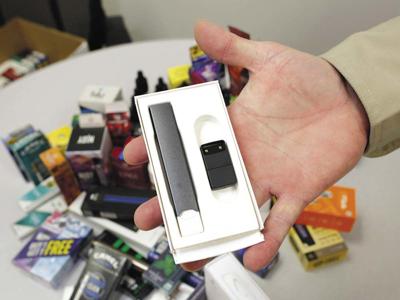
Vaping is on the rise among Monterey County’s youth. Stone cites several reasons: For one, it’s discreet. Not only are vape pens small and easy to hide in pockets or backpacks, but they can also be odorless. They can smell nothing like tobacco or marijuana products, yet they do contain nicotine or THC.
There is also a techy aspect to it. Like having the latest iPhone, having the newest device to vape is appealing to young people, with brand names like JUUL offering sleek, modern designs.
There’s a range of devices, plus add-ons like cartridges, Stone says: “It’s easy to make a hobby out of [vaping].”
Then there is marketing. Pods and cartridges are sold in fruity flavors such as watermelon, mango and melon creamsicle. The industry also emulates cereal flavors that harken back to childhood like a cinnamon-sugar “Chef’s Crunch,” or an apple-flavored “Apple Smax.”
“When companies market tobacco as cigarettes, people who smoke don’t care about the taste,” Stone says. “When they’re marketing cereal or candy flavors, they’re appealing to a certain population.”
CHS launched a program to tackle the problem in all Salinas Union High School District high schools and at Chalone Peaks Middle School in King City. The Vape Offense Workshop launched at Salinas High in November 2018, and then rolled out to all high schools this February. It is meant as an initial intervention targeted toward students who bring vaping devices to school.
“It’s not meant to be punitive,” says Stone. Instead, counselors and administrators seek to figure out why an individual brought the device on campus, then focus on social and emotional support.
Outside of school boundaries, the Monterey County Health Department and Sheriff’s Office is trying to pony up their resources, too. Monterey County Sheriff’s Deputy James Day handles tobacco outreach and enforcement, which includes running juvenile decoy operations. (Vaping is legal for those 21 and up.) “We try first and foremost to make sure these products do not get into the hands of young people,” Day says.
Michelle House and Gonzalo Coronado run the county Health Department’s tobacco program. “Vaping is the new smoking,” House says, citing national stats that show the number of 12th-graders who reported vaping nicotine rose by 90 percent this year.
“California has the second-lowest rate of smoking,” Coronado adds. “Vaping walks back all the progress California has made.”
SUHSD will hold a vaping workshop on May 29 from 6-8pm at Harden Middle School, 1561 McKinnon St., Salinas. This educational workshop is for parents of current middle school students and incoming 6th grade students. The presentation will be translated into Spanish. Pre-reigstration before May 24 is encouraged by calling or email Karen Riveria at 796-7867 (option 9) or karen.rivera@salinasuhsd.org. Childcare will be provided.




(0) comments
Welcome to the discussion.
Log In
Keep it Clean. Please avoid obscene, vulgar, lewd, racist or sexually-oriented language.
PLEASE TURN OFF YOUR CAPS LOCK.
Don't Threaten. Threats of harming another person will not be tolerated.
Be Truthful. Don't knowingly lie about anyone or anything.
Be Nice. No racism, sexism or any sort of -ism that is degrading to another person.
Be Proactive. Use the 'Report' link on each comment to let us know of abusive posts.
Share with Us. We'd love to hear eyewitness accounts, the history behind an article.