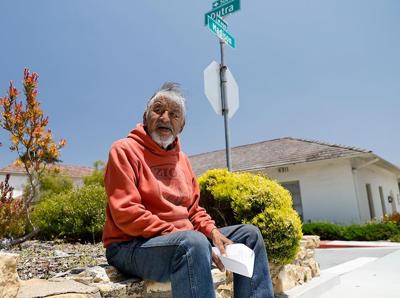

Before the Spanish built the mission system over 250 years ago, Indigenous people lived in villages across Monterey County, including what is today Monterey. One of these sites is the 600 block of Dutra Street, a longtime home to Esselen/Southern Ohlone families. Since 1959, the site has been known as El Cuartel, or the Monterey Police and Fire Public Safety Complex. Made into a parking lot during the City’s expansion in the 1950s, the block was never recognized as Indigenous, but that may be about to change.
On June 17, the Monterey City Council is scheduled to vote on a proclamation “apologizing to the Indigenous people of Monterey” and acknowledging “historic injustices toward Native American populations.” Details about more specific language are still being negotiated.
While the Dutra Street site has been permanently altered, Karen Brown, a retired Monterey librarian, had an idea how to correct the past and in May 2024 submitted her research to the Council, suggesting some form of reparations. She identifies Dutra Street as perhaps a remnant of the Esselen village of Achasta, “the last refuge.”
Brown was able to document “official ownership of property in the 600 block of Dutra Street next to Hartnell Creek by Indigenous people for over 100 years, beginning in the 1840s (back when it was still legal to enslave Native Americans), through 1956 and ’57 when the City of Monterey urban renewal efforts took the property.” Under the authority of the City Council, the land was taken by eminent domain to put in the police and fire stations, and parking.
Acquired primarily through inheritance and gifts, particularly from women married to early settlers like De La Torre, Dutra and Machado, the land comprised numerous residences leased to both relatives and other families. In 1956, the Machado and Torres families, along with their descendants, were bought out, directly impacting approximately 50 Indigenous individuals. (Records lack details regarding those who were displaced.)
Rudy Rosales grew up on Dutra Street and was displaced in the city’s eminent domain proceedings. Former chair of the Ohlone/Costanoan-Esselen Nation, Rosales has long been advocating for a plaque describing the history of the site and the families that once lived there.
To Rosales, the formal apology ends a year of effort to recognize sites in Monterey that used to be home to Indigenous people. “I’m happy with the proclamation,” he says.
That said, Brown and another person engaged in the effort, anthropologist Philip Laverty, would like to push for further edits of the text, which was originally scheduled for a vote on June 3. Laverty, whose doctoral dissertation was on the displacement of local Indigenous people in the 1950s, hoped the proclamation would concentrate more on displacement through eminent domain and the specific event in 1956-1957. “It’s profoundly significant that those communities survived,” he says. “Apology is a good place to start.”


(2) comments
Can the same be said of the people of London. Their homeland is being yanked out of their hands.
Thank you to Karen Brown, Philip Laverty, Rudy Rosales, and others, for your enduring efforts to secure this and other recognitions. Our families were born, lived, and died on Dutra Street and in surrounding areas. We are the survivors and descendants of survivors. Our resilience will continue to carry us through the challenges of time and circumstance.
Welcome to the discussion.
Log In
Keep it Clean. Please avoid obscene, vulgar, lewd, racist or sexually-oriented language.
PLEASE TURN OFF YOUR CAPS LOCK.
Don't Threaten. Threats of harming another person will not be tolerated.
Be Truthful. Don't knowingly lie about anyone or anything.
Be Nice. No racism, sexism or any sort of -ism that is degrading to another person.
Be Proactive. Use the 'Report' link on each comment to let us know of abusive posts.
Share with Us. We'd love to hear eyewitness accounts, the history behind an article.