
Sara Rubin here, fresh off a hike to one of my favorite destinations in the Ventana Wilderness, where human palms are painted in elegant white stripes on a rocky ledge above Church Creek. These Esselen paintings remain mysterious in their intent, a remarkable window into another time. As 20th century poet Robinson Jeffers wrote in “Hands” in 1929: “…over the division of years these careful / Signs-manual are now like a sealed message / Saying: ‘Look: we also were human; we had hands, not paws.’”
The paintings are unique in Esselen territory, but they align with the expectations I have in general of Indigenous artwork—rock paintings and etchings from generations past. I’ve been trained to look and see archeological sites from hundreds or thousands of years ago as a window into Indigenous cultures.
At first glance, I don’t see downtown Monterey as such a window, certainly not downtown Monterey of the middle of the 20th century. But retired Monterey librarian Karen Brown is encouraging Monterey City Council (and the public at large) to expand our perspectives about what Indigenous history looks like.
In a paper written in May, Brown lays out some of the history, the broad strokes of which are likely familiar. Before Spanish missionaries settled in the area, the Esselen people lived in a series of villages in the region, including Achasta in what is now the city of Monterey. Over generations of dispossession, these villages—along with language and identity—were whittled away. But in urban Monterey on Dutra Street, just behind Colton Hall, “perhaps a remnant of the Esselen village of Achasta became a last refuge.”
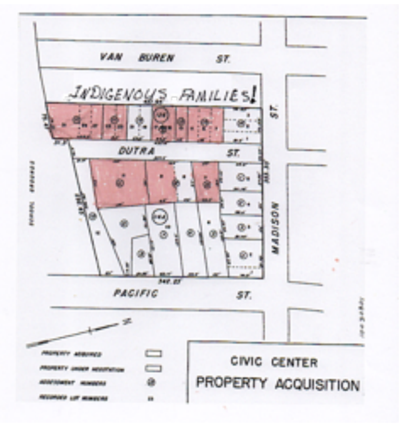
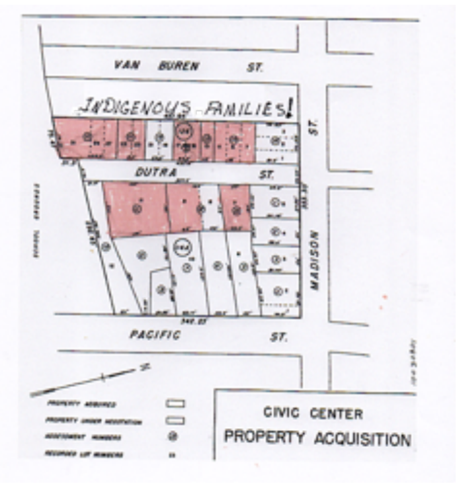
Brown is bringing attention to the 600 block of Dutra Street because documentation shows there was consistent Indigenous property ownership since at least the 1840s until the City of Monterey in 1956 claimed this property for an expanded City Hall operation, home to the police and fire departments (a property known as El Cuartel) and parking lots. In eminent domain proceedings, Brown reports Indigenous residents received payments of $3,500-$5,600, while other neighborhood residents received up to $30,000.
“To understand the significance of the loss of the Hartnell Creek portion of Dutra Street, we need to understand it as more than a city block, numbers on a dirt road and on a map,” Brown wrote. “Instead, we must see it as a neighborhood, a community, and even (as I dare to call it) a ‘village.’”
It isn’t an artifact of a long-ago habitation—it was continuously inhabited by Indigenous families until the middle of the last century, including people who are still living today, even as a modern city sprang up around them. (One such resident, Esselen tribal leader Rudy Rosales, joined Brown in addressing Monterey City Council on May 7.)
Brown is asking for some acknowledgement. Her suggestions include a public discussion at City Council, a public apology, the return of a nearby piece of land to a tribal entity, an educational display and/or plaque acknowledging the history, or financial reparations to descendants.
At the end of the meeting, City Councilmember Kim Barber requested the council agendize a formal conversation about the Dutra Street Village. The history, of course, cannot be changed, but the future acknowledgment of past wrongs can be.

(0) comments
Welcome to the discussion.
Log In
Keep it Clean. Please avoid obscene, vulgar, lewd, racist or sexually-oriented language.
PLEASE TURN OFF YOUR CAPS LOCK.
Don't Threaten. Threats of harming another person will not be tolerated.
Be Truthful. Don't knowingly lie about anyone or anything.
Be Nice. No racism, sexism or any sort of -ism that is degrading to another person.
Be Proactive. Use the 'Report' link on each comment to let us know of abusive posts.
Share with Us. We'd love to hear eyewitness accounts, the history behind an article.