When great American directors are an endangered species, die-hard cineastes tend to desperately cling to the auteurs in their midst.
Like Martin Scorsese or Robert Altman, Terrence Malick is one of a dwindling supply of true visionaries who even in their failures give us a taste of their greatness and send critics scrounging for the crumbs of what might have been. Because Malick’s film output has been especially small, critics tend to pounce on each new offering with even greater vigor.
The New World is one such film, instantly identifiable as a Malick work, but a disappointing retreat from the promise shown in his 1973 masterpiece Badlands, and the flawed brilliance of his subsequent films Days of Heaven (1978) and The Thin Red Line (1998).
Like his other works, The New World is founded on stillness and internalized emotions, which Malick conveys through exquisite cinematography and a nearly religious faith in pictorial storytelling. The film has a heavy quiet that favors the sound of birdcalls and wind, while giving a heady impression of the difficulty and grandeur of the undomesticated new world of 1607 Virginia.
Malick’s fixation is an archetypal virgin American landscape that in The New World indicates a promise and potential squandered. Even more than in his other films, the America of The New World is an Eden of humankind and nature’s coexistence. That is, until the British set their muddy footprints on its beachhead and spoil it forever.
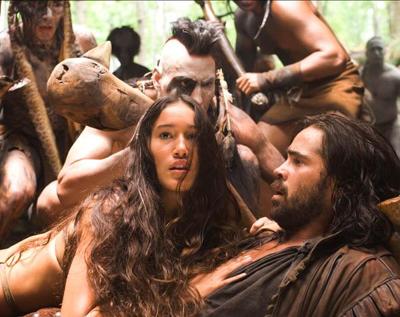
Capt. John Smith (Colin Farrell) arrives already branded a rebel, having been locked in his ship’s bowels for mutiny. This child of nature (as conveyed by his long hair and unbuttoned shirt) exists outside the laws of civilization and therefore takes quite naturally to his kindred spirits—the “Naturals” who capture him in the swamps when he is separated from his men.
But Smith’s surrender is sweet. Along with “imprisonment” comes a doe-eyed, slender Indian princess, the celebrated maiden Pocahontas (Q’Orianka Kilcher). She takes a warranted shine to the beefy Jamestown exotic, whose brown eyes mist equally for the virgin land and Pocahontas.
Capt. Smith and Pocahontas spend rapturous intervals bounding like antelope through tall grass and tumbling like frisky kittens in increasingly awkward. Their paradisiacal frolics are contrasted with the knee-deep muck and misery of the Jamestown settlement where Gummo-esque children run wild and the compound’s soaring walls appear to keep life itself at bay.
But by the film’s second half, Smith has, in the vernacular of chick lit, “changed” and is called away on a new mission by his fickle empire. A freshly domesticated and Europeanized Pocahontas turns to the less hunky, more reliable settler John Rolfe (Christian Bale).
Many will find civilization a relief after Malick’s endless gambols through the brush. His austere visual poetry lapses too often into pretense and an airless prettiness as the camera lingers over Kilcher’s fawn-like form and Mother Earth’s equally ripe charms. The inert, muddled voice-over expressing the characters’ inner thoughts also becomes increasingly hard to bear. Plodding, often excruciating, the narration blends the tortured cadences of a middling 17th-century scribe with New Agey koans.
The New World is beautiful but disappointingly empty, and will leave many hungering for more.
THE NEW WORLD (3 stars)
Directed by Terrence Malick.
Starring Colin Farrell, Q’Orianka Kilcher and Christian Bale.
(PG-13, 150 min.)
At the Century Cinemas Del Monte Center.



(0) comments
Welcome to the discussion.
Log In
Keep it Clean. Please avoid obscene, vulgar, lewd, racist or sexually-oriented language.
PLEASE TURN OFF YOUR CAPS LOCK.
Don't Threaten. Threats of harming another person will not be tolerated.
Be Truthful. Don't knowingly lie about anyone or anything.
Be Nice. No racism, sexism or any sort of -ism that is degrading to another person.
Be Proactive. Use the 'Report' link on each comment to let us know of abusive posts.
Share with Us. We'd love to hear eyewitness accounts, the history behind an article.