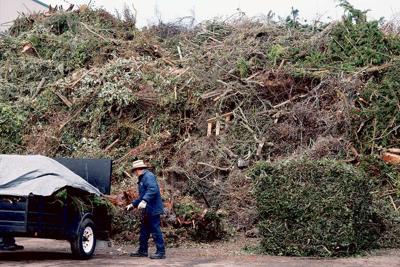

The truckloads of wood and brush just didn’t seem to stop coming March 4 to the Marina landfill. By the end of the day, 150 tons of yard waste had rolled through its gates, the equivalent of 15 garbage trucks. It was the largest single day of green waste disposal in the 65-year history of the dump.
Since a massive storm hit Monterey County Feb. 17-21, the tonnage numbers racked up by the landfill are staggering: 7,580.83 tons of green waste between Feb. 18-March 4, the equivalent weight of more than 2,500 Asian elephants and a 181-percent increase over the same time period last year, according to Jeff Lindenthal, Monterey Regional Waste Management District’s director of communications and sustainability.
“We’re having trouble chipping it fast enough,” Lindenthal says. The district is making plans to bring a new state-of-the-art wood chipper online in the coming weeks to help with disposal. In the meantime, the landfill’s on-site composter, Keith Day Company, is helping grind up surplus debris.
With even more tree and brush debris expected, officials are struggling to meet demand and dispose of it quickly – without causing damage to the environment. A prime example is in Prunedale, where hundreds of eucalyptus, pine and oak trees fell, and where it’s common practice to burn tree debris.
But smoke from burning debris in the many canyons of North County could pose a serious health risk, says Richard Stedman, air pollution control officer for the Monterey Bay Air Resources District. Soon after the storm, Stedman began investigating how to get wood-chipping equipment to Prunedale.
“We don’t have the financial resources to service the whole county,” Stedman says. “We’re trying to target this so we get our biggest bang for the buck.”
He’s taking a budget proposal March 15 to the air district board, seeking approval to pay for the wood-chipping program. He originally planed on asking for $25,000, but now expects he’ll need $100,000 – for Prunedale alone.
And then there’s the issue of what to do with the wood chips. While some residents may want to spread chips directly on their properties, any leftovers will have to go to the already-stressed landfill, which could cost more.
Waste management district officials are talking about whether to accept storm debris as disaster waste, and waive the cost. (The fee for green waste is $30 per ton, compared to $51.75 per ton for solid waste.)
The chips at the landfill are composted and sold as mulch. The composting process, which is designed to sterilize the chips and kill any potential diseases like pine pitch canker or sudden oak death, will neutralize any tannins in eucalyptus wood – highly prevalent in Prunedale – that might damage other plants, Lindenthal says.
The air district is also contemplating how to get rid of debris that flowed down the Salinas River, washing up on surrounding agricultural land. The presence of invasive plants means that debris will have to be burned, rather than chipped and used as mulch; plans are underway to incinerate it onsite.
For Stedman, February’s storm and the colossal debris effort is just a trial run for what’s to come in the future.
“With climate change, we expect to have more of these storms,” he says. “This will probably be the mainstay of the future.”



(0) comments
Welcome to the discussion.
Log In
Keep it Clean. Please avoid obscene, vulgar, lewd, racist or sexually-oriented language.
PLEASE TURN OFF YOUR CAPS LOCK.
Don't Threaten. Threats of harming another person will not be tolerated.
Be Truthful. Don't knowingly lie about anyone or anything.
Be Nice. No racism, sexism or any sort of -ism that is degrading to another person.
Be Proactive. Use the 'Report' link on each comment to let us know of abusive posts.
Share with Us. We'd love to hear eyewitness accounts, the history behind an article.