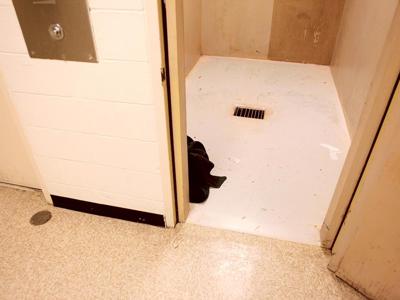

Lara Gillis was walking in and out of traffic on Reservation Road near CSU Monterey Bay last Dec. 4 when Marina police arrested her on suspicion of being under the influence of a controlled substance and resisting arrest. They took her to Monterey County Jail, where she was placed in what’s called a “safety cell,” a rubber-padded room without a bed, sink, toilet or natural light.
Gillis, a mother who had battled drug addiction, spent a day in that cell without having her vital signs taken by jail medical staff and without receiving any medical care. Her last moments of consciousness took place in that cell – she was finally removed from it 27 hours after being placed inside, after she became completely unresponsive.
She was then taken to Natividad Medical Center, where she died three days later. Her family says her brain activity ceased and her liver failed within a day after arriving at the hospital.
How the jail uses those safety cells, where inmates have only a hole covered by a grate in which to urinate and defecate and where they are completely reliant on sheriff’s deputies for care, is one of a number of problems a lawsuit filed by a group of inmates against Monterey County wants to fix. The suit over health and safety issues was filed three years ago, and settled in May 2015 with an agreement from the county that changes were coming.
Those changes have been slow to arrive, and new allegations about inhumane conditions are coming to light, according to a brief filed April 1 by plaintiffs in the case.
With an amended plan – one that requests additional changes – to improve conditions at the jail, the plaintiffs are asking the court to promptly force the county to make the changes. They’re also asking the court to assign third-party monitors to ensure improvement in key areas – mental health, dental, disability access and medical – are being made. In the meantime, the county says in court documents it continues to work on improvements and that it would be “unwise for the county to spend money, only for the plans to be changed later,” as it continues a modernization effort that includes a multi-million dollar jail expansion.
But some changes are pressing, as evidenced by the Gillis case.
According to that April 1 brief, plaintiffs’ experts including physician Robert Cohen, a specialist in the field of correctional medicine, toured the jail in April 2015 and noted findings ranging from “appalling” conditions of safety cells and “life-threatening” medication errors.
Gillis appears to be a victim of some of the jail’s systemic inadequacies, according to court documents. News of her death also came long after the case was settled in court and the county vowed to make improvements.
When housed in a safety cell, inmates are dependent on jail staff to get food, water, exercise or showers. A 2013 audit revealed some inmates went without water for long periods of time.
The experts say these rooms appeared to not be regularly scrubbed and sanitized from feces, and that food and garbage littered the floor where inmates are supposed to eat, sleep and sit. The average stay inside these cells is reported at 30 hours. But some inmates have been lodged in these rooms for days, sometimes weeks.
The longest stay reported was 29 consecutive days.
The plaintiffs’ experts recommend no inmate should stay in those cells more than 24 hours over a period of three days, and if placed there, inmates should be psychologically and medically evaluated within 15 minutes of being placed inside.
Sheriff’s Office Cmdr. John Thornburg declines to comment on Gillis’ case, but says her autopsy has been completed.
While no inmate has died in a safety cell, “these punitive and unsanitary spaces are used excessively by jail staff as a suicide precaution, rather than an emergency placement for inmates who need quick medical or mental attention,” according to court documents. One of the plaintiffs’ experts notes the rooms have become a “warehouse for arriving inmates.”
Among the changes the county made to its facility has been the rehabilitation of these cells, but plaintiffs argue that just because they’re cleaner doesn’t mean inmates should be left in them for extended periods of time, without attention.
Also alleged by plaintiffs’ experts is that the poor conditions of the rooms “exacerbate the risks of suicide by discouraging inmates from reporting suicidal ideation to avoid being moved to such intolerable conditions.” Suicide prevention is a big focus in the jail’s reform.
Last year, the suicide rate at the jail jumped to seven times the national average when three inmates killed themselves. On top of those suicides, three other inmates died while in custody.
That total of six inmates who died last year is one of the highest death tallies ever recorded at the facility.
The plaintiffs’ experts also noted dangerous errors when administering medication to inmates. At the jail there are no pharmacists, which is one of the change being requested by plaintiffs and one the county has not enforced. There have been documented instances of pills getting mixed up in the process of handling stock bottles. Some of the errors include finding schizophrenia drugs in bottles containing heart medication, and anticonvulsant pills inside containers that are supposed to contain mood-stabilizers.
In earlier hearings, the court said it wanted to address conditions at the jail quickly. Despite the intent, currently there is no timeline for a court ruling on when improvements should be made.



(0) comments
Welcome to the discussion.
Log In
Keep it Clean. Please avoid obscene, vulgar, lewd, racist or sexually-oriented language.
PLEASE TURN OFF YOUR CAPS LOCK.
Don't Threaten. Threats of harming another person will not be tolerated.
Be Truthful. Don't knowingly lie about anyone or anything.
Be Nice. No racism, sexism or any sort of -ism that is degrading to another person.
Be Proactive. Use the 'Report' link on each comment to let us know of abusive posts.
Share with Us. We'd love to hear eyewitness accounts, the history behind an article.