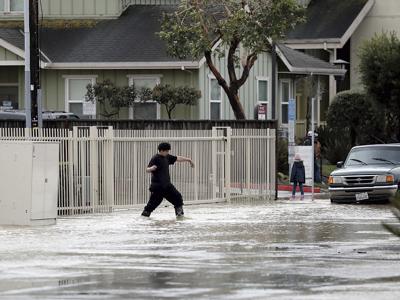

On Oct. 2, about a year-and-a-half after the Pajaro River levee failed, flood agencies broke ground on the long-awaited Pajaro River Flood Risk Management Project. The five-year, $599 million project sets out to protect the river valley and its tributaries from 100-year storms, by constructing stronger levees and working on improvements to the area.
Following the celebration, the environmental watchdog group LandWatch commissioned a report from EcoDataLab – a consortium of universities that applies data science to scale up climate and sustainability solutions – to get a better sense of whether the levee improvements would protect potential housing development within the floodplain.
The resulting Pajaro River Flood Risk Report, released earlier in October, focuses on whether the project’s design sufficiently accounts for future climate impacts, assessing the area under both typical and extreme weather scenarios.
The report concludes that, with proper levee maintenance, the area is suitable for housing development. It states that the Flood Risk Management Project is expected to significantly reduce annual flood risk, “providing resilience even against a 1-in-500-year flood for the entire town of Pajaro and most of Watsonville.”
Could this be good news for unincorporated Monterey County, which the state determined needs to plan for 3,326 new homes by 2031?
“People are still going to have to get flood insurance, and we all know what’s happening with flood insurance premiums because of places outside of California,” says Michael DeLapa, executive director of LandWatch.
Floodplains are typically never a good idea for new housing developments in the long term, especially if these areas add to commute times for residents (i.e carbon emissions from driving), or are in high-risk fire areas, according to LandWatch.
But the net benefits might outweigh the costs with the new levee plans, offering security for an area like Pajaro which is situated near public services like schools, hospitals and local businesses.
“I think on measure, some housing there is probably a good thing,” DeLapa says.
In the past year, two controversial farmworker housing projects have moved forward in Pajaro: one, owned by Rio Vista Group LLC, has already been built; the other, owned by Anthony Nicola, received approval in September.
More than $1.3 million in funds have been distributed to Pajaro residents and businesses over the past six months to address impacts of the 2023 flood, according to the County of Monterey. And while some of the 3,000 residents in the rural community moved elsewhere, rent elsewhere can be much higher.
In the midst of fatigue surrounding a history of poor construction coupled with deferred maintenance of the levee, the Pajaro River Flood Risk Report may temper some concerns about building in the floodplain, but not all.
“We wanted to be as objective as possible about it and say, ‘OK, here’s what the models say, here’s what the climate impacts say,’” DeLapa says. “Looks pretty good. But there are these other risks that you need to always keep into account.”




(1) comment
Typical response from MCN, rather than celeberate a community that can now withstand potential flooding and may finally have the infrastructure they need, the reply is--yes, more housing!
Welcome to the discussion.
Log In
Keep it Clean. Please avoid obscene, vulgar, lewd, racist or sexually-oriented language.
PLEASE TURN OFF YOUR CAPS LOCK.
Don't Threaten. Threats of harming another person will not be tolerated.
Be Truthful. Don't knowingly lie about anyone or anything.
Be Nice. No racism, sexism or any sort of -ism that is degrading to another person.
Be Proactive. Use the 'Report' link on each comment to let us know of abusive posts.
Share with Us. We'd love to hear eyewitness accounts, the history behind an article.