For years, fall brings a familiar kind of smell in Marina. Sometimes it’s the essence of a hot, starchy vegetable wafting through the neighborhoods, sometimes it’s a water holding pond that turned septic. Over the years, Marina Mayor Bruce Delgado and County Supervisor Wendy Root Askew have hosted multiple town hall meetings to discuss the issue, which trends during fall and winter as wind patterns and temperatures trap the smells closer to the ground.
“As complaints come in, the sources of those odors are doing their level best to address those issues,” Richard Stedman of Monterey Bay Air Resources District said at a July 7 town hall meeting. “What we’ve seen is [the smell] gets worse when the weather gets really bad or we get warm, humid weather.”
While not all odors can be controlled, some can.
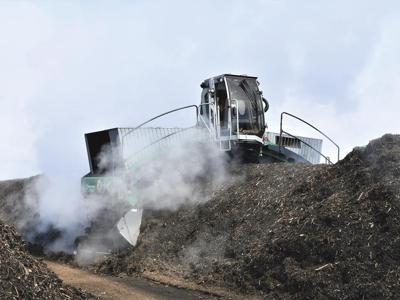
ReGen Monterey, which operates a landfill, recycling and composting facility, is one of many industrial operations in the area that contribute to the stench. The agency is investing $8.7 million in a new composting system, partially supported by a $3 million CalRecycle grant and an additional $1 million investment from compost operator Keith Day. The project will transition its composting operation to a system known as CASP, or Covered Aerated Static Pile.
The new system aims to reduce both odors and emissions while shortening ReGen’s composting process (for residential green waste) from 90-120 days to approximately 30 days.
For decades, ReGen has used a process called windrow composting, which involves separating the organic material into long rows (windrows), and using heavy machinery to turn the rows every few days.
The new system will cover the organic material with a membrane and use automated technology to manage airflow, temperature and irrigation simultaneously. This process will help materials break down more efficiently, and capture gases and odors before they release, and cut down the need for diesel-powered equipment.
Construction began in May and is expected to be completed by year-end.
“Composting operations have increased due to state requirements to divert organics out of landfills, so there is potential for composting odors to increase,” Delgado says. “This all makes it important and timely to take action to reduce compost odors that can affect Marina residents. CASP is an expensive but needed project.”



(0) comments
Welcome to the discussion.
Log In
Keep it Clean. Please avoid obscene, vulgar, lewd, racist or sexually-oriented language.
PLEASE TURN OFF YOUR CAPS LOCK.
Don't Threaten. Threats of harming another person will not be tolerated.
Be Truthful. Don't knowingly lie about anyone or anything.
Be Nice. No racism, sexism or any sort of -ism that is degrading to another person.
Be Proactive. Use the 'Report' link on each comment to let us know of abusive posts.
Share with Us. We'd love to hear eyewitness accounts, the history behind an article.