

Before arriving in Monterey County, Dan Baldwin led a community foundation in Iowa. “One thing that was so refreshing when I came to CFMC was a willingness to be entrepreneurial,” he says. “In Cedar Rapids, there was concern about staying in your lane. Here there’s a willingness to be a little bit more of a risk-taker.”
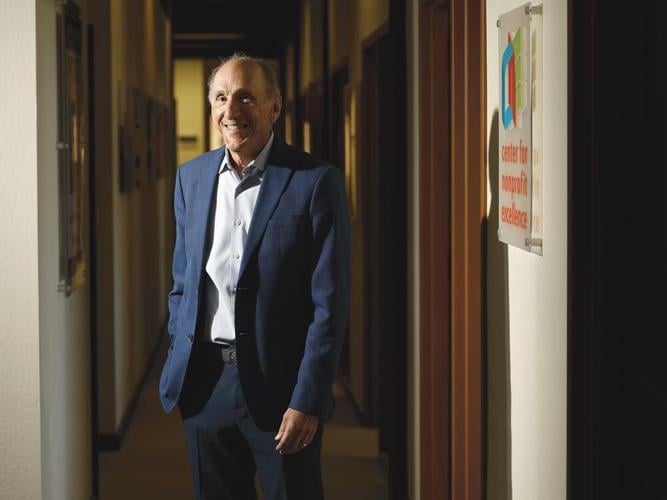
AFTER 16 YEARS AT THE HELM, Dan Baldwin, president/CEO of the Community Foundation for Monterey County, will pack up his office and begin his retirement Dec. 15.
Previously, Baldwin spent 15 years as a museum professional and then ran the Greater Cedar Rapids Community Foundation before landing in Monterey in 2010.
He’s an Iowa native with a bachelor’s degree in English and a master’s in nonfiction writing from the University of Iowa, married to author and artist Anne Ylvisaker. They share three children.
Under his leadership, the Community Foundation for Monterey County’s assets grew from $130 million to $450 million, and its charitable funds went from 300 to more than 900. Monterey County Gives! – a project in which the foundation, the Weekly and the Monterey Peninsula Foundation, are partners – grew from $565,000 raised in 2010 to more than $17.2 million in 2025.
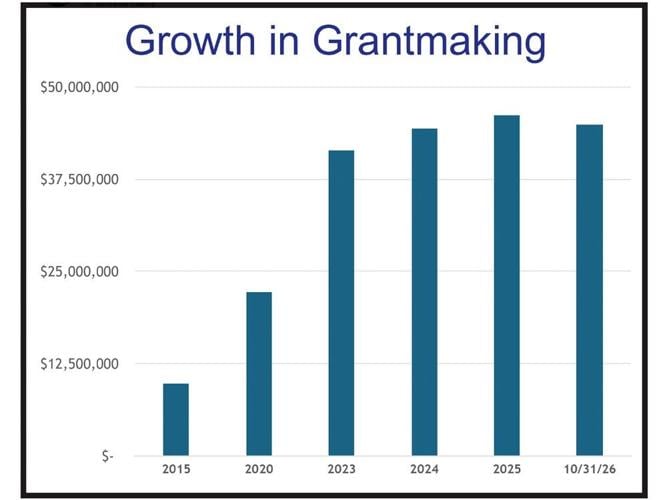
Baldwin says a foundation should be measured by what it gives away, not by its assets. In 2025, the foundation granted a record $46.2 million.
Weekly: You first punched a time clock at the age of 16. What did you learn early on?
Baldwin: In one of my early jobs, I worked for an engineering company that did test borings and I ran a drill rig; we had these augers to take core samples. I wasn’t really aware of it then, but looking back on it I learned about work ethic, to work hard, and that not everything’s easy. People showed confidence in me and gave me responsibility on very expensive equipment.
Have you ever been fired from a job?
Yes. At 29, I was living in Dallas, Texas at the time. It was a company that fired everyone at one time or another. They would manufacture all these flimsy reasons, and then they would bring someone in and pay them a little bit less than they were paying us. It was a pretty traumatic moment, but there was the silver lining. I found a job doing publications and programs at an outdoor history museum, and that launched my next career, a museum career.
I’ve heard more than once that you love taking a red pen to someone else’s writing who works for you. What’s your best advice to a writer?
It’s not just a single thing. Know sentence structure and grammar, get that part right, because people can be judged by not having a complete understanding of the fundamentals.
I like writing that feels like it’s really moving. Run with momentum; get your idea and then get it moving.
John Steinbeck’s writing breaks the rules. I can imagine that if you had been his editor, he would have been very unhappy with you.
I don’t think I would have touched a darn thing. I revere Steinbeck, and Steinbeck had a huge influence on me in my appreciation of good writing.
Do you have a favorite word these days?
This would be a little ironic. One of my favorite words is nomenclature.
What do you like about that word?
It’s chewy. Words create nuance. They create special meaning. And in nomenclature, what I like about it, it’s specific.
An interesting choice of words these days, because nuance is being lost. What does the Midwest do better at giving-wise than California? And vice-versa.
My immediate thought is, really nothing. I mean, not everyone is really generous, but there’s a level and a spirit of philanthropy here, and a real recognition that our nonprofits just aren’t feel-good kind of operations. They are delivering much-needed services in ways that, frankly, local or county government cannot.
Lynn County, Iowa, has publicly traded companies there. So people [who live and work there] have had a lot of stock options, and there were a lot of management levels for big corporations. Here are mostly dynastic farm families. The other thing that’s different here, is that the value of real estate is so much higher here so gifts can be made that utilize that real estate.
Do you find yourself more of a Midwesterner at this point in your life or more of a Californian?
I’m a Monterey person. When I came to work here, we were getting a lot done, and the board leadership kept talking about my “Midwestern work ethic.” Maybe there is something to that.
One of my kids is a trans man, and here is simply normalized whereas Iowa passed the first anti-trans bill in the country. I just feel way more aligned in this state than I did there.
You’ve had the experience of having many one-on-one meetings with some of the wealthiest individuals in this county, and also worked on programs helping the poorest. What have you learned across all of that?
It’s a real part of the joy of the job. When you can find the common ground with people, work with those whose politics don’t align with mine, we find there’s something that they want to support. We don’t have to agree on all of the mechanisms of how government works, or how society ought to operate, but we can certainly find the common ground on things that are important.

This graph shows the growth in grantmaking by the Community Foundation for Monterey County since 2015. The green bar at right shows 2026 grantmaking as of Oct. 31.

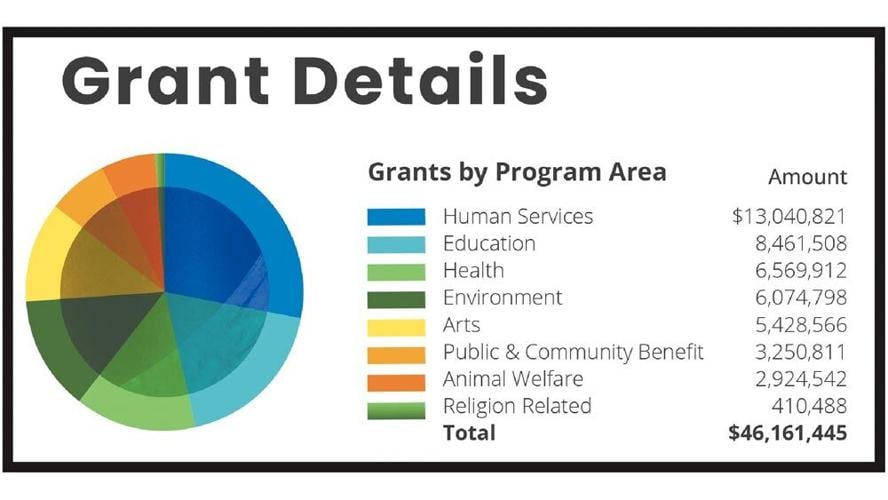
This pie chart below shows the breakdown for subject areas of grants made in 2025, with most going to human services.
When your retirement was announced, you told our reporter at that you’re “very self conscious being described as a community leader.” What did you mean?
I don’t describe myself as a leader. What I mean is, I like to have a vision, and I like to bring ideas to the table. Oftentimes, it’s a table that I’ve created, and there’s no question that my position gives me a certain amount of leverage to affect things that not everybody can. It’s a privilege, not everybody gets that opportunity. Sometimes you have to rally people around [an idea], and it fits some definition of leadership.
I’m describing myself as somebody who just tries to get stuff done, to show a little more humility, and think more about what it is we’re trying to accomplish together, rather than glorify ourselves.
You can lead, but you don’t have to be out front all the time. Really, what leadership is about is allowing other people to succeed. I recoil when I get described as a leader – none of us do anything on our own. I think a lot about encouraging others to think and be creative and be the best, bring out the best that they can. If [we] do that collectively, within a shared goal, we’re able to accomplish big things.
What is your definition of generosity?
Always be ready to help others, because you’re going to be in that situation sometimes, whether it’s because of your age, some infirmity, something to do with your financial situation, whatever it might be. You’re going to want others’ help at the right time.
I’ve gotten to the point now where I’m not judgmental [about] people who don’t give. I just realize it’s just not in their DNA. Sometimes something happens in their life that compels them, they think that they’re impervious to stuff, and whether it’s a disease in your family or mental health, and then they realize that there are all these [services] that are created by philanthropy, and then they may want to participate.
But I just don’t lose sleep over the people that don’t give, and I spend my time encouraging those that want to.
Andrew Carnegie is a very controversial historical figure because he became rich on the backs of the steelworkers, many of whom worked 24-hour shifts once a week. And, he was wildly generous, opening more than 1,000 public libraries. One of his famous sayings was that people should die poor. Do you have a philosophy about giving?
I grew up a half a block from a Carnegie library in Manchester, Iowa.
The answer is, what’s right is what’s right to you. All family dynamics are different. People have different motivations.
What advice would you give someone in their 20s, who’s starting a career today?
I get asked, how did I get this job, how did I end up being the CEO of a Community Foundation? My answer is that it’s just a byproduct of curiosity. And so my advice: Everybody’s geared to be able to do this, but you don’t have to find some cookie-cutter approach to how your life and your career is going to manifest or grow. When something’s interesting to you, you’ll know. The main thing is just stay curious, and let that curiosity guide you – on a journey that’s going to be very gratifying.
Congratulations on your upcoming retirement, after 50-plus years in the work world. What do you think you’ll miss the most about going to work every day?
As CEO of the Community Foundation, we let people know what we do, and then hope that it aligns with what their interests are, what’s going on in their life. We have things come up that are very, very interesting. We just sold two manufactured home communities, mobile home parks, in the state of Washington, as part of a gift. I’m going miss stuff like that. I’m going to miss the next complicated thing that I have never encountered. I mean, what did I know about mobile home parks, right? I didn’t know anything. And now, believe me, I know a lot about them.
It’s taking those opportunities, those complex assets, those complex situations, and working through them – and then seeing that get converted to philanthropic assets, then seeing those philanthropic assets go to work. That’s what I’m going to miss.
Is there some aspect of your work you’re not going to miss?
I don’t mean to overstate it, but the weight of that responsibility. Plus it’s just the grind. I’ve been a CEO of either a museum or a community foundation since 1992. I calculated once the number of board meetings or executive committee meetings that I’ve attended; it’s something like 400. Every one of them required an agenda, and it required a packet, and it required working in advance with the board chair. There’s a certain grind to that. It’s necessary, it’s part of the job, and that’s how organizations function really well. I’m just kind of exhausted a little bit.
I hope I’ll always maintain curiosity. I just want to stay curious.
Thank you for the partnership of Monterey County Gives! The 2026 campaign kicks off Nov. 12. On the day that you step away from your desk we’ll have surpassed $100 million raised and donated for the community – a remarkable milestone.
It’s been a tremendous run, and I think we both agree that it’s exceeded both our expectations. We created a platform and people took advantage of it, and I think that’s fantastic, and it’s just going to continue on.
(0) comments
Welcome to the discussion.
Log In
Keep it Clean. Please avoid obscene, vulgar, lewd, racist or sexually-oriented language.
PLEASE TURN OFF YOUR CAPS LOCK.
Don't Threaten. Threats of harming another person will not be tolerated.
Be Truthful. Don't knowingly lie about anyone or anything.
Be Nice. No racism, sexism or any sort of -ism that is degrading to another person.
Be Proactive. Use the 'Report' link on each comment to let us know of abusive posts.
Share with Us. We'd love to hear eyewitness accounts, the history behind an article.