

Seymour Grey harvesting material to render his new candles.
IMAGINE BEING IN A CAFE SOMEWHERE IN MONTEREY COUNTY, ordering a coffee and croissant. After receiving both, you sit down at a table to read a newspaper, perhaps, or engage with your digital device. And before you take your first sip of coffee, you notice the lid is slightly opaque, and has the word “compostable” on it.
When you’re finished with both your coffee and croissant, you notice the cafe has three different waste bins – one each for trash, recycling and compost. A picture above each bin shows what types of items go into it, and for the compost bin that includes paper plates and cups, wooden stir sticks, napkins, compostable lids and cutlery, and food scraps.
As someone who strives to be eco-conscious and informed, you chuck it all into the compost bin, but wonder: Why can’t I throw any of these items, aside from food waste, into my curbside green bin at home? (They cannot go into the recycling, either.)
If this seems confusing, you’re not alone, and you’re not to blame: There are companies that fuel their profits by sowing that confusion.
People who do understand “what goes where” include those who work in the local waste management industry, and they are fighting an uphill battle against a single-use product consumer culture that has become the norm in America, and much of the world, over the last half-century.
This is a paradigm that some corporations have a vested interest in maintaining, but others, like local waste management districts ReGen Monterey and Salinas Valley Recycles – which collectively serve the whole county – are trying, along with environmentalists, nonprofits and state regulators, to battle against.
And in this battle, the stakes are high: Food waste that goes into landfills, or is left to rot, accounts for approximately one-sixth of global greenhouse gas emissions. And in America, about 38 percent of our food supply, per data from 2021, is wasted – it’s low-hanging fruit that, instead of being picked and eaten, just falls to the ground.
Or worse, it goes into a landfill and emits methane, a greenhouse gas more than 25 times as potent as carbon dioxide, and which is created by things decomposing in an anaerobic environment. According to CalRecycle, 20 percent of the methane emitted in California comes from decomposing organic matter in landfills.
It is for this reason that California enacted Senate Bill 1383, which then-governor Jerry Brown signed into law in 2016 and which, starting in 2022, requires every jurisdiction to provide a service to collect organic waste – including food waste – so that it can be turned into end products like compost or natural gas.
How many Monterey County residents are utilizing that service so far remains an unknown, though people are creatures of habit, so it’s fair to say many are not – just look down the street in a residential neighborhood on trash pickup day and, depending on where you live, you might notice some households don’t even put out a green bin on the curb. Some still don’t even put out a recycling bin. Change is hard.
So it’s fair to ask, just over a year after SB 1383 went into effect: How are we doing? And where are we going?
The answers, like nearly everything related to waste management, are complicated.

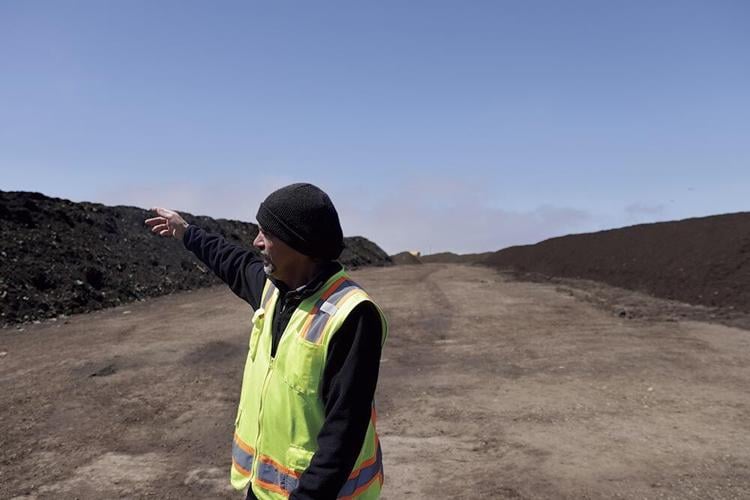
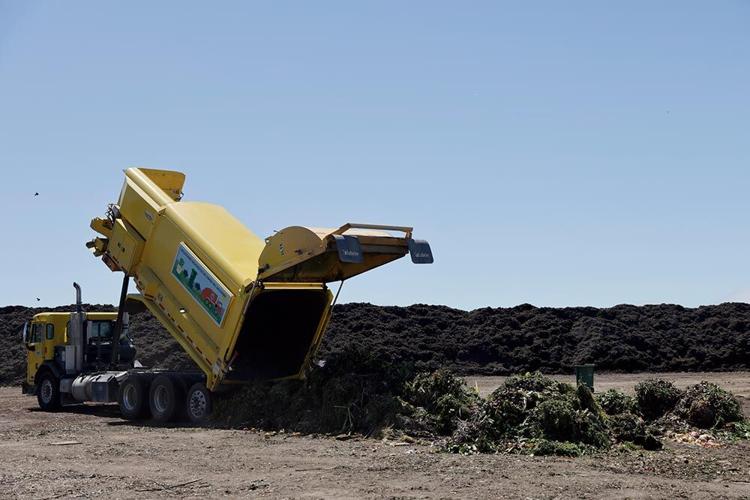
Top: Michael Brautovich manages the composting operation at ReGen Monterey. Below: A hauling truck dumps a fresh load of green waste on the ground; the load will soon be covered with other material to prevent scavenging by seagulls.

IT’S A WINDY SPRING AFTERNOON as Michael Brautovich, who manages the compost operation at a 45-acre site at ReGen Monterey’s facility in Marina, leads the way through rows of organic material – mostly – in the process of breaking down.
Thermal activity is a key factor in the process. These rows have to maintain a minimum temperature of 131 degrees fahrenheit in order to kill off E. coli and salmonella. The heat also accelerates the decomposition of the organic matter.
Near where Brautovich starts walking are piles of cut, downed trees from winter storms, representing about a 30-percent increase over a normal year. It is all self-haul waste, predominantly trees and yard trimmings, and it awaits a trip into a grinder.
Next is a row from the commercial stream that comes from restaurants, cafes, grocery stores and special events. It’s visibly contaminated with pieces of plastic bags and plastic cutlery – some of which might be bioplastic, made from plants, which is theoretically compostable.
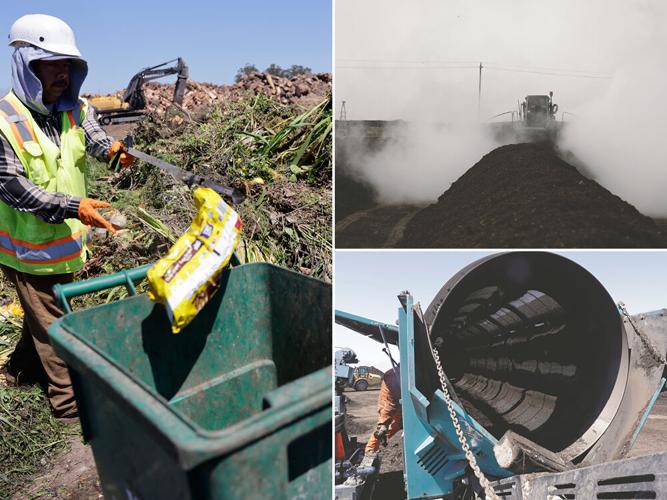
The commercial stream processed at ReGen allows for bioplastics and soiled paper, unlike the residential composting feedstock. It is decontaminated on the front end, before being shoved into a row, by a primitive method: “We clean on the floor,” Brautovich says. In other words, workers from Keith Day Company, the contractor for ReGen that processes and sells the compost (Brautovich works for Keith Day), decontaminate the incoming material dumped by hauling trucks by bending over, picking up contaminants (such as plastic) with their hands, and putting it into a trash bin.
Because the feedstock for this commercial stream allows bioplastics, it can’t be classified under federal regulations as acceptable for organic growing. ReGen calls this their “Grade B” compost for that reason – although it’s not necessarily of lower quality – and Keith Day Co. sells the end product to vineyards, even though it could be used for row crops that aren’t organic.
As he keeps leading the way through the site, Brautovich points to a pile and says, “Underneath that pile right there is a load of food. As soon as a truck comes in, we cover it up to deter the birds.” He adds that the compost dumped from the commercial stream is “a mix of food, trash and foil,” and “if we leave it uncovered the seagulls come in for breakfast, lunch and dinner.”
On the surface of the pile, partially buried, are the tattered remnants of a compostable bag made of bioplastic. It looks different than a regular plastic bag; it looks soft.
“If it was only that,” Brautovich says, referring to the compostable bag, “it would be more manageable on the commercial end, but it opens the door for everything else.”
It’s that “everything else” that ReGen’s public education coordinator, Eric Palmer, says prompted them to forbid people from adding compostable products like bags to residential green bins. “This is what we didn’t want to happen when we opened the residential program,” he says. “This is a big shift. We’re just going to get better at it over time.”
THE FIRST PLACE IN THE U.S. that allowed food waste to be mixed in with yard trimmings in curbside bins was San Francisco, in 1996, at the behest of city leaders.
It started out as a pilot program in the Richmond district and a wholesale food market, and by 2001, residents all over the city were able to opt in.
In 2009, a city ordinance passed mandating curbside compostable waste collection for all properties, more than a dozen years before it became required statewide. And in San Francisco, unlike residential compost streams in Monterey County, that includes soiled paper like pizza boxes, other paper products like napkins, cups and plates as well as, notably, (theoretically) compostable bioplastics.
The company that carried out that program from the start is now called Recology, and handles the waste for San Francisco and a number of other municipalities in northern and central California.
Recology’s composting facility that handles San Francisco’s green waste, as well as 19 other Bay Area cities, is called Blossom Valley Organics, and is in Vernalis, which is in the Central Valley just east of I-5 and southeast of Tracy.
On April 20, Recology’s PR manager Robert Reed leads a tour of the facility and Tim Hester, Recology’s general manager of the operation, gives an overview of how the material moves through the site. Once unloaded, the material is conveyed through a process where it is screened for contaminants, and on the front end, workers stand on either side of the conveyor belt to pull out what they can.
It then goes to an aerated static pile for 30 days, and then it’s put into a row for another 30-45 days, and then it’s screened again and is market ready.
The 80-acre site is clearly more technologically advanced than the site at ReGen – it has several millions of dollars’ worth of infrastructure – but it’s not that different, except that it’s more efficient. And the finished product, which is sold to orchards and vineyards, appears pure both to the eye and touch. (Scratch beneath the surface a bit, and the compost feels hot to the touch – that’s microbes at work.)
But how well does it break down bioplastics? Hester says some of it may break down, but some definitely does not.
And Reed, when asked how much trash, as a percentage, is screened out in the final screening at Blossom Valley, says he doesn’t know.

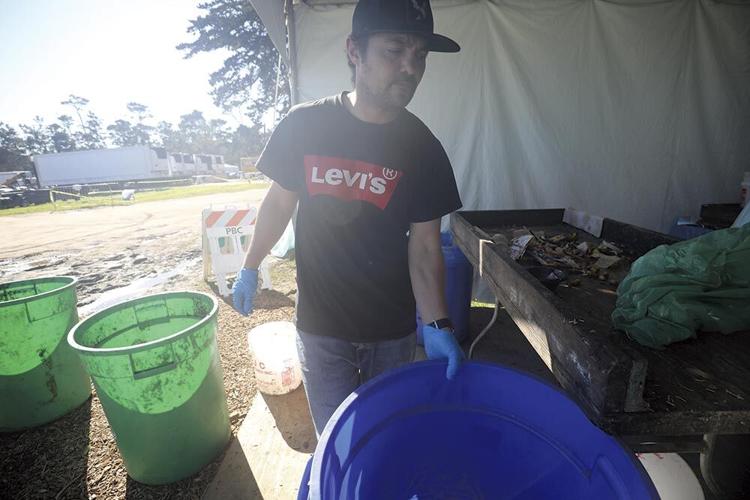
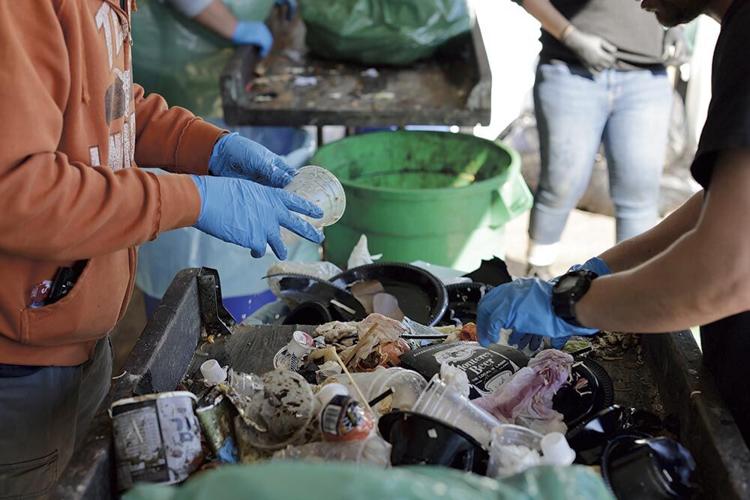
Blue Strike Environmental workers sort waste at the AT&T Pebble Beach Pro-Am in February. Many big events have strived toward a zero-waste concept (Blue Strike achieved 70-percent diversion in this one), made possible by sending various products into the compost stream. That may change, as ReGen is looking to limit the compost to food waste.

LIKE RECYCLING, a key aspect of industrial-scale composting is markets – once you process a material, you need to have someone willing to buy it, or it just piles up.
Recology spent years developing markets for its compost, Reed says, and much of that involved convincing farmers of compost’s benefits. When used with cover crops, it prevents erosion, and long-term, it makes the soil healthier – the soil is alive, and not full of chemicals.
When local waste management districts – ReGen, Salinas Valley Recycles – rolled out their programs to collect residential food waste, they wanted to keep it as clean as possible so that they felt confident local growers would buy it.
“Farmers are very specific about what they want and don’t want,” says Patrick Mathews, general manager of Salinas Valley Recycles. Of what those in the industry call “clean green” compost – made from just yard clippings and food waste – Mathews says, “That’s the stuff the ag community really wants. Some of it has to do with the uniqueness of what we grow here.”
Brautovich, who previously worked for close to 15 years at Earthbound Farm on food safety and compliance, echoes that. Because the Salinas Valley produces “predominantly raw agricultural commodities, the quality and the safety of the compost is the highest in the nation,” he says.
But at least part of what might make farmers wary of compost made from curbside bins, whether residential or commercial, is simply its newness. “[Farmers] are stewards of the land,” Mathews says. “That soil is all they’ve got, and they are very concerned about putting things in there they’re not used to.”
Everyone in the industry admits bioplastics are problematic. Even the types that are certified as compostable usually don’t break down within the time of an industrial compost operation, especially if they’re rigid, like forks and knives.
Nick Lapis, director of advocacy for nonprofit Californians Against Waste, acknowledges, “There’s really not a lot in it for composters to take the stuff… once you start taking any form of packaging, it’s much harder to notice contamination.”
He adds, however, “I would hate to foreclose on [bioplastics] on the whole. We’re not going to roll out a successful food waste program statewide if people don’t have anything to line their pails.”
Recology encourages customers to line pails with paper towels, which cuts down on odors and helps keep the pail clean. But at ReGen, Brautovich says the paper takes longer to break down than food waste – locally, it’s not currently accepted in residential green waste, nor are compostable bags made of bioplastic. (For more on what is and is not accepted as compost, see p. 28.)
Bob Shaffer, a Hawaii-based agronomist who’s consulted farmers on composting operations for decades, including in Northern California, agrees that composting paper or cardboard has its challenges, but says it’s very much doable. The main challenge to composting it, he says, is structural – it needs to be mixed with enough other organic matter like yard waste so that it can break down aerobically, as wet paper flattens out when wet and becomes “an anaerobic mess.”
But properly balanced with other materials, he says, paper breaks down very well if it has enough oxygen and water. “It’s just carbon,” he says.
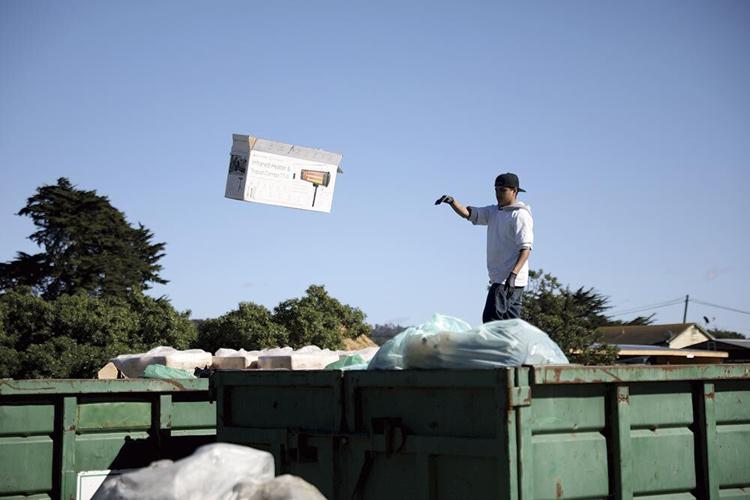
ANOTHER CHALLENGE FOR LOCAL COMPOSTING OPERATIONS is how to process waste from special events – things like music festivals, Car Week, and last weekend’s Big Sur International Marathon.
Karen Ferlito, a member of Carmel City Council and the ReGen board of directors, recalls that in 2008, when she was volunteering at the marathon, she saw all the dumpsters filled with trash at the end of the event and said to herself: “There has got to be a better way.”
That led to transitioning to compostable cups and plates. (Recyclable cups were off the table because they could blow away and end up in the ocean “forever.”)
The marathon’s waste stream is managed by Blue Strike Environmental, which also manages waste at other big local events, including the AT&T Pro-Am. For years, Blue Strike has worked with event organizers to reduce their waste footprint, including a visible presence at big events, guiding attendees for how to sort their compostable waste from trash. For many of those years, the compostable waste from those events went into an anaerobic digester that was part of a pilot project at ReGen. The digester, which was never intended to be a permanent fixture, was taken offline in 2019, and ever since then, the compostable waste from the events has been processed in a commercial compostable waste stream at ReGen – the “B” grade compost. (A disclosure: Blue Strike’s founder and CEO is Kristin Cushman, who is married to Weekly Publisher Erik Cushman.)
But Brautovich says composting the waste from events is uniquely difficult – it often contains very little food, and consists of mostly paper products. If it were up to him, he would stop collecting compostable waste from these events altogether (it would instead go straight to the landfill).
And locally, that’s how things are trending: Kristin Cushman says ReGen has informed her that as of June 30, they will no longer accept compostable products (aside from food waste) from the events Blue Strike works.
Zoë Shoats, ReGen’s communications director, says nothing has been “finalized” with Blue Strike to that end. “She’s done a ton of work to get vendors from single-use plastics to compostables,” Shoats says of Cushman. “But this is an industry problem.”
Shoats says that there have been talks with Blue Strike about transitioning the events from compostable products to reusables, which is a movement gaining traction elsewhere too. But Shoats concedes that will be a tough battle when consumers have been conditioned for years to be able to just throw everything away.
Cushman is hoping ReGen agrees to a five-year transition period, instead of just flipping the switch after event organizers have been working for years to make their events zero-waste, even if only theoretically. Otherwise, she says, everything could just revert back to plastics, and we’re right back to where we started.
Not to mention many event organizers, and businesses, have spent more money buying compostable products – which are considerably more expensive than plastic – just to see it all get landfilled anyway.

At the AT&T Pro-Am in February, workers from Blue Strike Environmental pick through waste on a table and sort it into three different streams: trash, recycling and compost.
WHEN PALMER SAYS, “WE’RE JUST GOING TO GET BETTER AT IT OVER TIME,” it sounds like it is fait accompli. But nothing is in the waste management industry. Hopefully, part of getting better includes a push to develop and expand the market for the Grade B compost, which can be every bit as rich in nutrients as the residential and self-haul stream, even if it can’t be used on organic crops.
And if local growers of row crops are hesitant to use it on their crops, fine – there are acres of vineyards.
Steve McIntyre, who co-owns McIntyre Vineyards with his wife Kimberly, is an early adopter of applying compost to his vineyards. (He uses the “clean green” grade, but that was before the commercial stream grade was available.)
McIntyre says he used 30,000 tons of compost – that’s 60 million pounds – in each of the last two years, and has been applying it to his vineyards for the last 20.
(By comparison, Brautovich says the composting operation at ReGen produces about 90,000-120,000 tons of compost annually. Last April, the ReGen board approved a $9-per-ton increase, from $26.25 to $35.25, that it pays Keith Day Co. to process the compost, due to added expenses with implementing SB 1383. That contract scales up every fiscal year; it is now $36.56 per ton. That means ReGen pays roughly $4 million per year to the company to process its compost.)
“We’re big believers,” McIntyre says of using compost. “It increases organic matter in the soil, and becomes a carbon source for the microbiome. We’re totally non-till, permanent cover crop in all of our vineyards. The microbiome benefit is huge.”
McIntyre is speaking the language of Shaffer, the agronomist who is evangelical about the benefits of farmers using compost. The benefits extend beyond just the health of the soil.
“When I sit down with composters, I say, ‘We’re not building compost,’” Shaffer says. “We’re farming bacteria and fungi. I train farmers on getting carbon into the soil. Farmers don’t call people like me unless there’s something wrong.”
What that often is, he says, is the soil is not being fed enough carbon. And in that fact lies a throughline, or perhaps a circle – SB 1383 was passed to prevent food waste, and other compostable waste, from creating methane emissions in landfills. The spirit of the bill was to fight climate change.
And in converting that waste into compost, it’s putting that carbon back into the soil.
“For farmers right now, this is a historic moment,” says Shaffer, who also has his own small farm in Hawaii. “We can not only help ourselves get more carbon in the soils, but we can be part of a world movement to get carbon out of our atmosphere.”
(0) comments
Welcome to the discussion.
Log In
Keep it Clean. Please avoid obscene, vulgar, lewd, racist or sexually-oriented language.
PLEASE TURN OFF YOUR CAPS LOCK.
Don't Threaten. Threats of harming another person will not be tolerated.
Be Truthful. Don't knowingly lie about anyone or anything.
Be Nice. No racism, sexism or any sort of -ism that is degrading to another person.
Be Proactive. Use the 'Report' link on each comment to let us know of abusive posts.
Share with Us. We'd love to hear eyewitness accounts, the history behind an article.